Archive for March, 2009

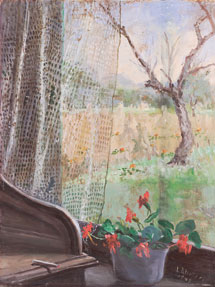
Pierre Bonnard and the White Tablecloth at the Met

Filed in Artists, Museums by on March 19, 2009 0 Comments

The first exhibition to focus entirely on the radiant late interiors and still-life paintings of Pierre Bonnard (1867-1947) opened January 27, 2009, at The Metropolitan Museum of Art.

Pierre Bonnard: The Late Interiors features 80 paintings, drawings, and watercolors that date from 1923 to 1947, when Bonnard centered his painting activity in Le Cannet, a hill town in the south of France. Working in his modest house overlooking the Mediterranean, Bonnard’s paintings transformed the rooms and objects that surrounded him into dazzling images infused with intense light. It is these luminous late interiors that define Bonnard’s modernism and prompt a reappraisal of his reputation in the history of 20th-century art. Among the 45 paintings, 16 watercolors and gouaches, and 19 drawings and sketches in the exhibition are numerous rarely seen works from private collections, as well as loans from prominent museums in Europe and the U.S. The exhibition will also reunite several pictures that once hung side-by-side on Bonnard’s studio wall in Le Cannet.

More modern than is commonly recognized, the late work of Pierre Bonnard is remarkable for the artist’s individualistic approach to color, light, perspective, and composition-particularly as seen in his interiors and still lifes. Although less well-known than his paintings of bathers, Bonnard’s late interiors and still-life paintings are equally extraordinary. Over the course of 24 years of painting the simply furnished, familiar rooms of his house at Le Cannet, Bonnard discovered infinite possibilities, much as Paul Cézanne had discovered in the landscape of Mont Sainte-Victoire. The exhibition will feature the artist’s finest interiors, including Corner of the Dining Room at Le Cannet, The White Interior, and The French Window, all from 1932.

Bonnard’s late interiors and still lifes explore a multitude of nuanced color relationships among glowing yellows, violets, reds, oranges, greens, and whites, as in Basket of Fruit: Oranges and Persimmons (ca. 1940) and Bouquet of Mimosas (ca. 1945). His images of fruits and bread baskets, teapots and milk jugs, in such paintings as Breakfast (ca. 1930) and The Dessert (1940), transcend domestic narratives to speak of the artist’s process of creating pictures through a masterful orchestration of color and light.

Although Bonnard’s subjects were close at hand, he rarely painted directly from life, relying instead on pencil drawings sketched rapidly in little diaries. Four of the artist’s diaries from his years at Le Cannet will be loaned by the Bibliothèque national de France, Paris. The diary notations lay out idiosyncratic marks as reminders of color, tone, intensity, and contrast. These shorthand sketches were critical to the genesis of large-scale paintings, which Bonnard developed slowly, through a process of continual editing and revision. He often worked on several paintings at once, tacking the unstretched canvases to his studio wall in order to allow for alteration of the periphery of the painting and its overall proportions.

In creating his paintings, the artist deferred to the memory of perception. His interest lay in exploring how diverse objects interrelate within a pictorial field, rather than dwelling on the literalness of any object or figure. For instance, in the paintings Still Life with Ham (1940) and Young Women in the Garden (Renée Monchaty and Marthe Bonnard) (ca. 1921-23, reworked 1945-46), equal attention is paid to every component of a painting. Negative spaces are as important as positive forms, thus achieving a kind of “overallness” in the composition.

Bonnard created a body of work that became less obviously descriptive and more metaphoric over time. The artist played with conventions of perspective and proportion and intensified the relationships among objects and figures to a disquieting effect. Bonnard’s paintings often convey a feeling of forbidden sights, as if one is trespassing among private or intimate settings. In Before Dinner (1924), the figures, though physically present, are emotionally absent. In later paintings figures become peripheral, even lacking corporeality. Some figures begin to disappear off the picture plane, as in Dining Room Overlooking the Garden [The Breakfast Room] (1930-31) and Table in Front of the Window (1934-35). Through a shimmering palette of intense, pulsating colors and a fluid interaction between foreground and background, the forms and spaces of Bonnard’s still lifes and interiors are not still at all, but quietly transient.

Exhibition Dates: January 27-April 19, 2009
Exhibition Location: The Robert Lehman Wing

End Times: Now at the Warhol Museum

Filed in Art, Museums by on March 16, 2009 0 Comments
End Times: Now at the Warhol Museum
Mirta Tabrizian, Untitled

If a crisis does nothing else, it makes for good art. I’m not so sure I would go so far as saying it’s the end of the world as we know it, but there does seem to be a seismic change or two in the air.

The Andy Warhol Museum (in Pittsburgh) has arranged a show of works by contemporary artists titled The End that seeks to analyze the power of art in troubled times.

The End confronts this hard-edged topic of a spiral into economic collapse. In addition, Warhol’s Death and Disasters, Skulls, Jackie, and Electric Chair series will be on view in the permanent collection galleries to explore Warhol’s own fixation and fascination with the theme of disaster. “The financial industry tanked mere days before I started my position here at The Warhol, and when presented with the opportunity of organizing my first exhibition at the Museum, I wanted to jump right into the abyss and confront this crisis head-on. Andy Warhol was no stranger to death and disaster, and it only makes sense that we, as an institution, respond to this momentous period in history as it plays out,” said Eric C. Shiner, The Warhol’s Milton Fine Curator of Art.

The contemporary artists included in the exhibition are Lida Abdul, Beth Campbell, Luis Camnitzer, Daniel Canogar, Castromori (Hiroshi McDonald Mori + Stefano Castronovo), Davis/Langlois, David Deutsch, Mary Beth Edelson, Karen Finley, Roland Flexner, Daniel and Geo Fuchs, Felix Gonzalez-Torres, Lukas Maximilian Hüller, Rashid Johnson, Cary Liebowitz, Daniel Joseph Martinez, Jonathan Meese, Trevor Paglen, Hirsch Perlman, Raymond Pettibon, Jane Philbrick, Martha Rosler, Diane Samuels, Shelly Silver, Susanne Slavick, Althea Thauberger, Mitra Trabizian, Banks Violette, Hugh Walton, Lawrence Weiner, Christopher Wool, and Aaron Young.

The Impressions of the Unknown R. Mulders

Filed in Art, Artists by on March 15, 2009 0 Comments
The Impressions of the Unknown R. Mulders

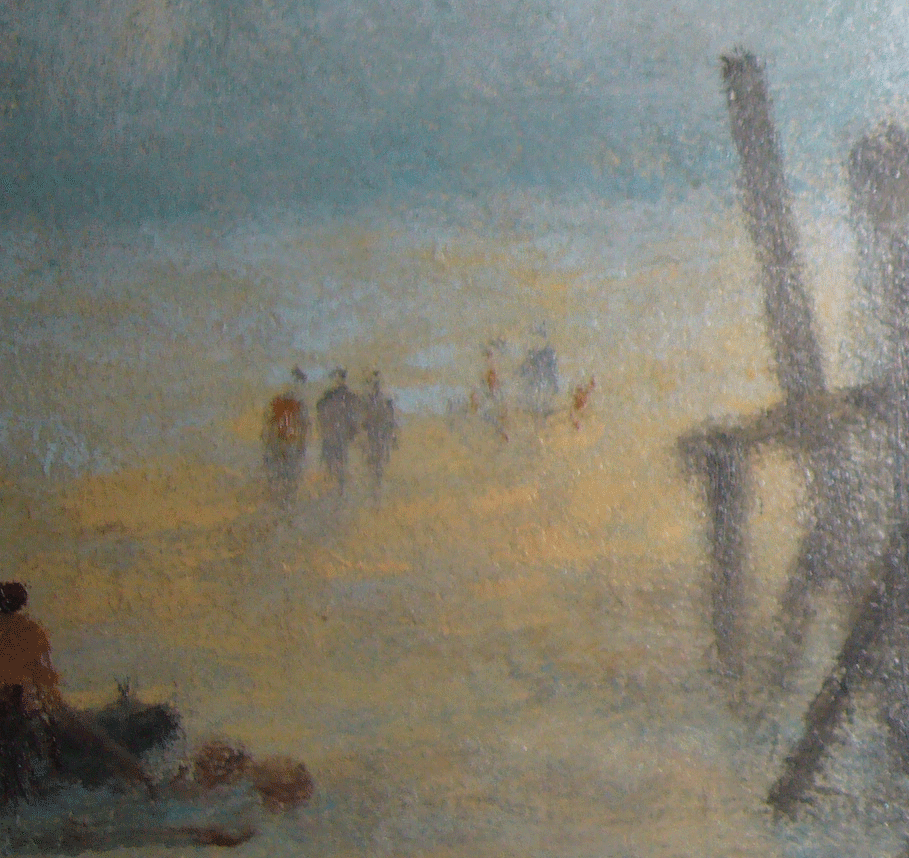
A painter known only as R. Mulders left a number of masterful impressionist paintings, but little else. One painting, Fishing at Low Tide, is currently being offered on ebay.

The oil painting is signed by R. Mulders on the lower left corner. His name and his work is all we have to go one. Recently watching Sister Wendy Beckett’s interview with Bill Moyers, it was intriguing to hear her say paintings where little is known about the artist are the most captivating. To paraphrase, she said “we can only judge the painting, not the artist.”

The Impressions of R. Mulders

The Impressions of R. Mulders

The Impressions of R. Mulders Although there are plenty of auction records for R. Mulders, one of the most recent was at Christie’s in 2007. No detailed biography is available about the painter. He is probably Dutch or Belgian based on some online information and was active at the last quarter of the 19th century.

From his paintings, it’s obvious R. Mulders had a profound love of seashore and the daily life of fisherman, whom he painted with both dexterity and sympathy. The painting on ebay is not too much different from the painting auctioned at Christie’s in 2007 although it is much bigger. In this painting, Mulders chose to downplay the hardship of the mundane routine of fishermen, and romanticized the reward of the life working harmoniously with the nature. At low tide, a few females are waiting on the pier. One bends her body toward the shore, there a fisherman is unfolding the mast. Under the hazy light and above the simmering sea more boats are heading home.

Mulders’ “Fishing at Low Tide” shows he was both influenced by impressionism and Dutch Hague School. The chalk looking brushstrokes of rendering people in succinct efficiency and the pointilistic depiction of waves under the perculiar light (a combination of pinkish warm yellow and the cool purple-blue – complimentary in tertiary colors) demonstrated the impressionism style. On the other hand, the fact that the overall colors are in relative somber scale and are harmonized under the poetic airy mood, suggests his familiarity of Hague School.

Disclosure: The owners of this site have a financial interest in the painting.

Closing Bell: Pier Antiques Show

Filed in Antiques, Auctions by on March 15, 2009 1 Comment
Closing Bell: Pier Antiques Show
Pier Antiques Show

Pier Antiques Show

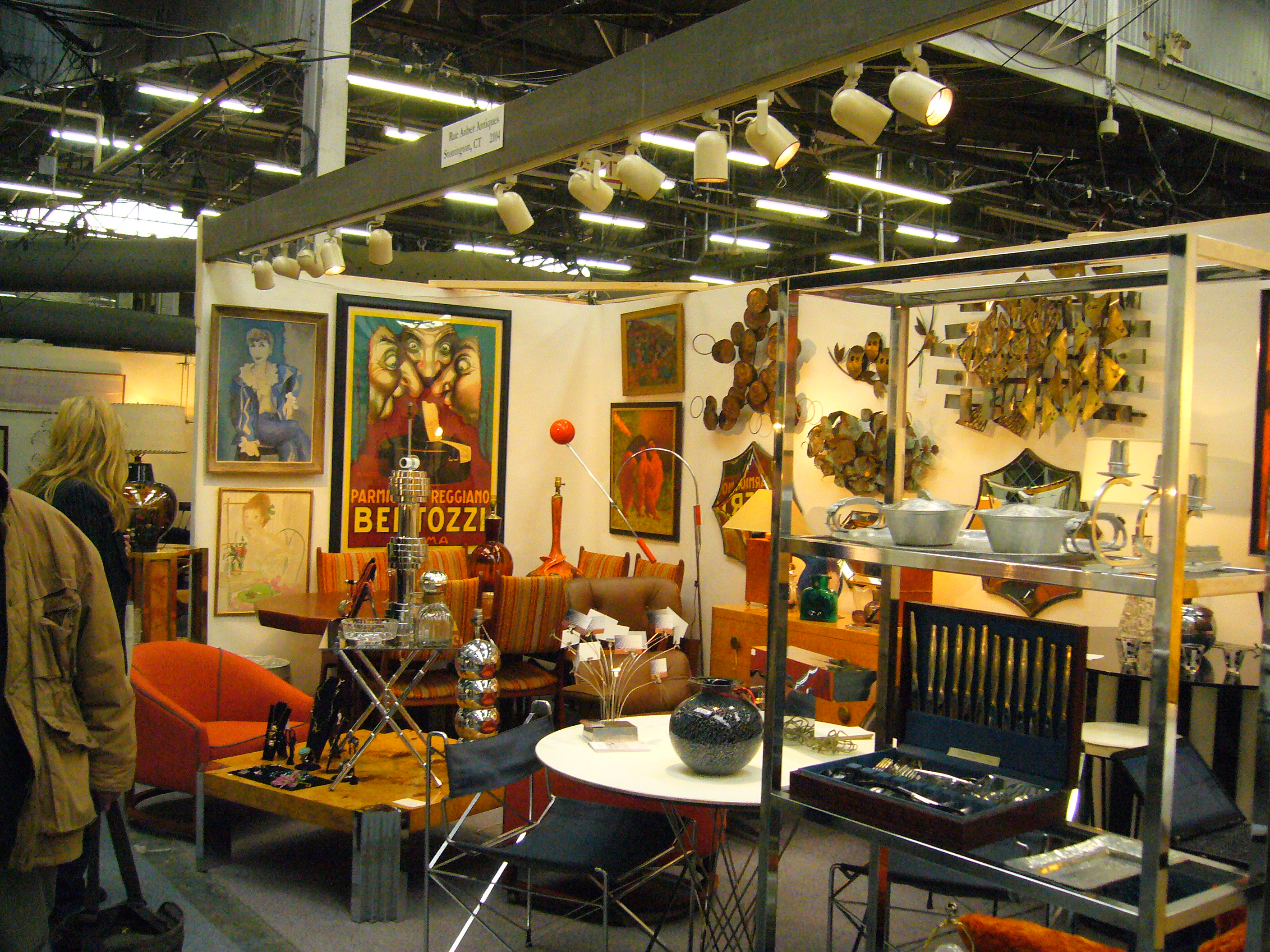
The aisles were full at the Pier Antique Show in Manhattan this weekend. The crowd seemed generally in a good (and buying mood) after a week of gains on Wall Street. We saw one significant painting sell before we could get a good look at it. Dave Smernoff, From Here to Antiquity in Guilford, Connecticut brought items of interest including a pair of mahogany carved dolphins made into lamps. Spending some time in the booth of Pottery Dealer Barbara Gerr and Arnie Small, we learned a bit more about Rookwood and its artisans and were directed to the American Pottery Show and Auction April 24-26th outside of Philadelphia (look for information in our calendar).

It was also a nice feature that Samuel T. Freeman & Co. Auctions was on hand to provide appraisals. I’ve had good experiences with Freeman and see now that Chris Jussel was supposed to be on hand to appraise items. You may remember Jussel from the early days of the Antiques Road Show. I have always wondered why he didn’t continue with the show, I though he was perfect for the role.

The next Pier Show is November 14-15, 2009.

Philadelphia is the Only Venue for a Major Exhibition Exploring Cézanne’s Impact on Artists of Succeeding Generations

Filed in Art, Museums by on March 12, 2009 1 Comment
Philadelphia is the Only Venue for a Major Exhibition Exploring Cézanne’s Impact on Artists of Succeeding Generations
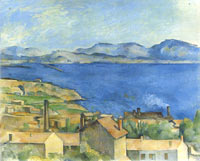
The Bay of Marseille, Seen from L’Estaque, c. 1885

In 1907, the French painter Paul Cézanne’s posthumous retrospective astonished younger artists, accelerating the experimentation of European modernism. Cézanne (1839-1906) became for Henri Matisse “a benevolent god of painting,” and for Pablo Picasso “my one and only master.” Cézanne’s inclusion in the Armory Show in New York in 1913 also offered American artists a new direction. Cézanne & Beyond (February 26 through May 17, 2009) will examine the seismic shift provoked by this pivotal figure, examining him as form-giver, catalyst, and touchstone for artists who followed. It will survey the development of an artistic vision that anticipated Cubism and fueled a succession of artistic movements, and will juxtapose Cézanne’s achievement with works by many who were inspired directly by him, showing a fluid interchange of form and ideas. It will place his work in context with more recent artists like Ellsworth Kelly, Jasper Johns, and Brice Marden, who in quite different ways came to terms with the master of Aix-en-Provence. His profound impact on successive generations endures to the present day. The exhibition will present more than 150 works, including a large group of paintings, watercolors and drawings by Cézanne, along with those of 18 later artists.

The works will be drawn from public and private collections around the world, including Canada, France, Germany, Italy, the Netherlands, Norway, Russia, Sweden, Switzerland, the United Kingdom, and the United States. It will be seen only in Philadelphia.

The artists included, in chronological order, are Henri Matisse, Piet Mondrian, Marsden Hartley, Fernand Léger, Pablo Picasso, Georges Braque, Charles Demuth, Max Beckmann, Liubov Popova, Giorgio Morandi, Alberto Giacometti, Arshile Gorky, Ellsworth Kelly, Jasper Johns, Brice Marden, and Jeff Wall, Sherrie Levine, and Francis Alÿs.

All of the artists in the exhibition have acknowledged Cézanne’s profound impact on their work. When Henri Matisse (1869-1954) donated his Cézanne painting of Three Bathers to the Petit Palais in 1936, he wrote: “in the 37 years I have owned this canvas, I have come to know it quite well, though not entirely, I hope; it has sustained me morally in the critical moments of my venture as an artist; I have drawn from it my faith and my perseverance…” Picasso (1881-1973) in his long and varied artistic career often used Cézanne as a lever in his critical shifts, from his Self-Portrait with Palette, through to the lyricism of La Rêve, and onto his later examination of bathing subjects both as painting and sculpture. Braque, who with Picasso used Cézanne as his principle touchstone early on, spent time at several of Cézanne’s painting locations. For him “it was more than an influence, it was an initiation.”

Piet Mondrian (1872-1944), who was drawn especially to the formal structure achieved by Cézanne, brings an analysis of Cézanne to an abstract conclusion, as reflected in his own words “… that beauty in art is created not by the objects of representation, but by the relationships of line and color.” “Cézanne taught me the love of form and volumes,” Fernand Léger (1881-1955) once remarked, and “the power of Cézanne was such that, to find myself, I had to go to the limits of abstraction.” In Russia, Liubov Popova (1889-1924) discovered Cézanne in the Moscow collections of Morosov and Shchukin and drew from him the pleasures of geometric fragmentation, which swiftly moved to pure abstraction.

In the United States, as modernism gathered force, members of the Stieglitz circle, especially Charles Demuth (1883-1935) and Marsden Hartley (1877-1943), became fascinated with Cézanne. Demuth’s still life compositions in particular show a deep connection to Cézanne’s bold late watercolors. In his autobiography, Hartley noted that Cézanne offered “ideas that were to make the world of painting over again and give modernism its next powerful start,” adding that “there is no modern picture that has not somehow or other been

Arshile Gorky (Armenian, c. 1904 – 1948), Staten Island, 1927

built upon these new principles.” Arshile Gorky (1904-1948) studied Cézanne closely, and the exhibition reflects his keen engagement with Cézanne’s style, especially in the mid to late-1920s. Gorky affectionately referred to the French artist as “Papa Cézanne” and even in his later abstractions there is a profound sense of the lesson of Cézanne.

Later, looking back on his career, Max Beckmann said: “my greatest love already in 1903 was Cézanne.” He “revere[d] Cézanne as a genius” throughout his life, looking particularly at the dark, emotional early works and the heavy black outlining of some of Cézanne’s figures. In Italy, Giorgio Morandi (1890-1964) first saw Cézanne images in books in 1909 and then in person in exhibitions in Venice and Rome. His path as an artist of both still lifes and landscapes was set. Alberto Giacometti (1901-1966) was introduced to Cézanne by his painter father, but had to wait until the Venice Biennale of 1920 to see his work face-to-face. For him the attraction was the sense of process rather than arrival. Cézanne is firmly linked to an existential sense of doubt and anxiety that permeates Giacometti’s explorations of objects and people in space through two or three dimensions.

In this sense Giacometti is akin to Jasper Johns (b. 1930), for whom Cézanne has been a continuous point of reference and has served over the years as a sort of eminence. The exhibition presents numerous works by Johns that make overt and oblique references to Cézanne, including drawings inspired by Cézanne’s bathers and paintings of figures that are referenced in Johns through such works as the Seasons and In the Studio. Ellsworth Kelly (b. 1923) first discovered Cézanne as a student in Boston and is quick to explain that Cézanne is often at play in his art making. Kelly’s exploration of the relationships between form and color, figure and ground, take on an immediacy and constancy for our understanding of both artists. Brice Marden (b. 1938) commented “that Cézanne almost made the perfect painting.” In Marden’s own works, Cézanne’s pursuit of an essentially unobtainable goal of distillation, often through repetitions on the same motif, is a shared journey.

The exhibition places substantial emphasis on artists of the present day, including long established masters such as Kelly, Johns, Marden, and Jeff Wall (b.1946), and younger artists responding to the idea of the show such as Francis Alÿs and Sherrie Levine. Wall’s magnificent light box photographs show that Cézanne’s influence transcends the medium of painting. While working in an entirely different medium, the photographer Wall is a life long admirer of Cézanne either through direct quotations or more often through implied transgressive references.

During the preparation for the exhibition, Anne d’Harnoncourt, the Museum’s late Director, said: “Cézanne is a rare artist whose work touched so many artists and contributed to shape a broad spectrum of talents and who, remarkably, continues to find fresh resonance today. Philadelphia, like Aix, has long been a major destination for Cézanne lovers because the Museum and the Barnes Foundation hold such comprehensive collections of his work. This exhibition presents an opportunity to fully appreciate both Cézanne’s art and its impact over time, offering visitors the experience of participating in the extraordinary conversation among artists that has engaged many of the major talents of the last century.”

Economic Temporary Exhibition

Filed in Artists, Museums by on March 11, 2009 0 Comments
Economic Temporary Exhibition

In yesterday’s NYTimes, Ken Johnson wrote a review of the current exhibition of Hernan Bas at the Brooklyn Museum. In the end, Ken pointed out a touchy question: How much the cost saving factor impacts the decision of the installation of a retrospective show of an artist who is just getting started ?

Here is the excerpt:

But the museum loses some of its intellectual and ethical credibility in letting the Rubells and their former in-house curator, Mark Coetzee, completely determine an exhibition devoted to an artist whose importance remains speculative. Had the Brooklyn Museum organized its own Hernan Bas exhibition or, better yet, a show examining the trend in faux-adolescent romanticism, these questions wouldn’t come into play.

We have heard the news of museum downsizing such as staff layoff (Indianapollis, Detroit, and Walters) or store closing (met). Under the tight budget, the costly temporary exhibitions would probably cut either in scale or in quantity. I tend to think the Hernan Bas’ exhibition is a natural choice after the exhibition of Gilbert & George. (I wish they could have been exhibited together!) In fact, compared to the compulsive nature of those photos from Gilbert & George, at least Hernan’s paintings feel more humane and sentimental. The museum owns at least one of his painting before the show (“Night Fishing”), so the museum must have considered Hernan as a promising artist and his artworks have met some curatorial standard. If it happens that the installation was paid from private sectors, then why not?

Sun Kwak and her masking tape (Courtesy to Brooklyn Paper)

Sun Kwak and her masking tape (Courtesy to Brooklyn Paper)

But I agree with Mr. Johnson that such exhibition will never not be tricky. If frequent temporary exhibitions are important venue to attract visitors, then why not seek inside? Brooklyn Museum’s American and Egyptian collection could rival any museum in the country. True, the exhibition may sound antique if the title is “William Merrit Chase and his Long Island” or “John La Farge, the versatile” or any painter buried in Green-wood cemetery, but  their collections in terms of dept, subject matters, and time span allow them to come up with some cross-collection exhibition like the intriguing show “The Seduction of Light: Ammi Phillips, Mark Rothko in Pink, Green, and Red” in the American Folk Art Museum. The current show “Unearthing the Truth: Egypt’s Pagan and Coptic Sculpture” is another good example. Just browsing their online database, you will soon find out the quality and the quantity of items “NOT ON VIEW”. Such exhibitions are not only cost efficient but also may bring visitors the awareness of the vast collection of the museum. 

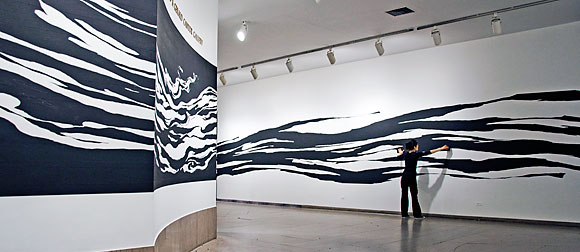
The Brooklyn Museum has its own answer. From March 25, Korean-born, New York-based artist Sun K. Kwak will create a site-specific work composed of approximately three miles black masking tape in the fifth-floor. The total cost for the material? 263 dollars based on the article in Brooklyn Paper

The Damaging Effect — Follow Up with Cai Mingchao

Filed in Auctions, Shows and Markets by on March 11, 2009 0 Comments

From the Artinfo:

Cai, the winner of the Chinese two bronze statues,  told Bloomberg that several days after he won the lots in the February 25 sale, he began to think that accepting them would be like having “two time bombs and placing them at home, not knowing when they will explode.”

He was praised for his decision in China, but says that he has been condemned by other dealers and that the incident has ruined his credibility. He added that he may have to close Xiamen Xinhe Art International Auction Co., the auction business he runs in Xiamen in southeastern China. He has already called off the house’s spring sale, which last year brought in an impressive 47.4 million yuan (almost $7 million), and is considering canceling his fall sale as well.

This has damaged me: I have lost the business I love,” he said.

Read the whole stories from the following links:

  1. Mr. Cai Mingchao, You Are Wrong!
  2. Follow up — French Judge Rejected the Petition To Block Two Bronze Animal Heads From Yuanming Yuan
  3. The Call at the Last Minute — Christie’s Auctioning Relics From Yuanming Yuan

Antiques, More than Age

Filed in Antiques, Art by on March 10, 2009 0 Comments
Antiques, More than Age

18th Century Wing ChairIt’s generally understood that the century mark defines an object as an antique. We all know, however that artistic value is not acquired by age. While most of us refer to our hobby as antique collecting, what most of us really seek is not just age, but the artistic values of an old object.

To be fair, age is an important attribute. From sophisticated New York, Boston and Philadelphia furniture to Kentucky, Pennsylvania and Ohio folk art, age brings a personal connection to the creator of an object and the people who had known it.

That personal component, the connection of an object to its maker is one that has been lost on objects that came into being from a machine rather than through the hands of a craftsman. While many machine-made objects have weathered the hundred years it takes them to come to be defined as an antique, they are still without that very personal connection to the past. They have age and connection with a time and place, but no individual connection with the person who made them.

It’s hard to relate to a time when the artist-craftsman was the source of most of consumer goods produced. The closest we come today is having objects by a noted designer. This is the model that most people alive today relate to, and perhaps one of the reasons it’s commonly observed that younger generations are not interested in antique collecting. While it’s easy to be aware of the “old” of an object, the appreciation of the art of it is not apparent as even the process in which these objects came into being is foreign.

Mass production has existed for most of our lifetimes, our parents and even grandparents lifetimes. The would-be collector is left with no obvious way to distinguish an object with age and artistic value from one that has merely acquired age. The differentiation is a learned ability and one the modern consumer is not accustomed to investing time in.

Most of the objects in homes today were not crafted by an individual. They are not of a unique design. They say even less about the craftsman who designed them then about the consumer who bought them and are more likely to be discarded than be in the homes of future generations.

The one exception is art. Despite the influence of Andy Warhol, while mass production has almost completely infiltrated the furniture market, the process has failed to diminish an appreciation of wall art among a broad segment of the public. Those who don’t realize they can have a real painting in their home have been to a museum to appreciate art.

The task before us who would like to see more collections in homes in addition to museums is to enhance the awareness of art as something we can not only appreciate, but should aspire to have adorn our walls. More, art is not limited to the wall. It can be found in our furniture and other home décor.

The limited definition of an antique as an object that has simply accumulated a hundred years may be one that prevents the hobby from being fully appreciated by younger generations. It is the universal appreciation for art that can change that.

Art on the Outside

Filed in Architecture, Art by on March 10, 2009 0 Comments
Art on the Outside
Art Outside in Park Slope

Art Outside in Park Slope

Quite a few of us bring art into our homes. Paintings, tapestries, sculpture and uniquely-crafted furniture bring art to our homelives. Sometimes we bring art into the garden. Unique garden ornaments come together with nature’s green to bring interest to private outdoor areas.

Sometimes outdoor sculpture graces commercial areas, but with the exception of the occasional gnome or gargoyle, it’s less-often found on public view in residential areas.

The sculpture in front of a home on 2nd Street in Brooklyn’s Park Slope neighborhood may be the exception. It blends in so well it looks to be part of the living green, rather than an object of art–especially now that the trees are bare. I’m not sure who created it, or the idea behind it, but I did find it to be a tasteful whimsical addition to the landscape.

Follow up Hernan Bas

Filed in Art, Artists, Museums by on March 8, 2009 1 Comment

After Brownie posted the previous article about the current show of Hernan Bas, I found this youtube video from Brooklyn Museum.