Archive for December, 2009
Aesthetic Chairs Bring $320,000 at Rago
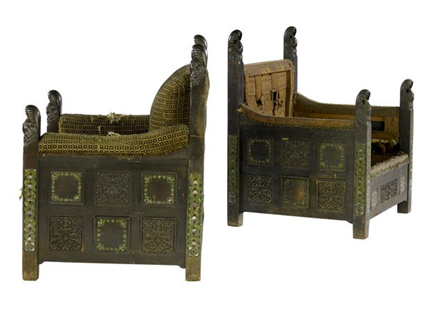
Stored in a boiler room for 40 years, a pair of American Aesthetic Movement chairs with missing panels and parts sold for $390,400 (hammer price of $320,000 + 22% buyer premium) on December 5 at Rago Auctions in Lambertville, NJ.
The chairs, lot 133 in the sale, were part of a larger consignment of property collected by a Philadelphia area couple whose hobby was weekend antiquing, inherited by their son and sold by his 70-year-old widow.
Having catalogued the chairs quickly for inclusion, Rago’s turned to Dr. Roberta Mayer, a visual historian and an expert in turn-of-the twentieth-century decorative arts, with a particular emphasis on the work of Lockwood de Forest and Louis Comfort Tiffany, for authentication. While Dr. Mayer could not definitely identify them as from the workshop of L.C. Tiffany or any other leading furniture maker of the period, her report stated:
“These massive armchairs, dating to the American Aesthetic Movement of the 1880s and early 1890s, are almost certainly custom-made pieces crafted for an elite patron…. several aspects of these chairs, including the glass inlay, are similar to furniture associated with or executed by Louis Comfort Tiffany (1848-1933)….They represent a unique and important design.”
The approximately 15 house and phone bidders came from throughout the Northeast, as well as California and Florida and were joined by more bidders online. A number were established clients at Rago’s, as it ranks in the top five of auction houses selling late 19th C./20th C. design in the U.S. Others had been contacted directly by Rago’s or found the sale online. Many bidders were still active in the $200,000 range, bested at the close by Mr. Eric Streiner, a New York collector.
“I joked before the auction that the chairs would definitely sell for between $20,000 and $200,000,” said Tom Martin, who found the chairs. “Now David Rago will be making jokes about how low I estimated these for years to come.”
Who Made Andrew Jackson’s Sideboard?

Hermitage sideboard before conservation. The earliest known photo of the sideboard is from the late 1800s
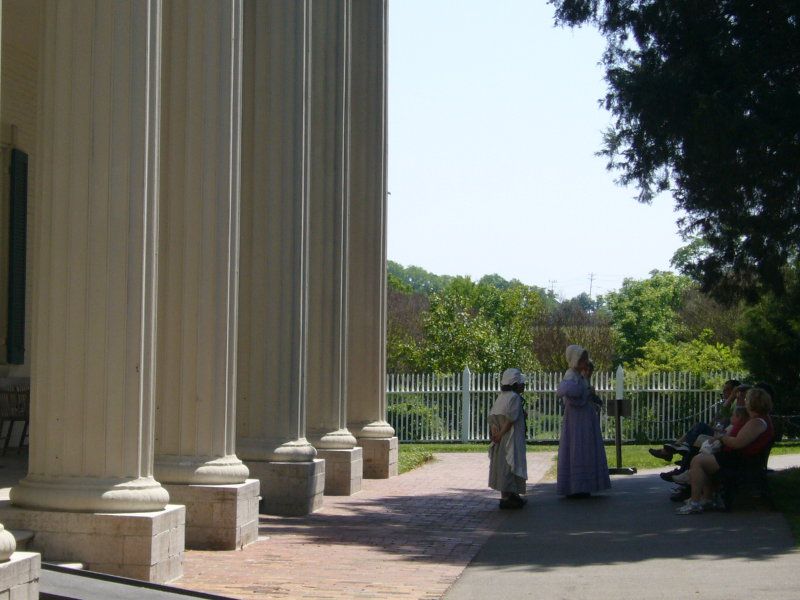
At some point, likely between 1831 and 1840, Andrew Jackson bought a sideboard for his home at The Hermitage outside of Nashville. While the sideboard remains in the same room he placed it, information about where it originated has been lost.
The sideboard is featured on page 405 of the recent book Philadelphia Empire Furniture. The text in the book indicates the design of this sideboard closely follows sketch 13 in the Anthony Quervelle sketchbook. Marsha Mullin, Vice President Museum Services and Chief Curator at The Hermitage, read my recent post on Pittsburgh sideboards and sent an email about the sideboard at the Hermitage.
“I was especially intrigued by comments you made about lack of gilding and less elaborate hardware on Pittsburgh sideboards,” Mullin wrote. “Several years ago Donald Fenimore from Winterthur commented that our sideboard had Philadelphia and especially Anthony Quervelle features, but wasn’t quite right – an observation you made about Pittsburgh sideboards as well.”

- Star shape on Hermitage sideboard
Looking at the Quervelle sketch, there are similarities between it and the sideboard at the Hermitage, most notably the cylindrical or basile ends as the book calls them. The design for the feet in the sketch are also similar to those on the sideboard. However, the actual sideboard is larger and contains a third foot. It also contains center cupboards, compared to the sketch where the area between the cylinders was open.
The circular pedestals at either end open with sliding doors to reveal lazy susans for decanter storage. The star panel in the front slides up and back. The back of the inside is mirrored. The two panels on either side of the star panel are meant to slide toward the pillars

- Star shape on Quervelle center table at Smithsonian
Mullin wondered if the sideboard may have been crafted in Pittsburgh. So I started to think about it.
One of the early drivers of the Pittsburgh furniture industry was the difficulty of travel over the Allegheny Mountains. It was much easier to bring a skilled cabinetmaker over the mountains, craft furniture in Pittsburgh and ship it down the Ohio River. By 1834 a canal system was in place that made transportation across Pennsylvania much easier. The date of 1831 was chosen because enlarged dining room was added to The Hermitage in 1831. Furnishing purchases seem to end after a second remodeling of the house was completed in 1837. I think it’s safe to conclude that a date before 1834 favors Pittsburgh and a date after the opening of the canal favors Philadelphia. The date span overlaps the canal opening date making guesswork all the more difficult.

- Quervelle sketch
There is another sideboard in the Missouri Governor’s Mansion that is nearly identical to the one at the Hermitage. Its origins are unfortunately also unknown, except that it has a long history of being in the Governor’s Mansion.
The star shape on the front of the Hermitage and Missouri sideboards is known to have been used by Anthony Quervelle. There’s a center table in the Smithsonian American Art Museum that features a similar star shape, and one in the Philadelphia furniture book. The star shape on the Hermitage sideboard has six points, and the one on the Smithsonian table, five. The candy cane shapes, for lack of a better description, on the far ends of the carving are also seen on lots of furniture attributed to Quervelle.
The cylindrical shape of the Hermitage sideboard is unique. Most of the sideboards thought to be Pittsburgh are quite square.
One other curiosity is the wooden pulls. All of the other sideboards attributed to Quervelle in the Philadelphia book (my feeling is many of them could actiually have Pittsburgh origins) have glass pulls. The only one with wooden pulls is attributed to Charles White of Philadelphia. Mullin said the drawer pulls may have originally been glass.

- Hermitage sideboard foot detail
“We have a glass pull in our collection that was acquired in the 1920s that has as its only documentation ‘stolen from the Hermitage dining room,’” she wrote. “If it is actually a Hermitage item, I suspect it may be from the sideboard.” However, the Missouri Governor’s Mansion sideboard has plain wooden pulls like those on the Hermitage sideboard.
If I had to place a bet on it, I’d go with Quervelle, or someone very familiar with his work. There are only three identifiable Pittsburgh sideboards that I know of and this one is more complex and different in form that all three. However, without a signature, date or other documentation, it’s impossible to know for sure. I’m wondering if there are other sideboards like this out there.
The Journey of Antiquing – 5

Yes, treasure is hidden here, perhaps. But I don't want to explore it
Too many times I have heard that young people are not buying antiques from dealers, but have the dealers truly reached out? Is there any measure that the owners of stores and malls can take to attract more young collectors?
Here are some of my thoughts:
1. Website
You don’t have to know all search engine optmization (SEO) tricks to be searchable online. The young generation used the internet to find stuff, so you have to be there. If you cannnot click on it, it does not exist. At the minimum, the store information should have an online presence.
2. Photographing
On more than one occasion I was instructed that no photos are allowed to be taken in antique malls. Are the owners shy of their booths? Are they afraid they’ve missed something and will sell it below value? Or were they afraid of “trade secrets? Most likely a customer takes photos because of interest in purchasing by themselves or someone they know. Yes, someone else may make more money as an item moves up the chain from attic to high-end gallery–so what? Even if such a photo appears online, isn’t that a free advertisement? The young generation communicates online through photos and videos– if you don’t accommodate their preference, you don’t have them as your customers.
3. Mixing Old and New
Occasionally I have found pleasing results from stores which sell antiques along with restorations and reproductions. But there is a distinct line between antiques and reproductions. Mixing them together will drive serious shoppers away and decrease credibility and cause some to give up altogether. It is a good idea to decorate the store based on the seasons, but don’t leave buyers with the impression yours is a Christmas collectibles store with all the ribbons and ornaments hanging around.
4. Stuffed
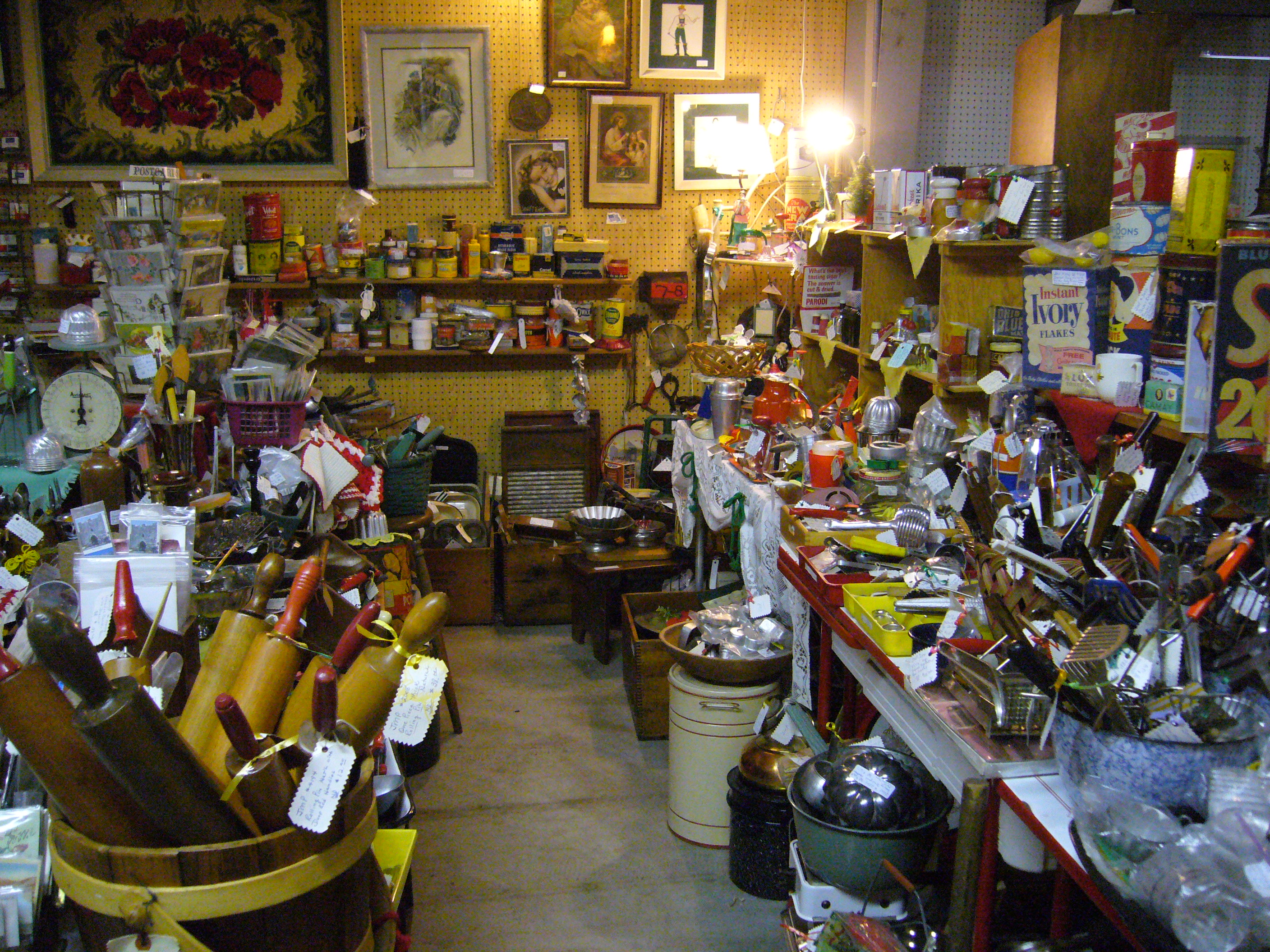
It happens more often in antiques mall than stores that some booths are so stuffed that you cannot even walk to one corner to check things out. Even the seasoned collectors have their limits, not to mention young generations aspiring for lean and simplified living style. The abundance of merchandise only helps the sale to some degree. Once such abundance overwhelms presentation, every item looks unworthy of exploring. Yes, 99.9% of visitors won’t check the boxes of glass tucked under the corner desks.
Read previous article of the series:
The Journey of Antiquing – 4
The Journey of Antiquing – 3
The Journey of Antiquing – 2
The Journey of Antiquing – 1
A Gaggle of Interests – Dec 6, 2009
In this series, the UAA team will list some of the interesting items that we have found in auctions, antique shops or eBay. We neither own the items or have the capability of examining the items in person in most cases. It mainly serves as an inventory record of what interests us (not necessarily in terms of value or investment opportunities) and possibly how much it fetches (if the result can be obtained). If you are serious about some lots, please contact the auction houses, dealers or eBay sellers directly.
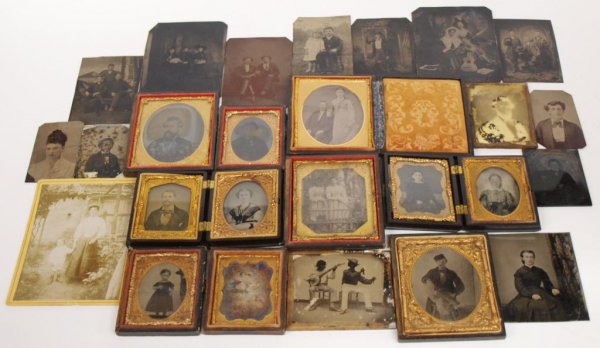
1. Austin Auction Gallery, Dec 13, 2009. Lot 32, (26) Daguerreotypes, Ambrotypes, Minstrel Players
This lot comes with 26 photos in tintype, ambrotype or daguerreotype. Some with interior settings, a few are group portraits. Interestingly, the auction house has identified one sitter as a drowning victim in 1878. Photos of important figures usually add the values. (Note: National Portrait Gallery is now exhibiting a dozen daguerreotype photos of famous people.) Otherwise, opulent interiors, additional tools, instruments provide not only additional visual information but also market values. The ambrotype photo with two minstrel players wearing blackface makeup seems missing its glass cover and the case, but it is, in my opinion, the most intriguing photo in the group. Another great one is the three female posed with artist pallets. The backdrop features a forest scene possibly painted on the wall. I don’t see often male artists in group portraiture; but female group photos are common. This photo may reflect either their amateur status or the non-professional nature of their hobbies.
2. Austin Auction Gallery, Dec 13, 2009. Lot 18, Framed Oil Painting, Portrait of A Gentleman
It is sad to see 19th century unsigned portraiture in the market fetch little money. Once such portraits fall out of the original families, the sentimental values and personal links are thus lost and perhaps can seldom be recovered.
This painting must be done by a professional artist with great skills. The light gives a sharp contrast to enliven the face, but such light is also fairly even and soft, rendering the tender flesh and pink cheek with a convincing juvenile beauty. He shuns away from the viewer and looks to the left. Although the propped left hand holding a strap balances the composition and suggests a determined mind, his expression is far from being assured. What is he carrying? Is he a military official? Such questions are up to the hands of the future owner of this portrait.
3. Dawson and Nye, Dec 9, 2009. Lot 198, A French Town on A River by Charles Daubigny
A typical painting by Daubigny from boating perspective, the painting will be a substantial addition to art collectors of French Barbizon School or French impressionism since Daubigny championed Impressionism from early on. Unlike Rousseau, Daubigny’s nature is more tamed, cultivated, and almost exclusively horizontal. To some extent his view of humanized nature is more or less echoed by the American tonalism school who favored cabins and wood stumps although only Dwight William Tryon officially took instruction under him. I would check the catalogue raisonne by Hellebranth published in 1976 to see whether the painting is listed in the book, although no raisonne publication can guarantee complete coverage.
4. Works by Arthur B. Davies from the Collection of Mr. and Mrs. Herbert Brill, 1979, exhibition catalogue published by The Pennsylvania State University
It is hard to believe that a university museum in central Pennsylvania can have such a substantial art collection. In particular, the American art at the Palmer Art Museum at Penn State covers the timeline from the Colonial period to contemporary with important painters. Then at the museum store, we spotted a whole shelf of catalogues, all marked as “1 Dollar”.
The Brills focused on three artists: Arthur B. Davies, J. Francis Murphy, and Robert Kulicke. Interestingly, these three artists, whose careers together span the past one hundred years, differ greatly in their subjects and styles. The Brills contributed a substantial amount of painting to the Hudson River Museum when an exhibition of John Francis Murphy was mounted there in 1982. Their relationship with the Palmer Art Museum at the Penn State started with loaning a painting by Kulicke. In the early stage of the museum when there was no encyclopedic collection of American art, the curator organized exhibition based on the availability of artworks from collectors, as shown from other cataglogues of the same period. This exhibition catalogue features an essay by John Paul Driscoll and description of 60 paintings in the exhibition. Roughly fifteen pictures are included and a few are in color. The book is listed on Amazon for $30. If you are interested, make a phone call to the store or simply make a trip to the museum. It is well worth it.
5. Marx Toy Train at Antiques Depot, 1401 2nd Ave, Duncansville, PA
Once shunned by collectors of American Flyer, Lionel, Ives and other companies, Marx trains have become more collectible in recent years. This Marx set is in a display case in Antique Depot, Duncansville, Pa. It seems to be in very good condition and priced reasonably at $110. Unlike other antiques, the values of toy trains are pretty standard and guided by Greenberg’s price guides. I don’t have a price book for Marx products, however. It’s available through Amazon.com here. Generally I find toy trains in antique malls are priced without the guide of a book and often higher than the listed values. I have found exceptions, and gotten some good deals. There are two types of toy trains, ones for the toy value and ones for the scale model value. Many of the products straddle the two extremes. Marx trains, which began production in 1919, were made for their toy value. They were cheap and sturdy.
Antiquing in Pennsylvania
A trip along Route 80, down I-99 and back brought us to a number of antique malls and shops and enough merchandise to make your head spin. The first stop was Lewisburg, Pa.
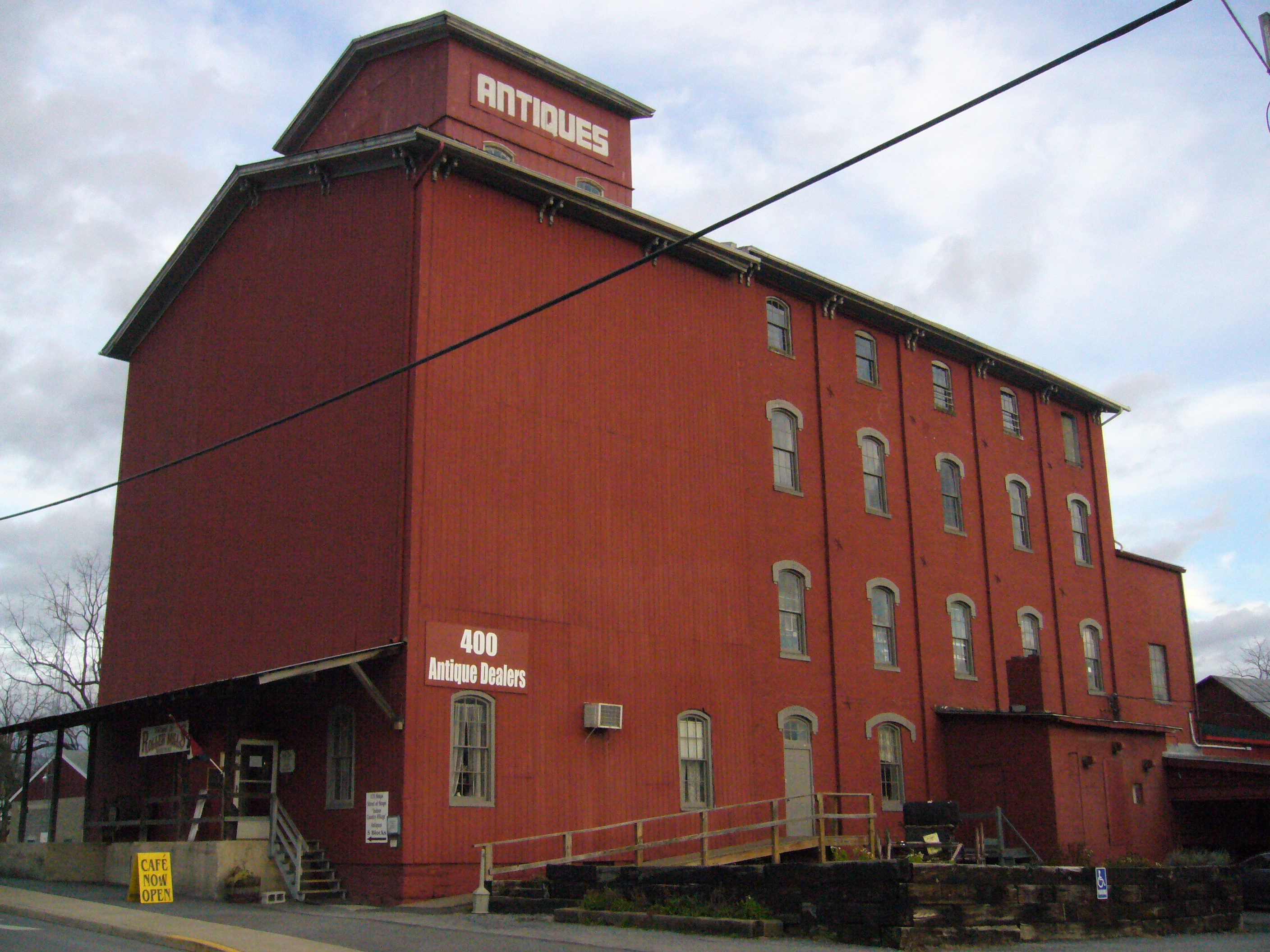
Roller Mills, 100 N. Water Street, Lewisburg, Pa—Contains merchandise from some 400 dealers including furniture, glassware and more. There’s a lot of stuff in here and probably only a small portion meets the hundred years of age required to be an antique. Still, most anywhere you find this much stuff, there’s got to be some goodies. As the old saying goes, there’s a treasure in every pile, you just have to know it when you see it. I didn’t have time to look through all the prints, there seemed to be many of reasonable quality. There’s some interesting stoneware and a basement full of goodies including old telephones and a film splicer. Had you the time and energy, I’d bet you can make a living driving to Lewisburg and taking the merchandise back to the Brooklyn Flea. I should also mention two other things, first the café has very good comfort food. Second, this is a mall that doesn’t allow photographs, which means I can’t easily show someone who may want to purchase something that it’s available. www.rollermills.com
125 Shops “An Indoor Country Village,” Lewisburg, Pa–A large portion of this place is a flea market, and almost the other half is country accents that have little to do with antiques except having some customer base crossover. There is one booth of books and railroad stock certificates I spent a considerable amount of time in. We left with a book and a couple stock certificates. The book turned out to be a good value, the stock certificates, priced at $5 each were $1 each online. The shipping cost takes them up to almost $5 each, however. There are some items of interest to be found in the flea market section. We noticed thirty bound volumes of Scribner’s Monthly for around $60. www.streetofshops.net
Antique Depot, 1401 2nd Ave, Duncansville, Pa—This place is pretty big and also attached to a flea market. I find myself here a couple times a year. It’s always interesting to note what people are buying. The clerk was ringing up a number of ceramic turtles for one fellow who told me his wife collects them. This trip the merchandise here seemed to be better than it has been in recent memory. If I didn’t have to lug anything I buy from Newark (where we drop off the rental car) to Brooklyn, I might have left with a lot more. The prices are generally very reasonable too. Antique Depot also doesn’t allow photographs, yet I imagine a dozen are more are taken every day with camera phones. duncansvilleantiquedepot.com
The Historic Red Mill, 44 Red Mill Road, Bloomsburg, Pa—This shop is housed in an 18th Century Red Mill. Inside we found mostly furniture, including some empire scroll game tables and dining room tables that look like they could be from the early 1800s. It’s all neatly displayed and in usable condition. About half of the furniture here isn’t very old, but all in a similar style. It’s a fun place and definitely worth a stop. You’ll also get to meet Roger and Me, two large dogs that inhabit the place. www.the-red-mill.com
Hoffman’s Antiques, 1028 Millville Rd, Bloomsburg, Pa—If you’re looking for shades for a gas chandelier, this could be the place. One area has a large number of glass shades for a variety of lighting fixtures including gasoliers. There’s also a good selection of 19th-Century furniture, clocks and an especially nice pair of cut glass decanters priced at around $150.
Flemings, 1609 Montour Blvd, Danville, Pa—Flemings is a store filled with lamps and lamp parts. Chandeliers, table lamps and a large array of oil lamps fill the
space. They also stock lamp parts. I didn’t notice any solar or argand lamps, but none-the-less found one cut-glass kerosene lamp far too attractive to use for lighting.
There are many more shops we were unable to visit. If you go, check out www.sundaydriver.com. They publish a number of maps that show shops in Eastern Pennsylvania, Western Pennsylvania and elsewhere. There’s a form on the site where you can request a pdf of any map. Hard copies are available through the mail for $1.00 each. This company needs to develop gps programs for their maps. They might not do it because they’re worried about hurting the ability to sell map advertising. It would be very valuable for the consumer and advertiser if they included the positioning free with an ad. If they don’t do it, someone else will.
Don’t Miss Antiques & Art at the Armory
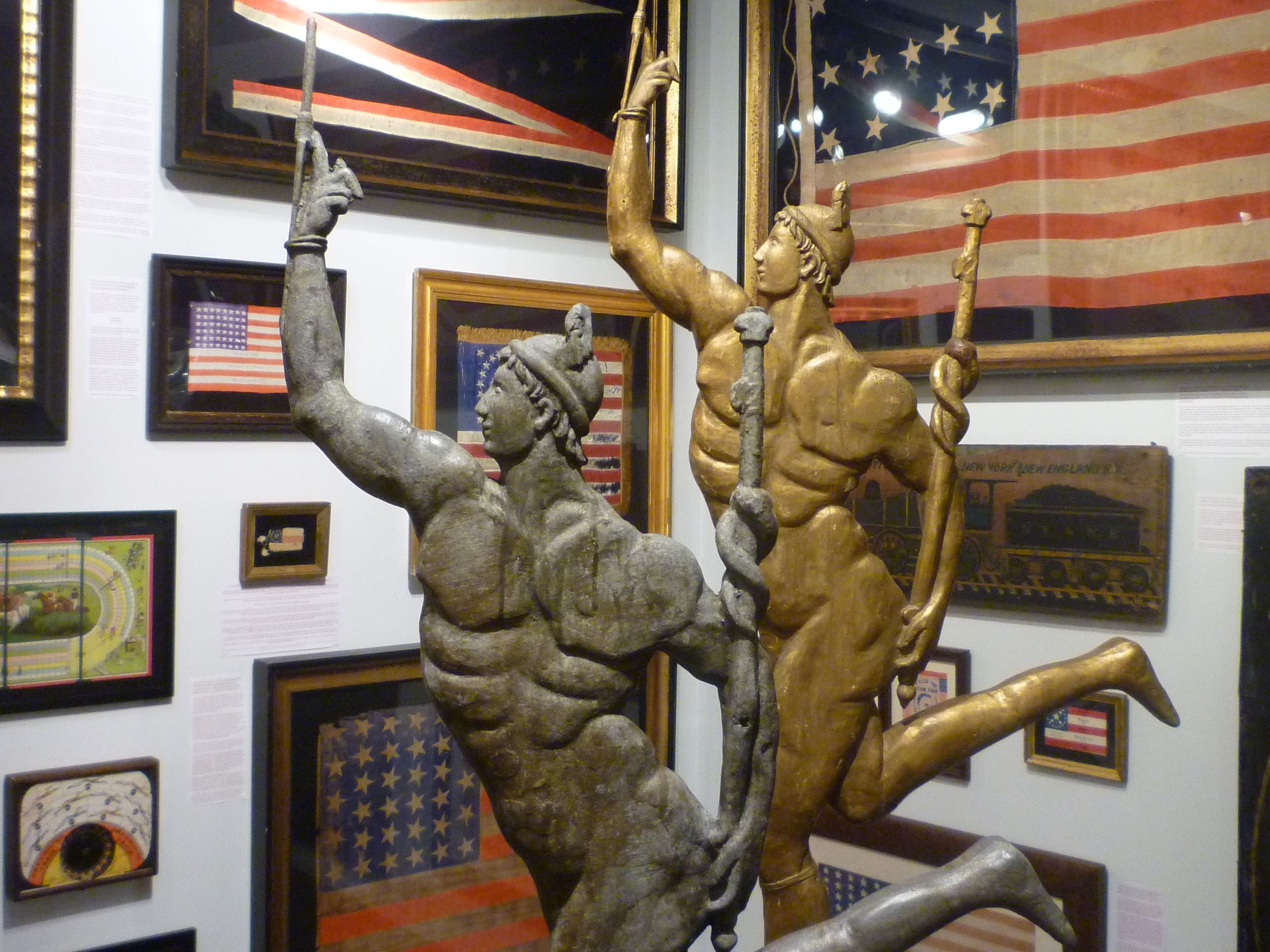
A rainy Manhattan night provided an excellent opportunity to spend some time at a preview for Antiques & Art at the Armory, although I don’t think a sunny day could have kept me outside. The best thing about the show is the wide variety of merchandise available. It’s not that big of a show as far as shows go, but here there’s more opportunity to see a great variety of really fine items. One booth specializes in dog paintings, although there’s a few cats and even a rooster represented. Other exhibitors concentrate on early gaming devices, barometers and Chinese jades. Another refreshing thing to note about the show is there are several artists set up selling their own art. Yes, some of the prices are above entry-level, but we did notice some particularly good values. We’ll talk about some of the dealers we met in a subsequent post.
Avenue shows put on a first-class affair with not only the typical wine and cheese, but dinner including salmon and steak. Brooks Brothers is the sponsor and guests received gift bags on their way back out into the rainy night. The show runs through Sunday, December 6 at the Park Avenue Armory, 643 Park Avenue.
Forgery or Not? Response From A Reader
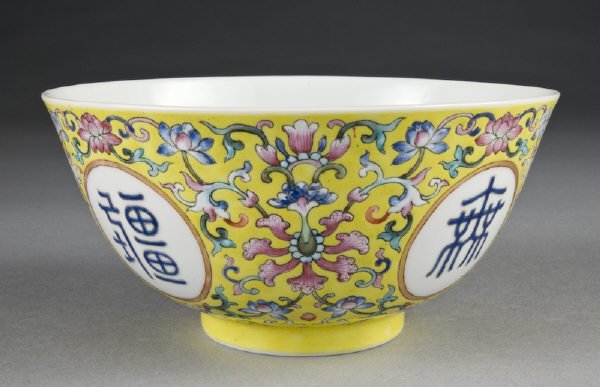
In last week’s “A Gaggle of Interests“, we have compared a bowl offered from the Dallas Auction House with a similar bowl in the Forbidden City Museum. The article was also posted on LinkedIn group and one of the readers Fay replied with her opinion, which we would like to share with other readers.
As much as I know, the references tell that THE bowl is stored in Forbidden City Museum, so I’m also confused about the amount of bowls in that period. Though I don’t believe there was only one bowl like this made in that time or only kept in China, the bowl held in the Dallas Auction House is really different from the next one. You could find out the form of the characters are sort of different. The first one was written in Zhuan Shu, and the latter one is like Jin Wen, and the color of the characters are also look different.
Of course, even these cannot tell which one is real and which one is fake. We may assume these two different bowls were manufactured in different batches. But according to my own experience and feelings, I consider the second one is real. Anyway, the stuff in Forbidden City Museum cannot be more authentic than other places, I have such feelings only accoring to the pictures.
Different Wyeth, Different Ending
On the morning of Dec 2, 2009, three generations of Wyeth paintings were auctioned in the Christie’s Important American Painting and Sculpture Sale. A large egg-tempera on panel by Andrew Wyeth Above the Narrow was the top lot of the sale. When the auctioneer hammered down the price of 6.1 million dollars given by a floor bidder, there was a floor-wide applause. The top lot, in this sale, was not only sold, but also exceeded expectations, beyond the five million dollar high estimate.
On the other hand, the result of 14 paintings of Rubinson Crusoe series by N. C. Wyeth, consigned by the Wilmington Institute Library was a mixed bag. Only five of them were sold (1.83 million dollars in total) beyond their reserved values, which may leave the complete series disassembled. However, Christie’s has 30 days by contract to find private buyers for the paintings, and hopefully will eventually bring 3.8 million dollars to the library.
The Robinson Crusoe series was purchased directly from N. C. Wyeth in 1922 and have been hanging in the reading room of the library built by Pierre DuPont since then. The series, in fact, contain 17 paintings. The library holds 14 of them, while two paintings are in private hands and one missing.
The library, which was hit hardly during the recession, is hoping to raise $4 million to $5 million to renovate the neoclassical building and help replenish the library’s endowment. Based on the original plan, quality prints will replace the oil paintings by Wyeth; but now the board will meet to decide the fate of the remaining unsold nine paintings.
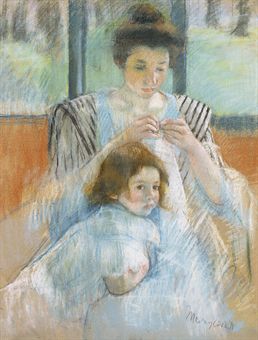
The only painting by Jamie Wyeth was sold for $110,000. Most of the lots, especially those deaccessioned from art institutes were sold with solid results. But a few stand out. Mary Cassatt’s large pastel works have always been blue chips in the art market and this lot, a study for Young Mother Sewing, was sold for over two million dollars. The Water Lily by Joseph Stella brought $190,000, much more than its high estimate of $70,000. UAA team overheard the conversation between a staff and Michael Quick during the preview that it was one of the most inquired-about paintings in the sale, the result proves so. The rare Raphaelle Peale which sold for $700,000, also beating the presale estimate. (Other still paintings faced a different fate: Neither Joseph Decker not Martin Johnson Heade attracted enough bids.) A phone bidder spiced up the sale by giving bids much higher than necessary and drove the price for a painting by Thomas Hart Benton to $520,000. It was one of the moments that both the auctioneer and the audience laughed in spite of some fierce competition between bidders, but such optimistic moments are too rare in the current market in which only the best quality works bring up the right values.
Sculpture Tour at Green-Wood Cemetery
Dr. Karen Lemmey, research associate of the Department of American Paintings and Sculpture at the The Metropolitan Museum, will lead a tour in Green-Wood Cemetery and examine its vast collection of sculpture. Most of the previous tours at the Green-Wood Cemetery are given in the historical subject area, thus this tour, accompanied by the historian Jeffery Richman, will provide a rare opportunity to visit the beautiful cemetery from a different angle.
The tour starts at 1 PM on Sunday, Dec 13, 2009. You can purchase tickets from their website.
UAA team has finished the artists in Green-Wood Cemetery task before. Here are some of the pictures we have taken from several trips.
Grif Teller Original Coming up at Auction

Grif Teller
It won’t be the first Grif Teller painting to come up at auction in recent years, but it is the first original created for a Pennsylvania Railroad (PRR) calendar I’ve seen. In terms of the estimated price anyway, that can make all the difference in the world.
Coming up December 8 at William Bunch is the original artwork for the 1936 PRR calendar Speed, Safety and Comfort. The scene depicts southbound GG1 electric locomotive #4823 with 3 red Pullman cars at Claymont, Delaware, Milepost 19.5.
Teller is the artist most associated with PRR calendar artwork. He working each year for more than 30 years to produce a painting to represent the carrier that employed hundreds of thousands and spanned more than a dozen states. More than 300,000 copies of each year’s calendar were printed and distributed. Teller was born December 9, 1899 and grew up around Newark, New Jersey. He graduated from the School of Fine and Industrial Arts in Newark and took night classes at the Art Students’ League of New York.

- Grif Teller,”Speed, Safety, and Comfort,” To be auctioned at William Bunch, Dec. 8
The 1936 calendar was also not the only PRR calendar by Teller to depict a GG1. The 1949 calendar, Main Line, Freight and Passenger and 1955, Mass Transportation also featured this Raymond Loewy-designed engine which became a symbol of modernity, clean power and electrification.
Teller’s work wasn’t limited to railroads, although the remain the most sought after. He also painted a number of landscapes and farm scenes. He also completed commission work of rail scenes after his work with the PRR was completed. He exhibited his works at the National Academy of Design.
No other auction record for original calendar artwork can be located (though probably exists pre-internet), but a train scene from 1989 sold at Dan Morphy Auctions in Reading, Pa for $1600, near the low end of the estimate. His landscapes and barn scenes have failed to reach the $1,000 mark.
All indications are this one will be different, however. The estimated price is from $15,000 – $25,000. I should also note, compared to the actual calendar print, the colors are considerably more vibrant from the image of the original seen online (I haven’t seen the actual painting). It’s one to watch.
A side note, like most of the engines, GG1 4823 was scrapped.


Recent Comments