In this series, Geo and I will list some of the interesting items that we have found in auctions, antique shops or eBay. We neither own the items and in most cases don’t have the capability of examining the items in person. It mainly serves as an inventory record of what interest us (not necessarily in terms of value or investment opportunities) and possibly how much it fetches (if the result can be obtained). If you are serious about some lots, please contact the auction houses, dealers or eBay sellers directly.
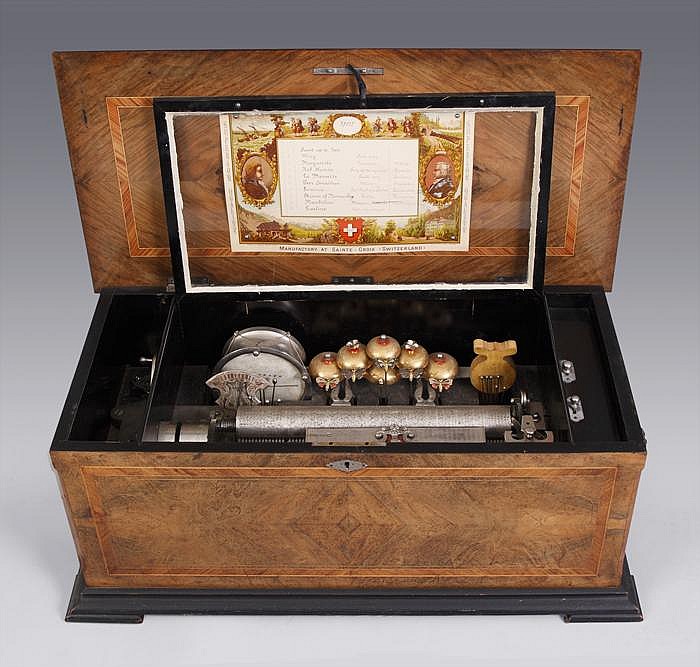
1. Cottone Auction, Sept 26, 2009. Lot 43: Harry Gautschi & Sons Music Box
I have found that to listen to a music box gives me more satisfaction than to use an iPod on a subway train. In general music boxes are not that rare to find, but this one with the inlaid & ebonized rosewood case and 3 interchangeable cylinders, drum & bells with enameled butterflies, is still a pleasure to watch even when silent. Based on the description, it is in working order with good teeth for the “comb”. I am wondering whether there are enough disks around to enrich the variety. Watching a moving music box has as much fun as enjoying its deep resonance. This one even provides the drum and bell to add the spice! I would buy it for my kids (if I had one) to intrigue them in both the mechanical wonders and musicality. Again, I always believe that plastic electronics can never beat the sound of vibration from real wood or metal.
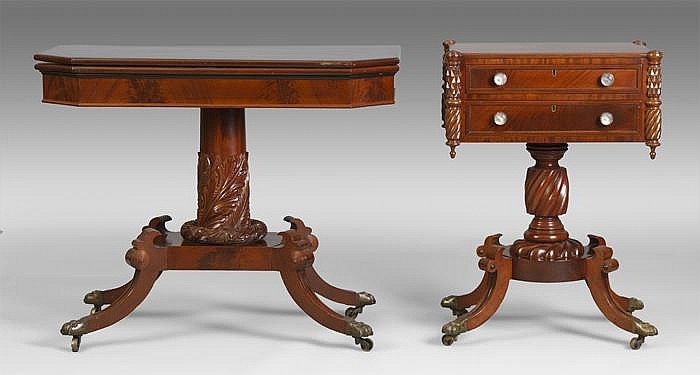
2. Cottone Auction, Sept 26, 2009. Lot 145: Philadelphia Federal Card Table and Sewing Stand, attributed to Joseph Barry.
Joseph Barry, a trained London furniture maker, moved to Philadelphia in 1790’s. Brry’s workshop produced one of the finest furniture with features such as carved acanthus leaves, fleur de lus, palmetto leaves, horizontal beehive reeding lion’s paw feet, female heads and serpents. Geo loves the spiral-carved foliage decorated pedestal of the card table. The reeded sabre legs and the lion’s head brass caps are typical of Joseph Barry. From the book “Philadelphia Empire Furniture
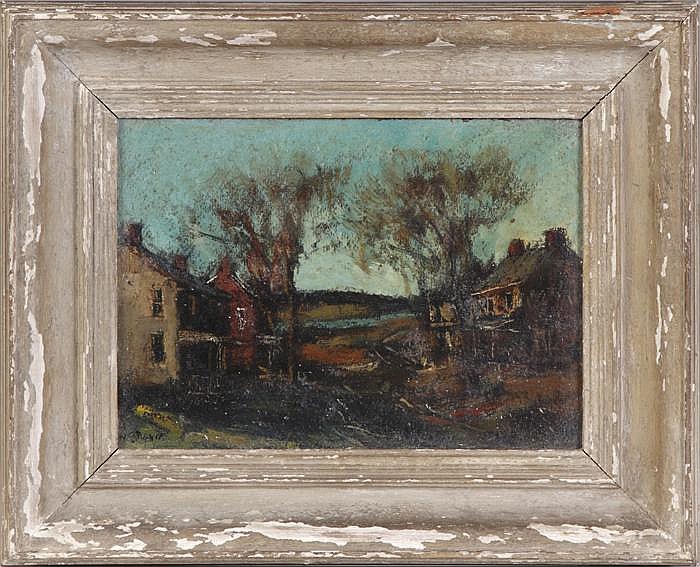
3. Cottone Auction, Sept 26, 2009. Lot 170: Walter E. Baum (American, 1884-1956) “The Village”
Walter Baum is one of the few Pennsylvania Impressionism painters that collectors with limited budget can still afford, even for a major work. A recent article disclosed that Baum’s wife pushed him to paint at least one painting a day for quick cash, thus probably certain degree of connoiseurship is needed to distinguish a daily-bread Baum from more time-consuming major works. I am not an expert on Walter Baum. At his best, I saw a muscular power from the succinct brushstroke. But if George Bellow’ passionate use of thick layers of pigments directly onto pictures is desirable for gritty urban scenes, then some of Baum’s autumn village scenes are too much of nicety for raw and bold treatment. This one, dark and solemn, bears a label from Salmagundi Club indicating it was selected for the “Thumb Box Exhibition, 1947”, perhaps an artist nod’s for its excellence.
4. Bonhams, SoMa Estate Auction, Sept 20, 2009. Lot 4518: A William and Mary walnut side chair from the late 17th century
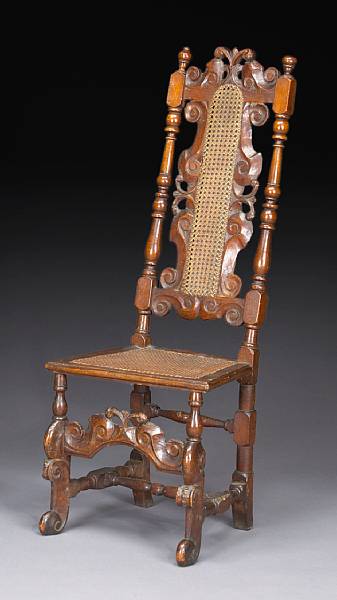
By now if you keep following this series, you probably think I am a chair mania.:) Tall, stately, and airy, William and Mary chairs, in my mind, are the first type that get away from the clumsiness. Yet its elegant baroque carving still recalls the old world. I am no expert on William and Mary, although I have learned certain carvings of the crest can be used to attribute the origin. Geo could not tolerate all the curves and turns, but I would love to have one if I had a library of oak paneling. On this particular lot, sadly, American Museums are selling inventory again.This time: the Fine Arts Museums of San Francisco. Take it on the bright side: Since it is a museum piece, at least seldom people sit on it and the old cane must still sound.
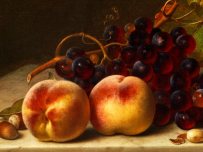
5. Hampel Auction, Germany, Sept 18, 2009. Lot 403: Still life by Johann Wilhelm Preyer.
Sometimes it takes a museum visit to learn and meet some painters who you will never forget. The visit to MFA, Boston brought me to look at Gerrit Dou, and the last trip to the Walters Art Museum it was Johann Wilhelm Preyer whom I put in the search list. Neither do I agree still life is a low level of fine art nor I think the consummate realism matters less with the arrival of photograph. Like other typical pictures of Preyer, fruits come alive under his mastery of texture and light. Also there is that warm glaze harmonizing the picture which almost makes everything glow. Maybe I am opiniated , but I tend to think it is the small subject that showcases the supreme vision.
6. eBay, item number: 250493485992. Landscape by Henry Ward Ranger
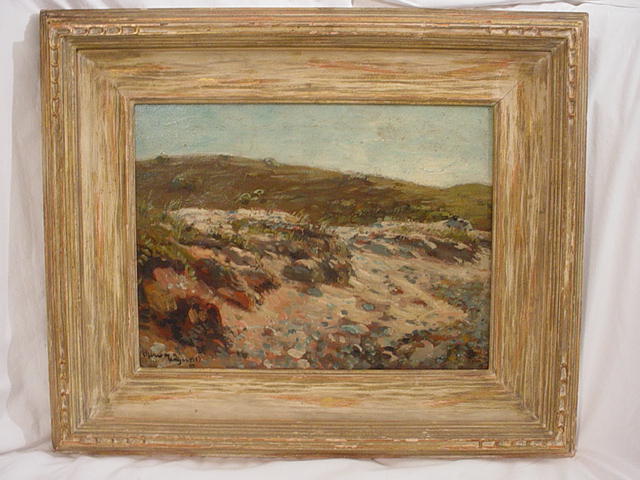
I guess the word impressionism help painting sell so that the seller added it to the title (although I won’t quibble on the use of “plein air”). This painting by the Dean of American Barbizon School, Henry Ward Ranger, will end the auction tomorrow. Ranger was a painter so prolific that sometimes it seems there are more Henry Ward Ranger paintings around than one man could have possibly painted. Ranger was the founder of the Old Lyme School in Connecticut (but left shortly after the arrival of Child Hassam). This 12×16 landscape is being offered on eBay and at the time of this writing, there’s considerable interest with 13 bids. Prices for works by Ranger vary widely. The listing notes they’ve sold for up to $23,000 at auction. Browsing through LiveAuctioneers.com it’s easy to see they’ve also sold for $650 at auction. One of the things to note is the National Academy of Design “Ranger Stamp” on the reverse. Ranger left his entire residuary estate to the National Academy to be sold and used to purchase works by American artists. The works purchased were to be given to libraries and art institutions throughout the country. The stamps indicate the paintings were part of Ranger’s estate. A stamp also indicates a painting may be an incomplete work or a study.
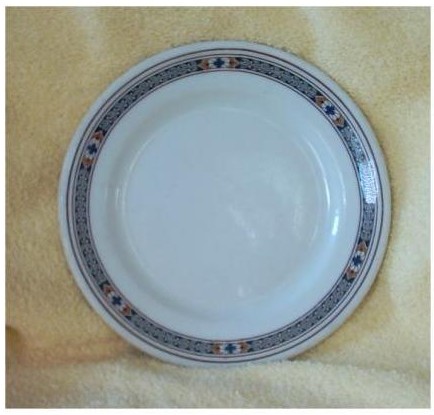
7. eBay, item number 150364756043. PRR 1940/50s LAUREL Pattern 7-3/8in. Dinner/Salad Plate
Why not make your dinnerware as interesting as your furniture and walls. China from hotels, restaurants and railroads can add interest to a meal that only increases as your plate clears. Of the three, perhaps the most expensive and collected is railroad china and one of the top roads to collect is the Pennsylvania Railroad. Offered on ebay (Buy it Now, $29.95) is a dinner plate in the Laurel pattern from the mid-century. Like most plates that were actually used the listing says this one has surface scratches. The back of the plate says it’s Buffalo China made exclusively for Kniffin and Demarest, china distributors in New York. Keep in mind “china” is a generic term and technically this is likely to be stoneware. One of my favorite designs in railroad china is the Dewitt Clinton pattern from the New York Central. It’s also one of the more affordable designs. For after dinner, there’s nothing like scotch on the rocks in one of these.





Leave a comment