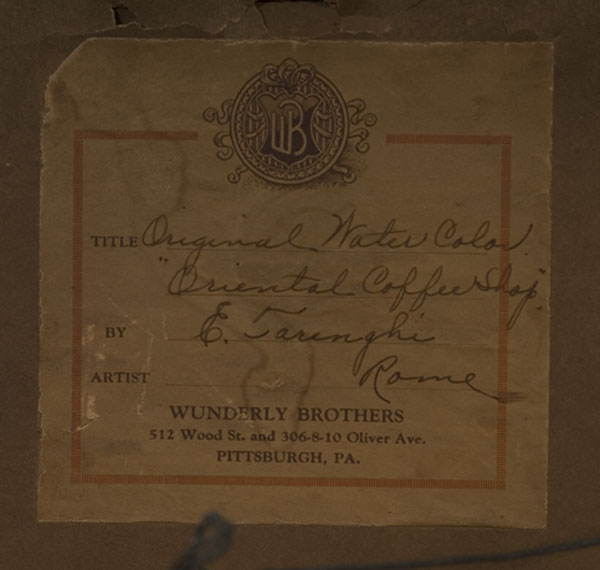

Except for Chinese ink-wash paintings, whose ownership is genuinely documented through personal seals over hundreds of years, for the majority of the artworks available in the market, tracing the previous owner is harder than deciphering a papyrus document written in hieroglyph. However, sometimes we are blessed with old labels from prominent galleries. For Barbizon and Tonalism paintings, a label from Vose Galleries in Boston or Macbeth Gallery of New York almost certainly validates their authenticity. Pittsburgh has its pedigree galleries. The most famous one is J. J. Gillespie Gallery, where Hetzel and his colleagues regularly gathered to share information, discuss their work, and plan their collegial painting outings and exhibit. At the time when Pittsburgh was still regarded as one of the frontier cities of the nation, Gillespie Gallery pioneered as a confluence point where old masters and contemporary European and American artworks were assembled to nourish the local art scenes. It was there that John Beatty, the first director of Carnegie Institute met the artist’s circle and supported regional art with the newly founded Institute and the Carnegie International.

The upcoming auction at Concept Art Gallery features paintings by Pittsburgh painters with provenance from another prominent local gallery: the Wunderly Galleries. Among them, there are two paintings by Emil Bott, whose artworks are seldom seen in the market. (The Westmoreland Museum of American Art has a few of his paintings and drawings in the collection.) Bott’s early training in Dusseldorf is evident in his highly realistic rendering of the paired landscape paintings (lots 132 and 133). The wayfarer in each of the pictures, almost certainly invented from imagination, brings viewers into nature when Western Pennsylvania was still nothing but rolling hills and valleys. In contrast, two paintings by A. Bryan Wall, also bearing old labels from Wunderly Galleries, show clearly only one generation later how artistic style and the Ohio Valley landscape had changed. It is noteworthy to point out that A. B. Wall didn’t embrace such an impressionistic style from the beginning. In the book “Henry Clay Frick
In fact, I was not aware of the story of Wunderly Galleries before the auction catalog became available. According to the galleries’ website, in 1894, the Wunderly brothers bought the business from Robert Mayer and moved the gallery to 25 Sixth Avenue. The gallery subsequently moved several times within downtown, Pittsburgh until 1980 when it moved to Florida and ended a legacy of nearly one century. It was not surprising that both Wunderly and Gillespie flourished during the peak of Pittsburgh steel power while withered when the city underwent a painful transformation in the 1980s. On March 26, 1981, Donald Miller, an art critic, published an article “149-year-old Gillespie art gallery fading out” in the Post-Gazette. It began with “One of the city’s oldest firms, J. J. Gillespie Co., founded in 1832, has declared bankruptcy.” He wrote that the gallery’s peak volume was in the 1920s when paintings sold between $65,000 and $125,000 apiece. In the article, he also mentioned that the Wunderly Galleries, Gilliespie’s competitor, had suffered a similar fate.

Although a landscape painting by A. F. King bears the Wunderly Galleries provenance in the upcoming auction; it is his still-life painting that stunned me the most. The painting’s provenance traces back directly to the artist who sold the painting to Ida Shields Fiekenson, the socialite wife of a Pittsburgh Industrialist. Based on the description and the photorealistic style, this still life was probably painted by King before or around 1900. A close examination of the detail showed that the artist experimented with some novel ideas in this large complex composition: The right end of the watermelon was painted slightly off-focus, almost fading into the dark. Thus, viewers are directed toward the crisp, clear rendering of the cherries in a basket, peaches, and a half-cut cantaloupe. He also applied a light impasto of pink on the surface of the watermelon so that the whole picture is harmonized in a warm tone. The fresh white linen still bears the folds, and the knife is ready for action to cut. Will William Gerdts, the great art historian and still-life collector who once lamented that he didn’t own a King’s still life, be intrigued to take a bid?
Other notable Pittsburgh painters offered in the auction include George Hetzel, Aaron Gorson, Christian Walter, and Martin Leisser. Lot 138 “Forest Stream in the Alleghenies” by Hetzel seems to feature the same spot where he painted another masterpiece “Pennsylvania Mountain Stream”. (I am wondering whether the specific locale can be identified, and one can thus organize a nature walking tour in the name of Hetzel.)

Nowadays, both Gillespie and Wunderly are not operating in the city anymore. Neither gritty steel mills scenes (lots 131, 136, 137, 160) nor serene Scalp Level (lots 138 and 144A) is their specialty. Those old labels on the back of the canvases tell us about their once intimate relationship with the city art scene. No matter where they are now, they hold “an important place in Pittsburgh’s art history,” as Mr. Miller wrote in his 1981’s article. Perhaps because of that, these old labels, like tickets to the trains heading back to the last time, added another tangible layer to the ownership.
Note: Concert Art Gallery holds the next auction on Oct 10, 2009.



Leave a Reply