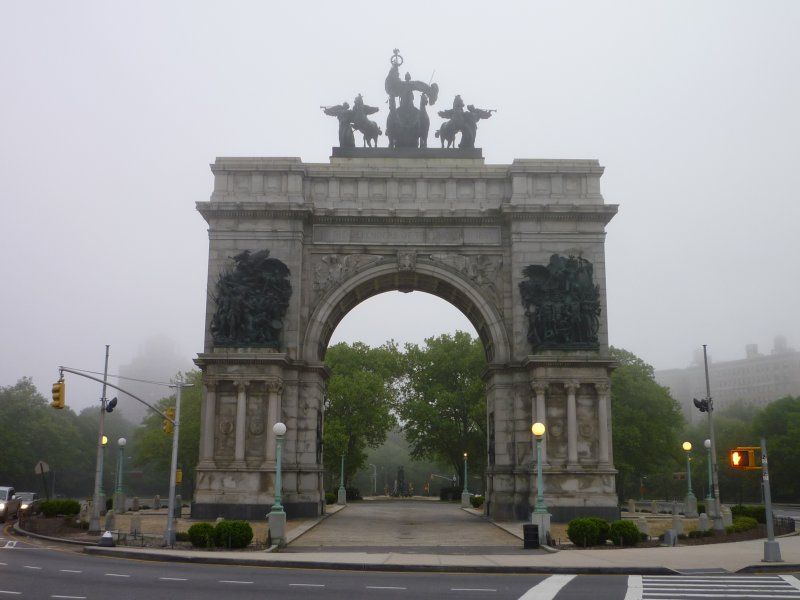

There is nothing more pleasant than sitting in the living room with a cup of wine at night and watching the liveness at the entrance of Prospect Park: people running, walking, biking, with dogs, with strollers, or with books fresh out of the library. No matter what they are doing, people naturally slow down. As if suddenly struck by the light, they would look up: There, divided by the busy traffic flow, stands the Soldiers’ and Sailor’s Memorial Arch by Mckim, Mead, and White.
The night view of the Grand Army Plaza is gorgeous. The Arch has always been dimly illuminated in purple light, which plays down the triumphant gesture of Lady Columbia riding a chariot. Although as if all traffic merges in front of the arc, they immediately skew away at different angles, leaving the park in peace and solitude.
It was not long ago that I began to get interested in Frederick William MacMonnies. At a beautiful house in Boerum Hill, the owner, who deals and collects antiques in his life, pointed out a bronze statue in the middle of his living room. “That’s by MacMonnies, who also made the statues at the Grand Army Plaza.” I cannot remember it clearly although, in my vague impression, it resembles a dancing bacchante, I must have seen the monumental statues in the plaza hundreds of times.

MacMonnies was a Brooklynite and Brooklyn offered him the best spot for showing his talent. Although the memorial arch itself is very Parisian, Quadriga, the group statues of the arch by MacMonnies, is American. The Spirit of the Army and The Spirit of the Navy flanked on each side both have compact compositions as if they narrate all aspects of the Civil War. Soldiers and officials are depicted in different layers and depths. Above all this turbulence, Lady Columbia, an allegorical figure of the United States, leads the victory with winged angles playing trumpet upon her arrival.
The south end of the park entrance, which faces the beginning of Ocean Pkwy, features a pair of statues by MacMonnies atop granite pedestals by Stanford White. It was exhibited at the Paris Exposition in 1900 and at the Pan-American Exposition in Buffalo the next year with the title “The Triumph of Mind Over Bruce Forte”. Its highly dramatic effect, exultant mood, and dynamic arrangement differ from that of his mentor August Saint-Gaudens who imbued his works with more sensibility and humanity. The somber mood at the sculpture “54th Massachusetts Volunteer Infantry” by Saint-Gaudens completed only a few years ago disintegrates in the high spirit of the Gilded Age. The optimistic fortissimo permeated throughout the end of the 19th century in New York City is evidently shown here: The tamer’s unyielding physicality and mentality are the manifestations of American power in the age of the Industrial Revolution.

Just as I thought I had seen them all, a few days ago at a Brooklyn Fleamarket, I saw an old postcard of the statue of General Henry Warner Slocum. I didn’t know who he was although I almost passed by him every day with the grinding wind at the plaza. The statue in the postcard was shown at a different place. But it is nice to move another work by Macmonnies into the plaza. The inclusion of General Slocum is appropriate because he was an important figure in the Civil War but also served as the Commissioner of Public Works in Brooklyn. Sanford White’s pedestal is adorned with a relief eagle on the front and four medallions, two on each side. Strangely the medallions are Medusa, but probably Macmonnies was not responsible for decorating the pedestal. On the Memorial Day of 1905, Theodore Roosevelt unveiled the monument. Macmonnies would probably be there. Not too far away from the corner of Eastern Pkwy and Bedford Ave where the monument was originally located, the boathouse was completed in the lakewater of the lake inside the park in the vein of Beaux-Arts style. By then, the grandeur and classism of architecture and sculpture, which dominate the area where I am now living, came full-fledged: It looks European but bigger, stronger, and louder.





Leave a comment