Archive for November, 2010
The Philadelphia Museum of Art Announces Acquisition of 3,000 Works by Paul Strand

Paul Strand (American, 1890 - 1976) Hacienda, Saltillo, Mexico (1932) Platinum print Purchase from the Aperture Foundation
The Philadelphia Museum of Art today announced that it has acquired, through several gifts and a purchase agreement with the Aperture Foundation, the core collection of photographs by Paul Strand, one of the pre-eminent photographers of the 20th century. Through the generosity of philanthropists Lynne and Harold Honickman, Marjorie and Jeffrey Honickman, and H.F. “Gerry” and Marguerite Lenfest, the Museum has received as partial and promised gifts 1422 images from The Paul Strand Archive at the Aperture Foundation, as well as 566 master prints from Strand’s negatives by the artist Richard Benson. The Museum has also entered into an agreement with the Aperture Foundation to purchase an additional 1276 photographs. As a whole, this acquisition comprises more than 3000 prints and lantern slides, including the finest examples of every image in the Archive. Together with other photographs by Strand already owned by the Museum, this acquisition makes the Philadelphia Museum of Art the world’s most important repository for the study of his work.
All of the photographs and lantern slides are now housed at the Philadelphia Museum of Art where they are being studied in preparation for a major retrospective devoted to the artist that is scheduled for 2014.
Timothy Rub, the George D. Widener Director and Chief Executive Officer, stated: “The Paul Strand Collection at the Philadelphia Museum of Art will rank among the finest and most significant groups of works by key figures in the history of photography held by any museum in this country. As the definitive collection of one of the 20th century’s greatest photographers, it will also be a critical component of the Museum’s internationally distinguished holdings of modern art, which include the renowned Louise and Walter Arensberg and A. E. Gallatin collections. Given the significance of Strand’s achievement as an artist it will, I believe, become a cornerstone of the Museum’s collections, much like our extensive holdings of works by Marcel Duchamp and Thomas Eakins.
“This is a major achievement,” Mr. Rub went on to say. “We are exceptionally grateful to the dedicated support of our enlightened donors, the Honickmans and the Lenfests, who recognized the value of their gifts to the Museum’s mission and to the study of the history of photography and worked together to help us strengthen the Museum’s collection. Our longstanding relationship with the Aperture Foundation, in particular through the work of the late Michael E. Hoffman, who formed the Strand archive at Aperture and served for many years as the Museum’s Adjunct Curator of Photographs, has enabled us to create a repository of the work of this artist that will chronicle his seminal contributions to the development of modern art and will advance the study of his remarkable body of work and prominent place in the history of photography.”
Celso Gonzalez-Falla, the Chairman of the Board of Trustees of the Aperture Foundation, commented on the placement of this extraordinary collection. “Given Aperture’s long association with Strand and the commitment that the Philadelphia Museum of Art has made to the development of its world-renowned holdings of photography, it is an ideal place for these works. This is true not simply because of the Museum’s long association with Aperture, but also because this gift and purchase, when added to the Museum’s existing collection of more than 600 exceptional works by Strand, provides a full picture of his remarkable achievement, adding strength to strength and creating a true and enduring public benefit. We salute the vision and perspicacity of Peter MacGill of Pace/MacGill Gallery, who has worked closely with Aperture to ensure that this important collection would find a permanent home in a great museum.”
The portion of The Paul Strand Archive that the Museum has made a commitment to purchase from the Aperture Foundation includes many remarkable photographs. Among them are two of Strand’s rare gum bichromate prints, which date to the earliest years of his career. Also included are masterpiece platinum and silver portraits of his first wife, Rebecca Salsbury, and several other key portraits of his circle in the 1910s and 1920s, including his father Jacob, painter John Marin, and fellow photographer Kurt Baasch; unique prints such as a 1922 image of Constantin Brancusi’s sculpture Mlle. Pogany and a solarized portrait of the architect Henry Churchill (1922); major examples of his nature and machine abstractions, including the unique Rock, Georgetown, Maine (1927) and a rare pair of vintage platinum and silver prints of Fern, New England (1928); and superb prints from his early sojourns to the Gaspé Peninsula, the Southwest, and Mexico.
“Combined with the Museum’s existing holdings, this acquisition will give the Museum an unrivaled collection of Strand’s critical early work and his photographs of the Southwest and Mexico, all recognized as high points of his career,” commented Peter Barberie, the Museum’s Brodsky Curator of Photographs. “Added to the recent gifts to the Museum from the Honickmans and Lenfests, the acquisition will also enable us to assemble nearly complete sets of vintage prints from all of Strand’s later projects, beginning with his prized New England photographs of the 1940s and running through the final series he made in the garden of his home in Orgeval, France.”
The Paul Strand Collection will permit the study of Strand’s career with prints from the majority of his negatives, including most known variants and croppings of individual images. It will, moreover, enable the Museum to keep together several prints made from a single negative using different processes, at different times, and with different papers. As such, The Paul Strand Collection will be an essential resource for any scholar of 20th-century photography. In addition to 2,768 prints and lantern slides by Strand himself, the acquisition includes the gift of 566 gelatin silver and platinum prints from Strand’s negatives by the eminent American photographer Richard Benson, made for Aperture in the 1980s. Benson has printed Strand’s negatives since the early 1970s, when he worked closely with the artist. As part of its ongoing publishing initiatives, the Aperture Foundation will prepare a Paul Strand catalogue raisonne in cooperation with the Philadelphia Museum of Art.
Season of Antique and Art Shows Approaching
The last months of the year, and then the first few months of the new year are the season for antique shows and art events. I thought I would take the opportunity to highlight some favorites, and introduce a new feature on Urban Art and Antiques, our calendar.
The Theta Antiques Show in Houston is coming up November 18-21 at the George Brown Convention Center there. The show features forum speakers and a special exhibit from the Bayou Bend Collections and Gardens.
The weekend after thanksgiving its the Holiday Antiques Show in Williamsburg, Virginia. It would also be an excellent time to check outGordon Converse of Antiques Roadshow fame will be on hand for a Sunday appraisal clinic. the grounds and decorative arts collections at Williamsburg. Plus Gordon Converse of Antiques Roadshow fame will be on hand for a Sunday appraisal clinic.
David Sokosh will pay a visit to the Fine Art Fair at the National Academy in New York City for Urban Art & Antiques. Established in 2008, the fair focuses on the grand tradition of American art established early in the 19th century and gathers more than 200 works in a virtual “group show” by National Academy members and their circle. The event takes place November 29- December 2.
The Tower Antiques Show takes place at Fair Park in Dallas December 3-5. It’s one of the region’s better antiques shows and a favorite in the Southwest.
Beyond that there are a number of exciting auction previews in New York and elsewhere including American paintings at Christie’s and Bonham’s, items from the Smithsonian at Pook & Pook and a collection of Pennsylvania items at Freeman’s. When January rolls around, Antique Week will be upon us and the month is full of shows in New York, Florida and elsewhere. Check out the calendar for details.
Can Betty White and the AARP Save the Antiques Biz?

By David Shankbone (Betty White David Shankbone 2010 NYC)via Wikimedia Commons
If Betty White told you to buy antiques, would you? More verification that the antiques trade is in disarray and more idea on what to do about it came in my mailbox today in the November/December The Magazine Antiques. Skimming the letter you may end up with a not entirely accurate take-away that Betty White and the AARP might help save the industry.
In the Editor’s Letter, Elizabeth Pochoda writes about a group of collectors who recently got together and came up with the idea to form a trade association to help things out.
Pochoda writes that while the idea is a good one, the mission is urgent. Teaching folks about antiques is a fine goal, but not one that’s going to help move expanding inventory anytime soon. Pochada suggests focusing on a national media campaign and perhaps a engaging spokesperson for the industry, which would be costly.
That’s where she loses me. Pochoda suggests a person situated culturally between Phillippe de Montebello and Betty White—though a lot younger, and then goes on to suggest the possibility of an alliance with the AARP. Montebello, a former Met curator, was born in 1936. Betty White, while having some appeal to members of younger generations, was born in 1922. I don’t think either could be taken as a suggested spokesperson, but I’m not sure floating the names brings us any closer to reviving the industry.
I’m also not sure an effective campaign would be expensive, however. It just needs to be creative. Antiques are receiving considerable airtime on old media anyway with Antiques Road Show, Pawn Stars and American Pickers. I think we’d go farther with a new media campaign focusing on Youtube, Facebook and targeting urban vintage markets, which seem to have no shortage of younger “antique” hungry customers. Listen to my conversation with Eric Demby of the Brooklyn Flea when he says without a doubt, these will be the consumers of higher-priced vintage goods. Perhaps hiring someone like Eddie Ross, take him to a few classes at Winterthur, then send him out to find real antiques in shows and walk through the period rooms at the Brooklyn Museum. Upload the videos to Facebook and Youtube and we’ll have twice the bang of an old media campaign at a fraction of the cost.
I do want to thank Pochoda for not using the word green and agree with a later point, that a campaign should not fous on collecting, rather just float the idea of purchasing a few antiques. Pochoda also refers to a friend’s belief that the word antiques has an aura too closely associated with mud turtles, but defends its use saying the campaign could help bring it around to a positive. Myself, I’ve been in enough persnickety arguments about what exactly an antique is to use the word “vintage.” I think this word already has a positive connotation with younger collectors and could eliminate those persnickety arguments. Vintage is cool and perhaps my classical sideboard could be cool too if I call it vintage. I think I like it better already.
Breathe In, We May Not Be Here Again
“Eden was; it will not be again. We must work our way to Paradise.” George Inness
The first painting collected by the Fort Worth Public Library and Art Gallery, which later became the Modern Art Museum of Fort Worth was Approaching Storm by George Inness. The painting was merely a quarter century old at the time and it seems the organization had its eyes on the “masters of tomorrow” much as Andrew Carnegie did.
While this painting currently hangs in the Amon Carter Museum, another work in the region, this one at the Dallas Museum of Art, better exemplifies the artists mature style.
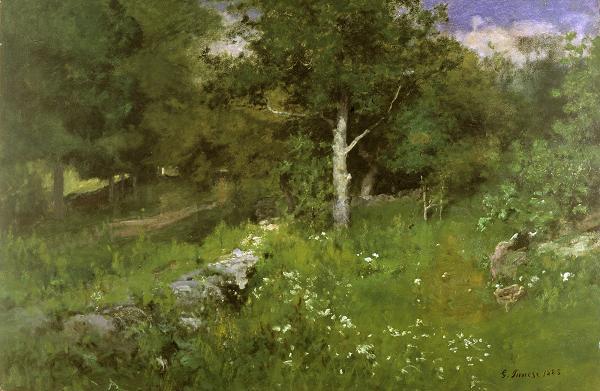
From 1883, Summer Foliage well conveys the mood we expect from so many tonalist landscapes. Inness says the true end of art is not to imitate a fixed material condition, but to represent a living motion. From the quote about Eden above, paintings by Inness are not a representation of a permanent landscape the way many others in the Hudson River School would lead you to take away, but a fleeting, but deep emotion that comes at once, leaves an impression then is gone.
Looking at the painting today, I noticed the colors on the right side are much more chromatic than those on the left side. A stone wall separates the two planes of the painting. Behind it is a path where we cannot enter, although someone may pass by at any moment and we may see them, and nod or wave, but not be with them.
So many of Inness’ late works contain human figures that are there, but not really there. They kind of fade out into the landscape. Today it occurred to me that these figures may be like the one I imagined may cross this path at any moment.
Where we stand in Summer Foliage, there is no way to enter the painting. The vegetation in front of us is thick and we would be unable to enter without much difficulty. Perhaps the wall in this painting is meant to separate the physical and spiritual worlds. I think that perhaps by the time of his death in 1894, these worlds were even less separable.
Inness was a follower of a fellow named Emanual Swedenborg and tried to implement Swedenborg’s view that humankind was integral to nature’s spirit and processes.
Paintings of course come to have personal meanings to individuals that may or may not have crossed the mind of the artist. That is perfectly fine in my view, and it can also be dangerous to adhere too closely to what we know about an artist even as fact. We shouldn’t, in this case, attempt to go beyond the knowledge of Inness and his devotion to Swedenborg and say this is why Inness painted the way he did.
It’s the best artist who has a keen awareness of what he does not know, and I imagine Inness to be one of these artists.
“I am seventy years of age,” Inness wrote. “and the whole study of my life has been to find out what it is that is in myself; what is this thing we call life and how does it operate.”
He died nine days later.
Ohhh…Alright Brings More Than $42 Million at Christie’s Sale

Roy Lichtenstein (1923-1997) Ohhh...Alright… oil and magna on canvas, painted in 1964. Price realized: $42.6 million
Christie’s made history on November 10 selling a Pop Art masterpiece from Roy Lichtenstein at its major Evening Sale of Post-War & Contemporary. The highly-anticipated masterpiece Ohhh…Alright… 1964 by Roy Lichtenstein realized $42,642,500, establishing a new world auction record for the artist. The work sold to an anonymous bidder on the phone. The previous record for a work by Lichtenstein was $16,256,000, achieved for In the Car, 1963, at Christie’s New York in November 2005.
Christie’s says Ohhh…Alright… characterizes the Lichtenstein’s captivation and inspiration with techniques of commercial printing and reproduction articulated in his signature Ben-Day dots. As with all of Lichtenstein’s iconic images, Ohhh…Alright… is at once striking and subtly and humorous. The stunning blue-eyed, flame-haired beauty forms part of the iconic cast of dream-girls painted between 1961-1965 that saw Lichtenstein attain international prominence as one of America’s most exciting and controversial artists.
Some Results From Sales at Heritage Auctions
Since moving to Dallas it’s been great fun to attend the events in the preview galleries including barbeques for Western Art and the Tuesday’s at Slocum lecture series. Last night was no exception for a talk from David Michaels on Empires of Mystery: Afghanistan and India.
The few coins on display, however might not be noticed among an array of decorative arts, American and European paintings, art of the American West, silver and other items. Much of the decorative arts and silver was there from a past auction and a list of unsold items was provided along with white wine, crème-broulette on little spoons and anti-pasta on a stick. I inquired about several pieces of Chinese silver and it turned out they had sold at or above the reserve value. In fact, they told me all the Chinese silver had sold well. Beside me I later heard one gentleman commenting to another that the prices for European silver were paltry compared to what the Chinese pieces were fetching.
Of course these days everything Chinese seems to carry a premium. While there may be many more years of growth ahead, I still have to wonder how far out of whack these things can get. Particularly in terms of silver where the weight of the object or material content a major factor, it may only be a matter of time before buyers start looking back at what’s being left behind.
Away from the food and closer to the lecture in the second room and a number of figural bronzes still conveyed their greetings. Most of those, I was told sold. So did an elaborate Italian bedroom suite in the corner. Two Rookwood plaques in the case didn’t sell, however. Either that can be chalked up to Dallas or Rookwood’s not still experiencing the demand it did a year or two ago.
I didn’t personally watch those sales, but I did watch the first part of the American and European paintings auction this morning. It was hard to make rhyme or reason of what sold and passed. In the European category I noted a work by Renoir went below the low estimate at $140,000 and the works by Cortez all sold well, which was expected given their popularity among Dallas collectors and decorators. A work by Karl Daubigny with a high estimate of $3,500 sold for more than $10,000.
On the American side, a work by George Inness with unusually intense colors failed to sell, as did the most conventional-looking Ralph Blakelock I’ve seen to date. More unanticipated ability to move a three figure children’s portrait by Ammi Phillips. Estimated at $60,000 to $80,000 it failed to interest a buyer at even $30,000. Works by tonalist painter Bruce Crane all sold, but towards the low end of the estimates or below.
On the bright side a work by Thomas Moran went above the high estimate and fetched $110,000. Thomas Doughty also hammered well above estimate at $24,000 as did a work by Wolf Kahn, which hammered at $14,000.
As the auctioneer noted, everything that didn’t sell is an after-the-fact opportunity. Indeed that’s not a bad environment to present a seller with an option they’d thought they were without.
Antiques are Green: The Major Disconnect
For years we’ve thought of antiques as brown, but lately a number of dealers are focusing on antiques as being the primary color of green. On the surface they are, and by saying that they’re appealing to a desire among consumers to be friendly on the planet. How can you argue? This antique chest aleady exists, a new one has to be manufactured, perhaps from a quick growth or even virgin forest somewhere on the other side of the planet. Antiques, they say are green.
From Britain the Antiques Trade Gazette and others sponsored a look into whether antiques were really green. Like the beer company who sponsors a study that finds beer is good for you, it may not come as a surprise the answer came out as a yes.
If we are comparing an antique of reasonable quality with something from a store that sells on price, I suspect this analysis may fall right into line. If we are comparing a top-end antique with a modern piece of similar quality, I would contend there is little difference. In fact, the modern piece may even have a slight edge.
I will undoubtedly be accused of throwing a pail of water on one of the few things the industry seems to have going for it. From my own experience modern consumers are not easily swayed by advertisements or shallow claims, however. If antiques were green we could shout it from the rooftops. But they are in actuality I suspect only sort of green.
They are green if we consider only that the antique chest has already been produced and unlike the chest at the furniture store, it’s purchase will not lead to the production of another. At least not until we run out of antique chests to be purchased. That’s because if we purchase the antique chest, then there’s one less antique chest available and the next person who needs a chest may have only the retail store option to choose from. But for that moment, on a personal decision level, the antique chest may be the greener choice.
Looking beyond the immediate moment and it’s anything but a clear choice.
It’s curious in my conversation with Eric Demby at the Brooklyn Flea, which is frequented by younger customers assumeably more in-tune with concepts like carbon footprint, that he revealed he never sees the concept of green being used to sell at the flea.
The green quality of antiques he says, is a nice added bonus, but not a major selling point.
To me if we’re talking about quality antiques, we’re really talking about decorative art and I can’t imagine purchasing art based on the carbon-neutral qualities of the paint or canvas. Only when they are reduced to used furniture can the green aspect begin to apply.
Yet we have major antique shows today selling on the premise that antiques are green. Whether they are or not is really beside the point. And the point is better made that the concept is a major disconnect.
Bronxville by George Smille
George Henry Smillie, N.A., (1840-1921) Bronxville
9 x 12 3/4 / 15.5 x 19.5 in Frame with Burliuk Label, Oil on Masonite
Provenance: Nicolas Burliuk Art Gallery, Hampton Bays, NY
George Henry Smillie was a significant figure among American Landscapists of the last century. His career began before the Civil War and ended after the First World War. Trained in the manner of the Hudson River School, Smillie eventually loosened his brushstroke and heightened his palette to produce works which paralleled the interests of the American Impressionists. But he never abandoned the firm compositional structure of his formative years. He made trips to many parts of the country, including one to the Rocky Mountains which provided him with material for many paintings. It is for his scenes of the farms and shoreline of Long Island and New England, however, that he is best known. Smillie was born in New York City in 1840. His father, James Smillie, was a well known engraver, and as a boy George studied under him. He also studied painting with James McDougal Hart, an important landscape painter of the period. Two older brothers, James, Jr. and William, also became artists and engravers. In 1871, Smillie made a trip to the Rocky Mountains and the Yosemite Valley of California, to sketch and paint. He used the material he gathered for years afterward for oils and watercolors. Most of his paintings were mountain landscapes, but some also included the Indians then native to the two regions. Smillie also traveled to Florida to paint, but for most of his life he lived and worked in the New York City area. In 1881, He married Nellie Jacobs, a genre painter who had been a student of his brother James, and for many years the three shared a studio in suburban Bronxville. He died in Bronxville in 1921.
EXHIBITED:
New York Etching Club, 1884
Salmagundi Club, 1883
American Art Association, New York City, 1885, Prize
Saint Louis Expo, 1904, Medal
American Art Society, Philadelphia, 1907, Medal
PUBLIC COLLECTIONS:
Corcoran Gallery of Art, Washington, D.C.
Metropolitan Museum of Art, New York City
Oakland Museum, California
Rhode Island School of Design, Providence
MEMBERSHIPS:
American Watercolor Society
National Academy of Design
Price upon request.

Two Princes by Herbert Blande Sparks
Oil on Canvas, signed by Initial (H. B. S.) at lower left. We’ve attributed this work to Herbert Blande Sparks.
Oil on Canvas
Sparks was one of the U.K.’s Victorian artists. He painted in oils and apparently had the habit of putting his paint brushes in his mouth …. this caused his early death by poisoning in 1916 at the age of 46. The painting is of the “Princes in the Tower,” Edward V of England (November 4, 1470 – 1483?) and his brother, Richard of Shrewsbury, 1st Duke of York (17 August 1473 – 1483?), were the two young sons of Edward IV of England and Elizabeth Woodville who were declared illegitimate by Richard III’s Act of Parliament known as Titulus Regius. Their uncle, Richard III of England, placed them both in the Tower of London (then a royal residence as well as a prison) in 1483. There are reports of their early presence in the courtyards etc, but there are no records of them having been seen after the summer of 1483. Their fate remains unknown, and it is presumed that they either died or were killed there. More can be read about the story of Princes in the Tower from the Wikipedia. A similar painting is by Sir John Everett Millais and part of the Royal Holloway picture collection. This painting is testament to Sparks skill as a painter, although somewhat darker than his other works which more typically use Victorian women in light colors as subjects. A label on the back reads J. A. P. Daborn, 9 The Broadway, Mill Hill N. W. 7, etc.
Not Your Uncle’s Sort of Cross-Dressing
This portrait of a young boy may give the 21st Century viewer cause for pause. At first we may incorrectly assume it’s a young girl. In that case the next question will be “but what’s with the rifle?”
As many who are accustomed to looking at early 19th Century portraits know, it’s actually a young boy. Certainly the way children dress has changed over the years! Here’s an excerpt from an excellent book, The Reshaping of Everyday Life: 1790-1840 (Everyday Life in America), by Jack Larkin.
Up to the middle of the eighteenth century, young children of both sexes had worn women’s gowns and petticoats, until boys put on adult male clothing around the age of seven.
Around the time of the American Revolution, children’s clothing began to suggest more complicated distinctions of age and sex. Parents now put all children between infancy and three or four years old into loose-fitting muslin frocks that were clearly unlike the clothes of adult women. Between four and ten or eleven, girls stayed in frocks while boys donned “skeleton suits,” tight-fitting pantaloons and jackets that were distinctively masculine but very different from the clothes of their fathers and older brothers. Older boys and girls continued to wear slightly simplified and less formal versions of adult attire, But in the 1830s, American families again blurred the distinction between the sexes up to age ten; they abandoned skeleton suits to dress boys in trousers and “surtouts” or long coats, while also giving girls trousers to wear under their frocks, perhaps to retain children longer in sexless innocence.
Many families of more modest means undoubtedly emulated the way affluent Americans dressed their children, but the majority of families surely could not afford to adopt these distinctions in full. All American children wore dress-like garments in their earliest years and put on approximations of adult clothing when they began to do serious work. In many ordinary households, young children wore only long shirts of towcloth or cotton most of the time, heavier and coarser versions of the garments which more prosperous children wore beneath their outer clothes.
On the Maryland plantation where Frederick Douglass grew up, slave children received only two shirts each year. If children damaged their garments or wore them out, they usually went without replacements.
In poor white families as well as slave households, children might well have to wait for dresses or jacket and pantaloons until they became old enough to work in the fields.
This is lot 818 in today’s sale at Skinner. I’ll post the results later.
Item description: Portrait of a Boy in a Landscape Holding a Rifle, 19th century, Signed and dated “Almeida Thos pintore 1847 l.r. Oil on canvas, c. 1835, 35 x 25 1/2 in., in a later burl veneer and molded giltwood frame, (minor spots of retouch to background).
Estimated between $4,000 and $6,000, this lot only brought $2,100…


Recent Comments