Tag: Bloomberg
Jeff Koons, Ikea, Old Masters and the Chinese Art Market

Ikea store in Atlanta
Several articles that appeared in the popular presses recently touch on the art and antiques industry and caught my attention. The first was a September 7 article about the Chinese art market in the New York Times. If you caught that you’ll already know that Chinese buyers are moving beyond reclaiming cultural heritage and are beginning to buy up Western art, except European Old Masters.
As an example, the article points out that it was a Chinese buyer who shilled out $21.3 million for Picasso’s “Femme Lisant (Deux Personnages)” at Sotheby’s last Spiring.
The most intriguing line came next, however. It’s one thing to buy a couple expensive Picasso’s, but the article uses data provided by ArtFact to suggest Chinese buyers are responsible for some $8.3 billion in sales– “which would make them the world leader.”
Folk’s that’s not Chinese art market, that’s art market. It could have tremendous ramifications- and pretty immediate ones. Especially since the article suggests the number of Chinese billionaires is expected to increase 20 percent each year through 2014.
Now back to those Old Masters.
The Kimbell Art Museum in Fort Worth, Texas, a museum with a building that is as much art as the collection in it- and some of the best European art in the country, announced the acquisition of Nicolas Poussin’s “Sacrament of Ordination (Christ Presenting the Keys to Saint Peter).” While the $24.3 million price tag is nothing to sneeze at, the painting failed to sell at Christies last December. $24.3 million was the low estimate, and less considering the commission savings.

- Inside the Kimbell
A writer for the LA Times wondered loudly, “Why the Getty didn’t buy it?” (short answer, they already have two). In one of the articles I read that the delivery to the Kimbell happened in part because the wealthy Russians aren’t interested in Old Masters anymore. But guess who is? Jeff Koons. While searching around I came up with an article about Koons lending three Old Master paintings, including a Poussin, to a Paris art fair.
Why is Picasso in and Old Masters not so much? My sense is we’re living in an international world. Collectors want international things. Picasso’s art is not Spanish in the same way Michelangelo’s is Italian. Art that transcends the geography that confines us will continue to be in demand.
The final note is about furniture. I’ve talked a lot about how not only the economy, but demographics is impacting the antique furniture industry. At the low and mid-range of the market, there’s a sense out there that big retailers, including Ikea, are the enemy. There not coming out of this unscathed, however. According to Bloomberg, Ikea’s sales are off and prices are being slashed at U.S. stores. Yes, this time there should be plenty of Millennials around to be buying up Ikea products, so I have to in this instance agree, it’s the economy.
This Week in Gracie Mansion
ABC This Week with Christiane Amanpour featured a segment in Gracie Mansion. Having had a private tour of the house and grounds, it is truly one of the gems of New York City and the country. The decorative arts collection is unequaled- and it appears the Mayor and other guests were sitting on some Phyfe chairs! MORE ABOUT GRACIE MANSION
The Dirt on Dallas: Thinner, Richer, Bigger, Sooner
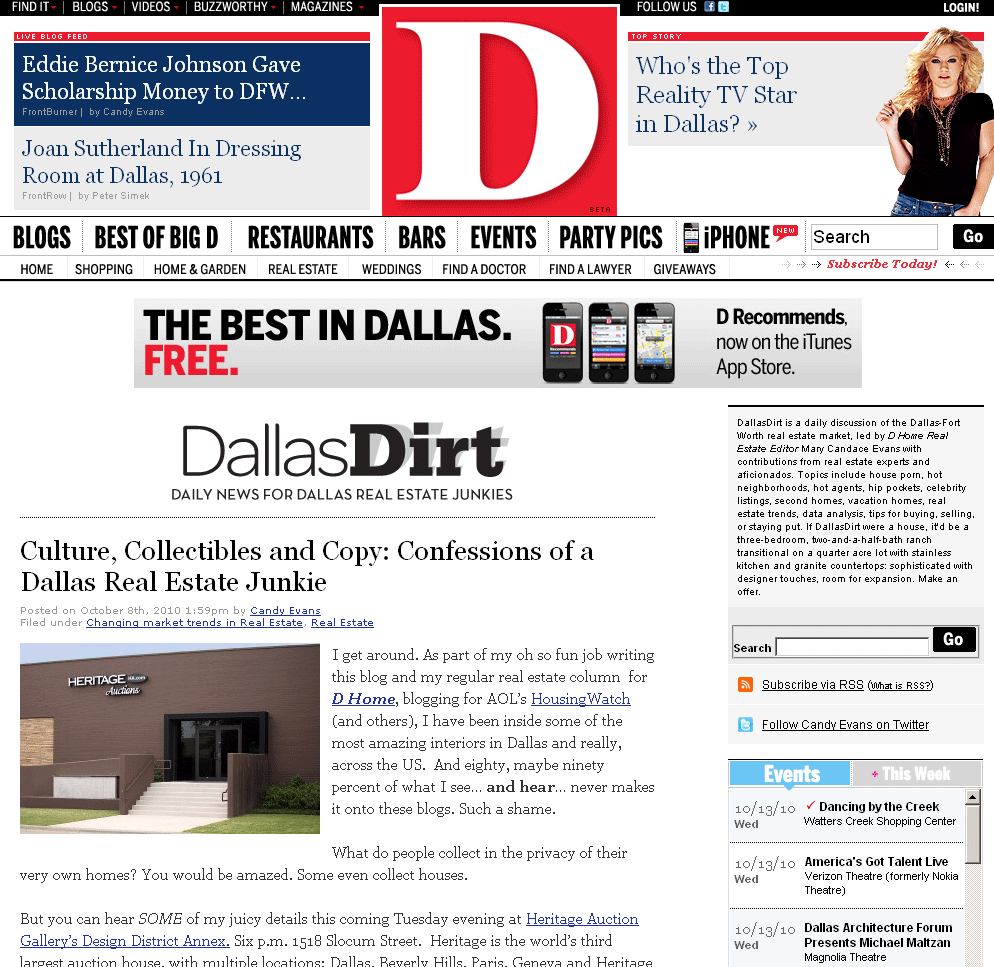
An evening at Heritage Auction Galleries allowed the opportunity to preview a number of items from upcoming auctions including Modern & Contemporary Art, October 27; Decorative Art & Design November 9 and Art of the American West and Texas Art November 20. The 2nd Tuesdays at Slocum Event featured a talk by the entertaining D Magazine Real Estate Blogger Mary Candice Evans.
Despite the vibrant personality and entertaining descriptions of Dallas homes, the promotion for the talk which was billed as “Culture, Collectibles & Copy: Confessions of a Dallas Real Estate Junkie,” there was little about culture or collectibles in the presentation. The whole talk just reinforced my notion that the bulk of things purchased in Dallas are for the purpose of decoration and not out of any great love for those objects.
Most of the homes in the presentation were of the monster house sort, and the flyer that was laying on every seat did mention Evans belief that you can never be too thin, too rich or have too many houses. Maybe its true that the upper stratosphere of income earners or just haver’s hasn’t been impacted by the recession, but I have to imagine even here there are a lot of homes that can’t be sold easily.
Evans also mentioned she didn’t believe the average size of the house was getting smaller. To paraphrase she said “they say that every time there is a recession.” Perhaps they say it, but census data has not recorded a drop in average house size since the 1980s. Then it was because families were getting smaller, now its because people want greener and more urban homes.
In my view one of the biggest problems in the art and antiques market has to do with real estate. As one shop owner in Dallas explained to me recently, “the builders aren’t building and the decorators aren’t decorating.” Beyond that, the average size of the American house has continued to get larger for the most part since the 1940s and with that an ever increasing portion of incomes has gone into our homes. The very wealthy may be free of the rigors of working longer hours to pay for those homes, but for most the extra time needed to make more money to afford the monster homes has cut into leisure pursuits like antiques collecting. You’d think a big house could accommodate more antiques, but the quality sometimes goes down when the space increases, and in the case of the money is no object people with instant collections from decorators, you get a look, but the collections rarely outshine that look. [hear a podcast John McIlwain: "The Death of the Monster House"]
To me, the world Evans described is what’s been wrong in America for several decades. We want what we want now and we don’t want to have to work up to that (or in the case of antiques, look for it and learn about it). Our first house was too often one bigger than the third or fourth home of our grandparents. They traded up, we bought on credit. They won, we lost. The antiques world isn’t in disarray because the wealthy stopped buying and collecting, its because the middle class stopped buying and collecting. The conventional 30 percent of income that can be spent on housing before a household can be considered burdened has shot past 50 percent in some cities.
It reminds me that some of the wealthiest people, Warren Buffet who still lives in the same house he purchased long ago for $31,000 and Mayor Bloomberg who has been wearing the same two pairs of work loafers for a decade, do not pursue better, bigger, more now, at least not in their personal lives. They love the work, not the money. It also reminds me of the tour I took of the Johnny Mercer House in Savannah. The docent relayed a story about a visitor who noticed some frayed fabric on a chair and relayed to Jim Williams that she guessed he was old money from that sign. “New money would have it repaired immediately, old money would leave it as it is.” Williams could in fact have been described as “new money,” but was an antiquarian at heart.
I have a photo of an interior of a non-descript brick Cape Cod somewhere in the upper Midwest. The home is clean and classic and not much to speak of in itself, but it’s decorated with carefully-selected antiques. Obviously not the work of a decorator, and obviously not a collection that arrived one afternoon. I have no idea who lived here, but I’ve saved it because it struck me as the home of a person who appreciates life, and appreciates art, not the constant pursuit of thinner, richer and more now.


Recent Comments