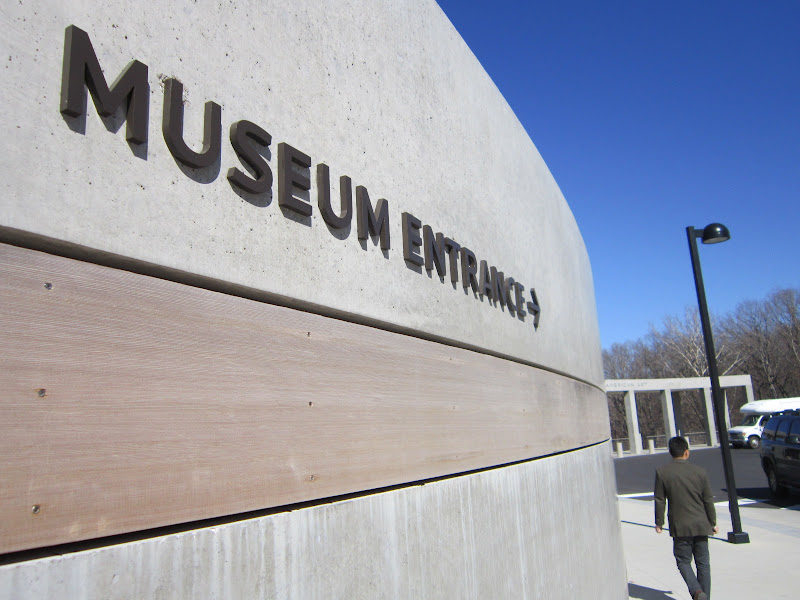
Tag: Crystal Bridges
Fisk and Crystal Bridges Agree on Sharing Stieglitz Collection
The battle over the art collection at Fisk University in Nashville is over. Crystal Bridges Museum of American Art announced moments ago that it will remain intact and be viewed, appreciated, and studied by a wide public audience because a long-term collection-sharing relationship has been finalized between Crystal Bridges Museum of American Art and Fisk University. The agreement for sharing the Stieglitz Art Collection, which, according to the New York Times, gives the University $30 million for the right to display the collection every two years, was bequeathed in 1949 by artist Georgia O’Keeffe to Fisk University. Crystal Bridges Museum of American Art and Fisk University each now own a 50 percent interest in the collection, which will be exhibited at both institutions at rotating two-year intervals. The agreement will allow the works to remain on display at Fisk for two uninterrupted years out of every four, thus allowing every Fisk student the opportunity to view or study the artwork for a period during the student’s academic career. Victor Simmons, Director and Curator of the Fisk University Galleries, said in a press release, “Alfred Stieglitz spent much of his life advocating and supporting American art, including the support of American artists such as Georgia O’Keeffe, Marsden Hartley, Arthur Dove, John Marin and Charles Demuth, among many others. I can think of no better place for the art to be exhibited, while away from Fisk, than in a museum of such quality and as dedicated to American Art as is Crystal Bridges.”
One Measure of a Great Portrait, Eakins at Crystal Bridges
It may not have been the first choice for a major work by Thomas Eakins to adorn the walls of the Crystal Bridges Museum in Bentonville, Arkansas. That of course was The Gross Clinic which shows Dr.Samuel D. Gross, a seventy-year-old professor dressed in a black frock coat, as he lectures a group of Jefferson Medical College students.
While The Gross Clinic shows a scientific medical procedure in a grand manor, the Portrait of Professor Benjamin H. Rand at Crystal Bridges Museum of American Art portrays the subject, not primarily for achievements and occupation, but as a person well known by and admired by the painter. Continue Reading »
Prelude to Posts on Crystal Bridges
The Crystal Bridges Museum of Art is more than I expected. While I expected to see great things, the assemblage of American Art is an outstanding achievement. Many of the paintings that line the walls of the Moshe Safdie-designed buildings are exceptional examples of works both of the period, and of the particular artist. That’s what I didn’t expect. I expected any collection spanning the history of American Art assembled recently would have a few landmark pieces, like Durand’s Kindred Spirits, and a lot of works by important artists that maybe aren’t so important. These are, after-all, hard things to collect, even with the power that comes with lots of money. There’s no want for quality, however. Continue Reading »
$20 Million Donation from Walmart Makes Crystal Bridges Admission-Free

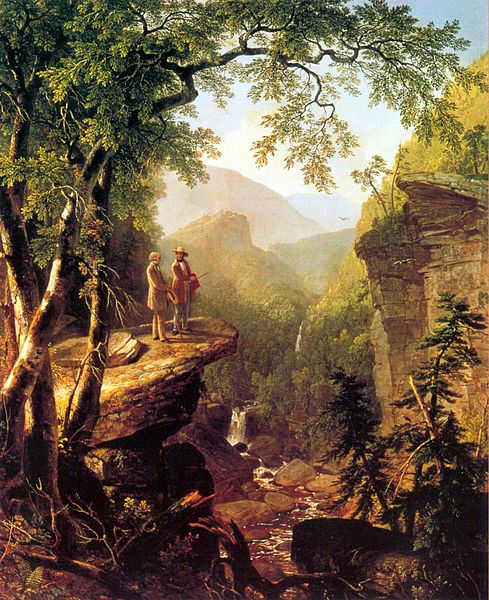
Asher B. Durand's Kindred Spirits
Crystal Bridges Museum of American Art today announced a $20 million grant from Walmart to cover admission fees for all visitors. Prior to the grant, a $10 admission fee was being considered for adults.
“While saving people money is how we make people’s lives better every day, we realize that things like listening to your favorite song, seeing a beautiful painting or laying eyes on an amazing sculpture make our lives better, too,” said Walmart president and CEO Mike Duke. “We are excited about the cultural opportunities Crystal Bridges is bringing to our area and even more excited that our families, friends and neighbors will experience it at no cost.”
“One of the greatest challenges for museums today is finding ways to remove barriers to community participation, including admission charges,” said Don Bacigalupi, Crystal Bridges executive director. “Walmart has shown extraordinary vision and foresight in funding access to the museum, providing all that Crystal Bridges has to offer to all people at no cost. We know that this gift will allow the museum to become a daily resource in our community.”
Given over a period of five years, the grant is the first gift dedicated to the museum’s newly created Next Generation Fund which addresses the economic, social and cultural barriers that often prevent diverse audiences from participating in the arts.
“The arts should be an essential part of every child’s education,” First Lady Ginger Beebe said. “When Crystal Bridges opens on 11-11-11, it will be an incredible resource, and now it will be free to all who visit. The outstanding art found there will encourage young people by expanding their creativity, giving them an invaluable outlet for self-expression, and helping to develop greater artistic literacy.”
Philadelphia Museum of Art on an Acquiring Spree

Monet's Path on the Isle of Saint Martin
Crystal Bridges isn’t the only museum acquiring these days, and some of the art is traveling north. The Philadelphia Museum of Art announced recently it has acquired three important French Impressionist paintings by Claude Monet, Camille Pissarro, and Alfred Sisley, and a pastel by Mary Cassatt, the Pennsylvania native and American expatriate who became famously associated with Paris during the late 19th century. All of the works are gifts from Chara C. and the late John Haas, longtime supporters of the Museum. They include Path on the Island of Saint Martin, Vétheuil (1881) by Claude Monet (French, 1840-1926); Apple Tree in the Meadow, Éragny (1893) by Camille Pissaro (French, 1830-1903); Mooring Lines, the Effect of Snow at Saint Cloud (1879) by Alfred Sisley (French, 1839-1899); and Madame Bérard’s Baby in a Striped Armchair (1880-81) by Mary Cassatt (American, 1844-1926). The Monet and the Pissarro have now been placed on view in gallery 152, while the Sisley hangs in gallery 157 and Cassatt’s pastel can be seen in gallery 162.
“With these remarkable gifts, John and Chara Haas have greatly enriched the Museum’s collections,” said Timothy Rub, The George D. Widener Director and CEO, “adding strength to the Museum’s extensive holdings of Impressionist art and enabling us to present a more complete picture of these artists’ remarkable achievements. We are deeply grateful to John and Chara Haas, who now join the many great collectors whose gifts have made the Philadelphia Museum of Art a major destination for art enthusiasts from around the world.”
“We are delighted to have these four works, which expand and enhance our rich Impressionist holdings with a radiant landscape by Monet created during the years he spent in Vétheuil in the late 1870s and early 1880s, a period that has not been represented in our collection, a remarkably fresh and beautifully painted winter scene by Sisley, a handsome landscape that Pissarro painted at his home in Éragny, and a charming pastel portrait of the young Lucie Bérard by Mary Cassatt,” said Joseph Rishel, The Gisela and Dennis Alter Senior Curator of European Painting before 1900, and Senior Curator of the John G. Johnson Collection and the Rodin Museum.
Monet’s Path on the Island of Saint Martin, Vétheuil (1881)is a colorful view of the fields near the village of Vétheuil on the north bank of the Seine, where Monet moved with his family in 1879. During the summer of 1881, Monet painted lush views of the town from the island of Saint Martin as his pictorial style evolved from the blunt, broad strokes of the 1870s to the delicate, rhythmic brushwork of Path on the Island of Saint Martin. This is the first work from Monet’s Vétheuil period to come into the Museum’s collection, and its presence will enable visitors to understand the development of the artist’s work during this important time in his career.
Apple Tree in the Meadow, Éragny (1893) captures the fields and gardens around Camille Pissarro’s (French, 1830-1903) home in Éragny, a small village about 90 miles northwest of Paris. This focused study joins four other views of the Pissarro home in the Museum’s collection from earlier years. A view of the meadow adjacent to Pissarro’s house (the brick building visible on the left), it is marked by the strongly-patterned brush and palette knife work common in the artist’s paintings of the 1890s and clearly demonstrates the influence that the work of the Post-Impressionist painter Georges Seurat (French, 1859-1891) had on Pissarro’s work during this period.
Alfred Sisley, an Impressionist landscape painter well represented in the Museum’s collection, painted Mooring Lines, the Effect of Snow at Saint Cloud (1879) while living to the west of Paris. Of particular note is Sisley’s dramatic treatment of the winter view in which the snowy river bank is animated by the mooring lines that secure an unseen barge to the bank of the river. Sisley was widely admired for his skillful renderings of winter scenes. Here the sky and the fugitive effects of light and weather are depicted here in nuanced tones of white and blue.
Mary Cassatt achieved remarkable success as a woman working in a field almost entirely dominated by men. Several of her sensitive portraits depicting family scenes and her nieces and nephews are in the collection at the Museum, including Portrait of Alexander J. Cassatt and His Son, Robert Kelso Cassatt (1884) and A Woman and a Girl Driving (1881). Madame Bérard’s Baby in a Striped Armchair, a portrait of 9-month-old Lucie seated on a vibrant blue striped chair, demonstrates the artist’s mastery of the pastel medium by the early 1880s. The brilliant use of red and blue in the background offsets the child, who is dressed in a formal white gown. Cassatt’s assured and sensitive handling of her young subject is particularly apparent in the modeling of Lucie’s moving hands.
Several other acquisitions have been reported. According to Philly.com, the museum also acquired Daniel Garber’s Tanis (1915), a portrait of the artist’s 8-year-old daughter. The painting had been in the collection of the Westervelt-Warner Museum of American Art in Tuscaloosa, Alabama and was acquired via a private sale. The paper reports the Westervelt Corp., owner of the collection, is selling about 50 of its most prominent holdings.
NY Masterworks Help Celebrate 50 Years of Art at the Amon Carter
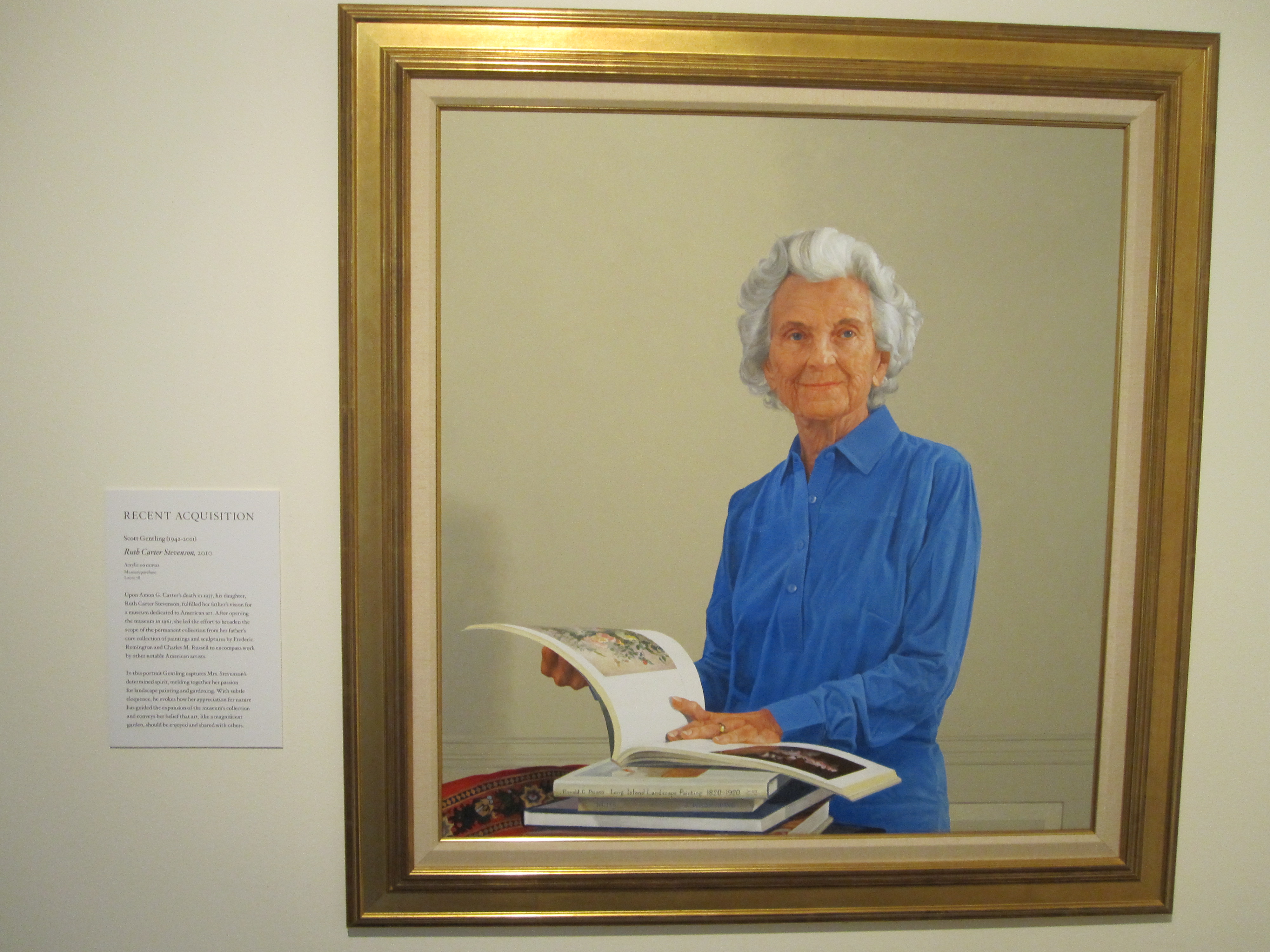
On the way in to preview what is likely a once in a lifetime opportunity to see masterworks from the New York Historical Society in Fort Worth, I noticed a portrait of Amon Carter by portrait artist Scott Gentling had been moved. Adjacent to it now hangs a portrait of Ruth Carter Stevenson by the artist. It seems appropriate given her contribution to the museum as it stands today.
According to a Star-Telegram article from earlier this year, “the Remingtons and Russells had been collected by her father, the museum’s famous namesake, but almost every other piece was either selected or approved for purchase by Stevenson herself.”
The portrait artist died earlier this month at the age of 68.
If you haven’t been to the Amon Carter in a while, it’s a particularly good time to go. In celebration of the Amon Carter’s 50th Anniversary, joining the masterworks collected by Amon Carter and Ruth Carter Stevenson is a portion of the permanent collection of the New York Historical Society including Thomas Cole’s Course of Empire. Joining them is Kindred Spirits, a monumental painting which once hung in the New York Public Library but will soon move to its new home in the Crystal Bridges Museum in Bentonville, Arkansas.
The paintings from the New York Historical Society have only left the gallery in New York on one or two occasions previously and are only making rounds to a select number of destinations now because the facility in New York is being renovated. On November 11, 2011, or if you prefer 11/11/11, the Course of Empire will be back in the Empire City and Kindred Spirits will be at home in Arkansas.
Vice President and Senior Art Historian of the New York Historical Society Linda Ferber joined Rebecca Lawton, curator of paintings and sculpture at the Amon Carter February 24th to discuss the exhibition with museum docents.
Ferber presented the paintings as beautiful artwork, but also as historical documents. more than any other form of art, referring to this not as art and history, but in terms of production and reception. We often talk about art in terms of history, but sometimes intentionally or unintentionally indicate the history is somehow secondary to the art. Ferber’s terms make sense and serve to elevate the history. “Production” in this case refers to the artist and the activity of creating art. “Reception” refers to how the artwork was received by the patrons and the public, and that’s the important part to social history.
In those terms there’s a lot to be learned from these paintings and knowing something about the reception improves our appreciation of them as objects of beauty. The attitude toward nature in 19th Century America is one aspect. Ferber says landscape paintings reached the greatest number of citizens at the time, more than any other genre.
Then there are the historical specifics of the paintings. Durand’s Kindred Spirits for example was created as a memorial to Thomas Cole. It shows Cole and poet William Cullen Bryant communing in the Catskills. Ferber points out that while Cole and Bryant are often discussed in relation to the painting, it was Durand who created the scene.
It’s also important not to discount the role of patrons.
Specifically mentioning Cole’s dislike of cities (this brought to mind Frank Lloyd Wright), Ferber notes Cole couldn’t have excelled without them. Cities were necessary both for the patrons and their sources of wealth, but for his art supplies.
Kindred Spirits was commissioned by New York art collector Jonathan Sturges as a gift to Bryant. Its title was inspired by John Keats’ Sonnet to Solitude. Bryant’s daughter Julia donated the painting to the New York Public Library in 1904.
Lawton notes the paintings are arranged in the galleries as an American Grand Tour, beginning in New York and moving up the Hudson River. At the other end of the exhibition is Cole’s Course of Empire. Ferber notes one of the five paintings titled Destruction has taken on a whole new set of receptive notions following the events of September 11, 2001. While Grand Tours in America focused on natural wonders, it’s worth noting here that Grand Tours in Europe often involved viewing ruins of civilizations which had reached the Desolation stage, shown in the fifth painting in Cole’s series.
When the works were completed, the story of the rise and fall of great empires was well-known, the question was if a Christian Democratic Republic could avoid the same conclusions, or as we say today, be sustainable.
These are questions that are likely to linger beyond our own time, as will the greatness of these works. Our moments are fleeting and we are lucky not only to have this collection of masterworks spending time in Texas, but displayed here with Kindred Spirits.
The exhibit opens February 26.
Hudson River Runs Through Texas
![Asher B. Durand, Kindred Spirits Asher Brown Durand [Public domain], via Wikimedia Commons](http://upload.wikimedia.org/wikipedia/commons/9/9e/Asher_Durand_Kindred_Spirits.jpg)
One of the most treasured paintings in American art, Kindred Spirits (1849) by Asher B. Durand, will be on view at the Amon Carter Museum of American Art this spring. The painting, on loan from the Crystal Bridges Museum of American Art (Bentonville, Ark.), will hang concurrently with the museum’s special exhibition, The Hudson River School: Nature and the American Vision, from February 26–June 19, 2011. Admission is free to the museum and the special exhibition.
Beginning in the 1820s, the American landscape became a significant theme for artists who traveled up the Hudson River from New York City to sketch the rugged mountains and tranquil valleys along its banks. With the noted landscape painter Thomas Cole as their inspirational leader, these artists gave impetus to the first self-consciously “American” vision for landscape painting, a movement that would become known as the Hudson River School.
In Kindred Spirits, Durand, a Hudson River School artist, depicts Cole with his close friend and colleague William Cullen Bryant, the esteemed poet and editor. The painting was commissioned by art patron Jonathan Sturges as a tribute to Cole following his death in 1848 at age 47. Invoking John Keats’ “Sonnet VII,” Durand portrays Cole and Bryant together as “kindred spirits” in the landscape. After the painting was complete, Sturges gifted the work to Bryant.
In 1904, Bryant’s daughter Julia gave Kindred Spirits to the New York Public Library in Manhattan, where it hung on public view for more than a century before being deaccessioned and acquired by the Crystal Bridges Museum of American Art.
In addition, the Amon Carter Museum of American Art presents The Hudson River School: Nature and the American Vision, organized by the New-York Historical Society (New York, New York) beginning February 26. Undergoing a comprehensive renovation, the New-York Historical Society is sending nearly 50, 19th-century landscapes on a journey across the nation, and the first stop is Fort Worth. The special exhibition is on view at the Amon Carter through June 19.
Leading figures of the Hudson River School are represented in the exhibition, including Cole, Frederic Edwin Church, Jasper Francis Cropsey, Asher B. Durand, George Inness and John Frederick Kensett, among others. Arranged thematically, the exhibition illuminates the sites that artists depicted as resources for spiritual renewal, as well as potent symbols embodying powerful ideas about nature, culture and history.

The highlight of the exhibition is the section Grand Landscape Narratives, featuring Cole’s monumental five-painting series The Course of Empire (ca. 1834–36). Charting the cyclical history of an imaginary nation, the paintings are breathtaking in their wealth of detail from the initial scene of hunting in the wilderness to the concluding panel portraying the aftermath of an empire ravaged by its own decadence and corruption.
“It’s quite a privilege to have these magnificent Hudson River School paintings in Fort Worth, and museum visitors should definitely take advantage of seeing them,” says Rebecca Lawton, curator of paintings and sculpture at the Amon Carter. “It’s very likely they won’t be on view in Fort Worth again in our lifetimes.”
Nature and the American Vision will also travel to the Peabody Essex Museum, Salem, Mass. (July 30–November 6, 2011); the Columbia Museum of Art, Columbia, S.C. (November 17, 2011–April 1, 2012); and the Crystal Bridges Museum of American Art, Bentonville, Ark. (May–August, 2012). The paintings will then return to their renovated home at the New-York Historical Society.
Additional works by Hudson River School artists, such as Cole, Frederic Edwin Church, Jasper Francis Cropsey and George Inness, are on view in the Amon Carter’s permanent collection throughout the year.
Moran’s Pennsylvania Valley Goes To Crystal Bridges
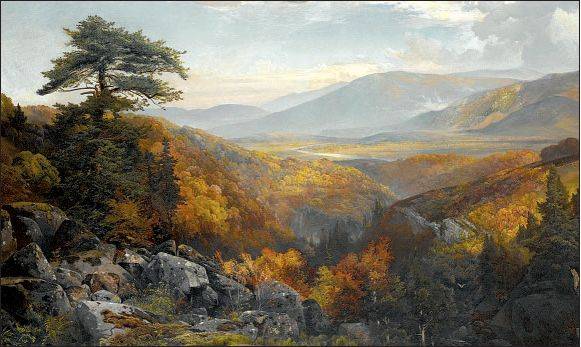
Yesterday, Alice Walton announced another addition to Cristal Bridges’ permanent collection. “Autumn Landscape” by Thomas Moran was bought by the previous owner, Bernice Jones, in an estate sale in Chicago for decorating her husband’s office. She didn’t know who the painter was when she bought it and was apparently was attracted by the eastern Pennsylvania valley scene where expansive rolling hills are always spectacular in autumn. From a recently trip to Western Pennsylvania, I would guess it could be from Bethlehem or Easton area.
From the picture shown in their website, it is a great example of Hudson River school, yet it is probably a more moderated and restrained work by Moran, possibly dated to his early career. In his large scale paintings of American West dated 1870′s, the sky and the rocks convey such brutal force that can hardly be rationalized or imagined in the east coast. Although Jones only paid $500 for the “unknown” painting (a great bargain for a canvas of 40 inches tall and 63.5 inches even if it were not by Moran), the purchase price by Crystal Bridges has not been disclosed.
At the time when New York art institutes such as the Brooklyn Museum, Guggenheim and the Met all cut their staff, Crystal Bridges of American Art is quietly growing bigger, assembling some of the best American works in a town of approximately 20,000 people. (The metro region has about 400,000.) The Met still proudly hangs Asher Durand’s famous “Kindred Spirits” in their American Wing, but it will be returned to Bentonville, AR before the completion of American Wing in 2011. Walton defended the question of amassing art collection in Northern Arkansas by saying “Why not? After all, this is the heartland of America.” But would people fly to the heartland? Without visitors, those pictures are not much different from Ikea wall art except with higher price tags.
Come and Go —- Thoughts About the Recent Acquisition and Deaccession
Museums are always collecting. I have found a tea pot in the Brooklyn Museum which was produced in the 1990’s for Target stores. Based on my observation, today major traditional American institutions mostly concentrate the contemporary arts. Such practice is NOT because they have changed their directions; on the contrary it is the direction that they have always been following: collecting contemporary art. By committing collecting arts through the times, they’ve shaped the aesthetic tastes of the public and quietly assembled works when they were still affordable.
That is not the case for Crystal Bridges Museum of American Art, founded by Alice Walton. No major American art museums will feel its 19th century collection complete without paintings by Hudson River school artits, early portrait painters like Copley, Stuart or Peale. The same can be said for works by Andy Warhol or Edward Hopper to lead the 20th century collection. But without years of primary collecting, Crystal Bridges has to start from scratch for everything.
Last Friday’s press release showed that Francis Guy’s “A Winter Scene in Brooklyn” was the museum’s latest acquisition. The painting was exhibited in the Brooklyn Museum in 2006 along with their own version. Possibly painted by Francis Guy’s last year, the two were almost identical except the one in Brooklyn Museum lost about 2 feet on the left side due to a fire. It was said that the one bought by Alice Walton once had a painted balustrade along its lower edge but was trimmed for unknown reasons. If so, the feature that evoked the artist’s window ledge would surprise all those 20th century artists who claimed inventing more naturalistic or accidental cropping compositions. At a time when there is no nationally recognized style or high demand for landscape paintings, Guy, trained as a tailor and silk dyer, painted his window scenes no less than five times.
I am personally not a fan of Francis Guy. His paintings have tremendous historical value for sure. “Tontine Coffee House” in New York Historical Society, painted in 1797 tells a vivid story how Wall Street came into being. The village scenery of Front Street and Fulton Street, long disappeared after the completion of the Brooklyn Bridge, provided scholars of the architectural, economic, social and ethnic views of Brooklyn in 1820. Guy, like other early landscape painters, has a peculiar detail-oriented tendency. The dramas, anecdotes, and humors were found here and there in carefully arranged objects and humans to provide a narrative sub context. If Hudson River School is going to be blamed for their tedious copy of nature, Guy, their predecessor, showed an amateurish understanding of naturalism by giving everything sharp edges.
But the painting does have its charm. Instead of looking from the far back to grasp the magic light in Durand’s landscape, one is enticed to get as close as possible to examine the daily life of the people in Guy’s “A Winter Scene in Brooklyn”. (About 40 names of the houses, stores, shops or people are identified in Guy’s painting! Don’t forget to look at the person on the chimney!)
But I would doubt such findings as the black person’s name is Samuel Foster would have the same “wow” effect in Bentonville, AR. A Winter Scene in Brooklyn is essentially Brooklynite. For those people who jog on the promenade and wonder why there are so many Asian wedding photo sessions under the Brooklyn Bridge, the painting reminds them of Brooklyn, although it has become much bigger and more diverse, it still holds a home feeling. The visitors to Crystal Bridges may successfully identify the painting as a primitive landscape, yet they would not have the chance to hop on the subway from the museum and get off at Clark Street and overcome all the obstacles now blocking the ferry to see what it’s like now and thus deeply appreciate the genius of Francis Guy.
The deaccession at the National Academy (NA)seems to be related to Crystal Bridges too. News broke out that Nation Academy sold two important paintings (one by Church, one by Gifford) from their permanent collection to pay their bills. Where the two paintings went has yet to be revealed, but the disclosure of selling works reminds New Yorkers of the outcry of the public when New York Public Library sold Kindred Spirits by Durand to Crystal Bridges Museum.
I have been to National Academy for both visiting exhibition and doing research. They do have an extensive permanent collection since every new academician is supposed to submit a diploma painting. But they don’t have a permanent place to exhibit them. Their permanent collection thus is most likely to be in the storage. This coming February, NA will have an exhibition to highlight some of their permanent collection. I agree with Eric that it is better to show artworks in public regardless of the location than store them in the dark room.
National Academy also mentioned that these two paintings were not diploma works but were donated by another member. This statement, in my mind, neither legitimizes nor invalidates their deaccession activity. Just because it is donated does not make a painting less important or less valuable. Ethnically, selling donated objects (more common in Natural History Museums nowadays because some donors insisted to donate their whole collection in the past) is in general against the donor’s intention. The donor of the two paintings must have regarded NA the most proper organization to place the asset. On the other hand, legally it is up to the museum who determines how to dispose the artworks when they do not want to show them permanently. I hope that the original donor would be happy to know that sometime soon the two paintings would be hung publicly.
My two cents: Don’t blanketly donate artwork to museums, at least not in unrestricted terms. They have thousands of objects collecting dust in the darkness for years. Why bother another one?
Thoughts on Crystal Bridges
Now there’s some speculation that Alice Walton, already the possessor of Durand’s Kindred Spirits, has bought two paintings from the collection of the National Academy. On an emotional level, it’s sad to see them leave New York. From a practical point of view, I’d say a painting on display in Arkansas is better than one stored in New York.
I hope that a new administration will help bring some renewed pride in America and interest in objects and paintings from the first century of our existence. We need the likes of Alice Walton, like Ford, Rockefeller, Hogg and DuPont before her, to breath new life and interest to American Art and Decorative Arts. I hate seeing our great collections of American Art overlooked. Nature hates a vacuum and the vacuum that New York creates, Arkansas fills.


Recent Comments