Tag: Hide/Seek: Difference and Desire in American Portraiture
What’s Up and On in New York City

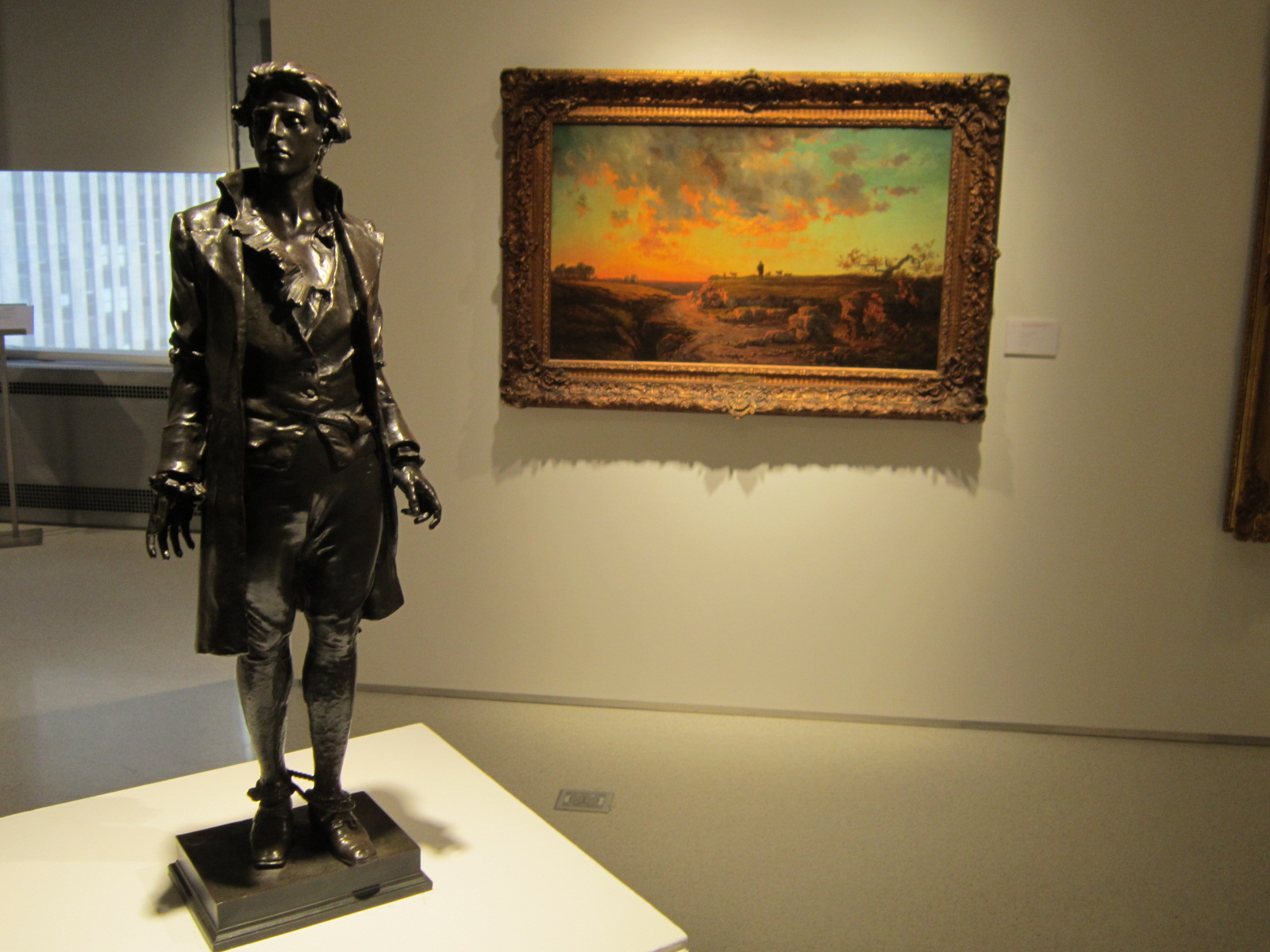
There's a bronze of Nathan Hale similar to this one on display at Christies in the Brooklyn Museum.
Three paintings by George Inness traveled to Philadelphia before I did. I met them on the 20th Floor of a building in Rockefeller Center during an American Art preview at Christie’s. Normally they would have been in the ground floor showrooms, but those were taken. Elizabeth Taylor’s jewelry is moving in. It will be available for preview December 3rd.
The Philadelphia Museum of Art consigned the paintings when it announced the purchase of the 1819 work by Charles Willson Peale of Yarrow Mamout. It’s always somewhat sad to see works leave museums, but I understand a portrait of an African-American by Peale is an exceptionally rare object. The other painting that seemed to stand out in the sale is a large portrait by William Merritt Chase. This Portrait of a Lady was a gift from the sitter, Eldridge Reeves Johnson, to the consignor. It’s one that should find its way into a museum.
Speaking of Museums, there’s much anticipation about the upcoming Duncan Phyfe Show at the Metropolitan Museum of Art. My New York friends were all talking about the article in the November/December Magazine Antiques. It’s also the most widely-read article on AmericanaWeek.com. I paid a visit to an art conservator in Brooklyn and couldn’t help but noticing a partially covered table-top. Sure enough it’s destined for the show and is pictured in the Magazine Antiques article.

- This chair by Duncan Phyfe is part of the 19th Century Modern exhibit at the Brooklyn Museum
The Brooklyn Museum was another stop, and on the trail of Phyfe there’s a chair currently on display in an exhibit dubbed 19th Century Modern, which traces modernism not to clean lines, but to the dawn of the machine age. It’s one of several spectacular exhibits there now including Youth and Beauty, the Art of the American 20s and HIDE/SEEK: Difference and Desire in American Portraiture. That’s the one that caused such an uproar at the Smithsonian because of a film that showed ants crawling on a crucifix. I personally found the video “A Fire in My Belly” by artist David Wojnarowicz so boring I couldn’t sit long enough to see the ants. My favorite painting was probably one of an aging ballerina by Ivan Albright. I immediately recognized his work from the piece at the Art Institute of Chicago. I also learned about the relation between Ivan and Madeleine.

There was also time to make a trip back to the Brooklyn Flea as it returned to the gilded banking cavern at One Hanson Place. And to Manhattan to see an exhibit of the work of Sarah Lamb, which while modern would fit into an antiques show well. Lamb paints still life including weather vanes, fruit and some irresistible olives. This exhibit traveled to Spanierman Gallery after a show at the New Britain Museum of American Art.
Work Asked to be Removed from Smithsonian Exhibit in Protest
The Washington Post reports that Canadian artist AA Bronson has asked the National Portrait Gallery to remove a major work of his to be withdrawn from the Smithsonian exhibition, “Hide/Seek: Difference and Desire in American Portraiture.”
The request is a protest of the removal of a controversial video by the late artist David Wojnarowicz that included 11 seconds of footage of a Crucifix crawling with ants. The work by Bronson is a mural-size color photograph titled “Felix, June 5, 1994″, showing the corpse of the artist’s partner Felix Partz, lying in bed only minutes or hours after his death caused by AIDS.
“As an artist who saw first hand the tremendous agony and pain that so many of my generation lived through, and died with, I cannot take the decision of the Smithsonian lightly. To edit queer history in this way is hurtful and disrespectful,” the artist wrote in an email to Martin Sullivan, the director of the National Portrait Gallery.
The Post reported is a separate item that objections to the work removed initially from two powerful Republicans, John Boehner (R-Ohio) and Eric Cantor (R-Va.), and noted the Congress controls 70 percent of the Smithsonian’s budget.
See the article in the Washington Post.


Recent Comments