Tag: James Peale
Rare Still Life by Duncanson Enters Collection of National Gallery of Art
The National Gallery of Art has acquired one of fewer than a dozen known still lifes painted in the late 1840s by African American artist Robert Seldon Duncanson (1821–1872). Classically composed, Still Life with Fruit and Nuts (1848) depicts fruit arranged in a tabletop pyramid in which the smooth surfaces of beautifully rendered fruit contrast with textured nutshells. The acquisition was made possible with funds from Ann and Mark Kington/The Kington Foundation and the Avalon Fund.
Measuring just 12 x 16 inches, Still Life with Fruit and Nuts is on view in an intimate room (Gallery M-69A) of the American collection alongside other still-life works by such American artists as Joseph Decker, William Michael Harnett, Martin Johnson Heade, James Peale, Raphaelle Peale, and John Frederick Peto. Like Duncanson’s other still lifes, it is spare and meticulously painted, reflecting the tradition of American still-life painting initiated by Charles Willson Peale and his gifted children—particularly Raphaelle and Rembrandt Peale.
Self-taught and living in Cincinnati when he created his still-life paintings, Duncanson exhibited several of them at the annual Michigan State Fair. During one such exhibition, a critic for the Detroit Free Press wrote, “the paintings of fruit, etc. by Duncanson are beautiful, and as they deserve, have elicited universal admiration.” The artist’s turn from still-life subjects to landscapes conveying religious and moral messages may have been inspired by the exhibition in Cincinnati of Thomas Cole’s celebrated series The Voyage of Life (1842). Cole’s allegorical paintings were purchased by a private collector in Cincinnati and remained in the city until acquired by the National Gallery of Art in 1971. Exposure to Cole’s paintings marked a turning point in Duncanson’s career. Soon he began creating landscapes that incorporated signature elements from Cole and often carried moral messages. Visitors can also see The Voyage of Life in the American galleries, not far from Duncanson’s painting.
Following the outbreak of the Civil War, Duncanson traveled to Canada, where he remained until departing for Europe in 1865. Often described as the first African American artist to achieve an international reputation, Duncanson enjoyed considerable success exhibiting his landscapes abroad. His achievement as a still-life painter has only recently garnered attention. The exceptional quality of Still Life with Fruit and Nuts suggests that much remains to be learned about this little-known aspect of his career.
PAFA Strengthens Its Renowned Collection of American Art
The Pennsylvania Academy of the Fine Arts (PAFA) has stepped up its efforts to expand and diversify its renowned collection of American art. The strategic plan, approved by PAFA’s Board of Trustees, calls for the growth of the collection through gift and purchase to fill gaps, including improving its holdings of Hudson River School artists, selected movements in 20th-century art, and contemporary art. In addition, PAFA seeks to add greater representation of works by women and African Americans.
“We are very excited about the focused attention we are placing on the development of PAFA’s already renowned collection of American art,” said David R. Brigham, PAFA President and CEO. “Recent acquisitions will enable us to more fully tell the story of American art and culture.”
Recent artwork purchased to begin addressing the strategic collecting initiative include Lilly Martin Spencer’s Mother and Child by the Hearth (1867), Philip Evergood’s Mine Disaster (1933), Dorothea Tanning’s Midi et Demi (Half past Noon) (1956-57), Norman Lewis’s Redneck Birth (1961), Nancy Spero’s At Their Word (The Sick Woman) (1957-58), The Great Mother, (1960) and The Bug, Helicopter, Victim (from her War series) (1966), Mickalene Thomas’s, Din Avec la Main Dans le Miroir (2008), Odili Donald Odita’s Future Perfect (2009), Mark Bradford’s Untitled: [Dementia] (2009).
PAFA’s purchases are being paid for by a combination of proceeds from endowment funds restricted for art acquisition and proceeds from deaccessioning. Five paintings from the collection have been sold to help fund the Collecting Plan: Autumn Still Life by William Merritt Chase (sold by Avery Galleries), Flowers (1893) by John H. Twachtman (sold by Menconi & Schoelkopf), Looking over Frenchman’s Bay at Green Mountain (1896) by Childe Hassam (sold by Avery Galleries), Bathers in a Cove (1916) by Maurice Prendergast (sold by Menconi & Schoelkopf), and Great White Herons (1933) by Frank Weston Benson (sold by Menconi & Schoelkopf).
Proceeds from these sales total approximately $5 million and are restricted to the purchase of works of art, in accordance with PAFA’s Collection Policy, which adheres to the professional standards of the American Association of Museums (AAM) and the Association of Art Museum Directors (AAMD).
Works were chosen for deaccessioning through a systematic and comprehensive review of the collection, conducted by President and CEO David R. Brigham, Ph.D., and PAFA’s curators and conservator. In each case, the artists of deaccessioned works are represented in PAFA’s collection by more important examples and/or ones that relate better to core works in the permanent collection. The recommended works were reviewed by independent curators, scholars and PAFA’s Collections Committee and approved for sale by the Board of Trustees.
James C. Biddle, Chair of PAFA’s Collections Committee, remarked: “PAFA’s staff and Board have made an extremely thoughtful and responsible decision in deaccessioning these paintings. Working towards the goal of strengthening the Academy’s collection where needed, the sale of the paintings by artists who are represented in the collection by more significant works, will enable PAFA to make future noteworthy and necessary purchases.”
PAFA’s Board has also approved the sale of five additional works: Girl at Piano (ca. 1887) by Theodore Robinson (consigned to Menconi & Schoelkopf), Top of Cape Ann (1918) by Childe Hassam (consigned to Menconi & Schoelkopf), The Turkey (1927) by Arthur B. Carles (consigned to Menconi & Schoelkopf), Peggy’s Cove, Nova Scotia (1924) by Ernest Lawson (consigned to Menconi & Schoelkopf), and Still Life #1 (1827) by James Peale (consigned to Avery Galleries).
PAFA has also successfully attracted a number of important gifts that further support the Collecting Plan, most notably the remarkable recent gift from Linda Lee Alter of 400 works by such women artists as Alice Neel, Louise Bourgeois, Louise Nevelson, Faith Ringgold, and Miriam Schapiro. Other recent gifts include five drawings by Norman Lewis given by Billy E. Hodges, a group of 86 prints by Sue Coe and other contemporary works of art donated by the Sue Coe Archives, Tom and Judy Brody, Frances and Robert Kohler, and The Raymond K. Yoshida Living Trust and Kohler Foundation, Inc. and Jared French’s silverpoint portrait of George Tooker presented to PAFA by Tooker.
PAFA will continue its ongoing efforts to build relationships with major national collectors of American art, utilizing a multi-faceted strategy for keeping collectors engaged through loans, meetings, and collector-specific programs.
An Art Fair to Remember
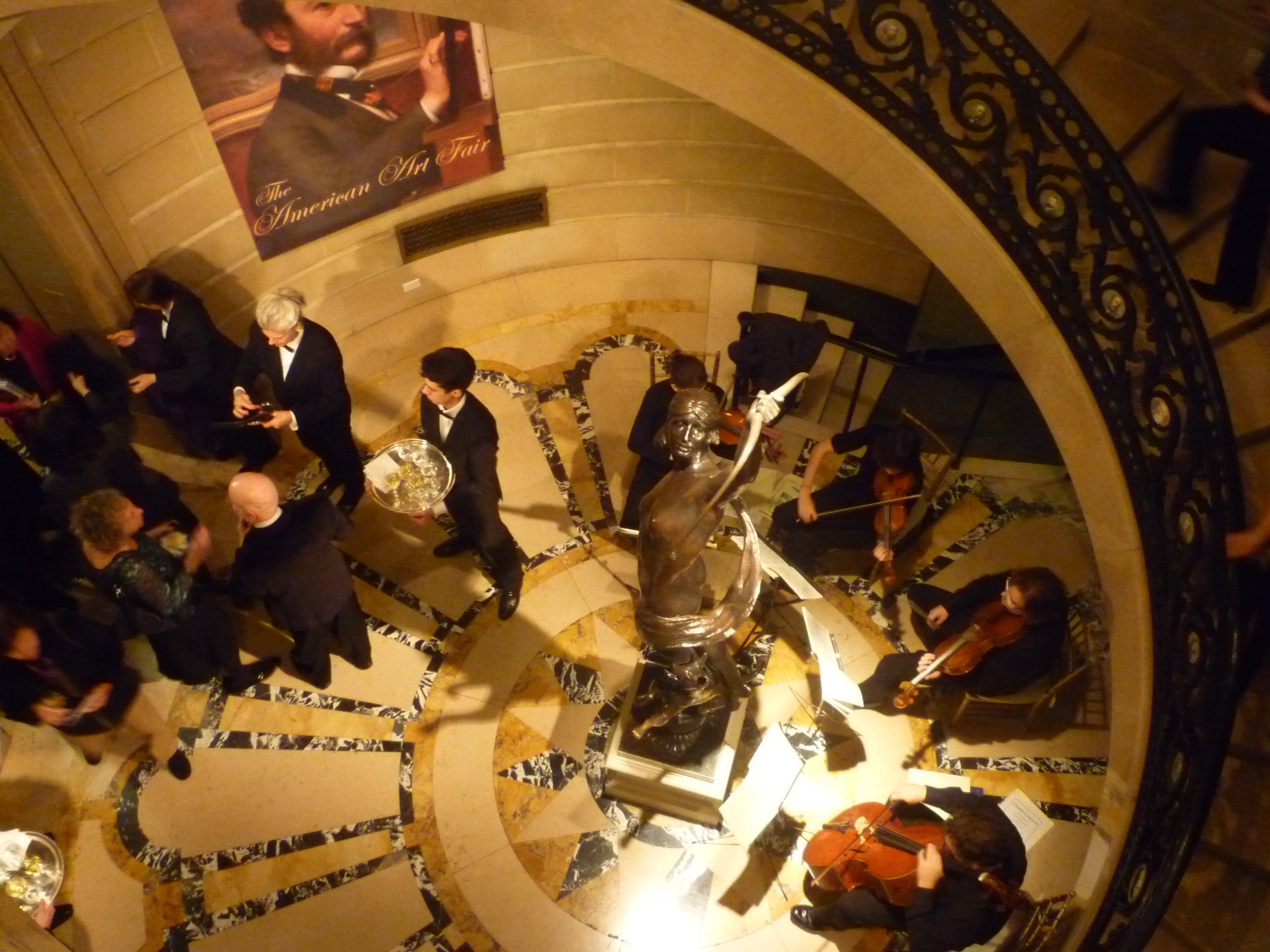
The opening reception for The American Art Fair at the National Academy really topped off a day of looking at paintings. The caliber of paintings I’d say could probably rival what’s in the NA’s permanent collection. The event was first-class. We were greeted with a quartet and handed wine before we ascended the stairs to the busy galleries filled with works by James Peale, Childe Hassam, Emil Carlsen, Thomas Eakins and John LaFarge. In the crowd were notables including William Gerdts, impressionist and still life expert and author of over twenty-five books on American art; art historian, critic and author of With a Gem-Like Flame: A Novel of Venice and a Lost Masterpiece, David Cleveland, whose pending book on American tonalism is anxiously awaited; and Alan Fausel, vice president director of fine arts at Bonhams (and Antiques Roadshow appraiser), who we seemed to follow from the Madison Avenue gallery (or were we there first?). We’ll post more later on some of the paintings on display and where you can find them. Or here’s a novel idea, the fair continues through December 3 and admission is complimentary, so have a look for yourself!
The art fair at the National Academy did raise some ethical questions about commercialism. I didn’t have the chance to talk to Dr. Bruce Weber, the senior curator of 19th century American Art of the museum when he was looking at pictures intensively at the show. But later a staff member from Thomas Colville Gallery told me that there is a percentage on the labels of each painting, indicating the percentage of sale which will go to fund the National Academy. Buyers are supposed to payin two parts, with the first part (taxable) payable to the gallery while the rest to the academy.
UAA is excited about the lecture on Wednesday in the show discussing “Collecting in the Age of Technology“. Additional reports are forthcoming.


Recent Comments