Tag: Jasper Johns
Joslyn Presents Show on Postwar Prints

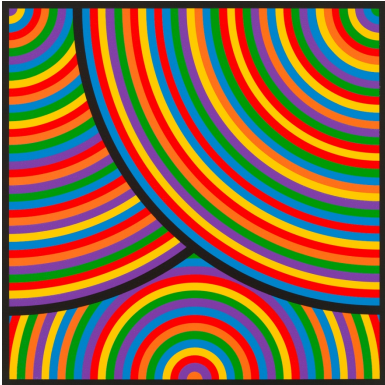
Sol LeWitt (American, 1928–2007), Color Bands (from Wadsworth Portfolio), 2000, edition of 75, linocut, Collection of
the Jordan Schnitzer Family Foundation, © Estate of Sol LeWitt/Artists Rights Society (ARS), New York
Tracing major currents in the art world, as well as developments specific to printmaking, an upcoming exhibition at the Joslyn Art Museum in Omaha addresses how the print rose to prominence in postwar American art. Under Pressure: Contemporary Prints from the Collections of Jordan D. Schnitzer and His Family Foundation, includes work by thirty-nine artists spanning the last five decades. Until the 1940s, most American artists viewed prints as an inferior medium, practiced by those who were concerned solely with the technical aspect of making art rather than with the importance of creative expression. Yet over the next two decades, bolstered by the adventurous spirit of experimentation championed by artists such as Jasper Johns, Robert Rauschenberg, and Helen Frankenthaler, printmaking became one of the most dynamic fields in contemporary art. The earliest works featured in the Under Pressure exhibition at Joslyn are mid-1960s prints by Omaha-born Edward Ruscha (pronounced rue-Shay); the latest, a 2009 print by Hung Liu. The youngest artist is Radcliffe Bailey, a 44-year-old, Atlanta-based printmaker, and eleven of the 39 featured artists are women. All but five of the artists in the exhibition are still living and working. The exhibition at Joslyn opens on October 6 and continues through January 6.
Hotel Chelsea Closes
![]() |
| From New York |
The Hotel Chelsea is now closed to guests. If you’re not familiar with the landmark, it has long been known as home to a number of artists extending back to the time it was built in 1884. Sir Arthur C. Clarke wrote 2001: A Space Odyssey while staying at the Chelsea, and poets Allen Ginsberg, and Gregory Corso chose it as a place for philosophical and intellectual exchange. It is also known as the place where the writer Dylan Thomas was staying when he died of pneumonia on November 9, 1953, and where Nancy Spungen, girlfriend of Sid Vicious of the Sex Pistols, was found stabbed to death on October 12, 1978.
Hotel Chelsea is often associated with the Andy Warhol Superstars, as he and Paul Morrisey directed Chelsea Girls (1966), a film about his Factory regulars and their lives at the hotel. Chelsea residents from the Warhol scene included Edie Sedgwick, Nico, Paul America, and Brigid Berlin.
The hotel has featured and collected the work of the many visual artists who have passed through. Robert Mapplethorpe, Jasper Johns, Edie Sedgwick, Claes Oldenburg and Willem De Kooning have all spent time at Hthe hotel. he painter Alphaeus Philemon Cole lived there for 35 years until his death in 1988 at age 112, when he was the oldest living man.
Monday evening residents learned that the sale of the Chelsea to developer Joseph Chetrit had been finalized. No word from developers on what’s in store for the future. One resident told the Village Voice he felt as though he had survived the Titanic.
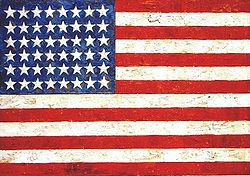
Jasper Johns Receives Presidential Medal of Freedom
Jasper Johns was at the White House Tuesday to receive the Presidential Medal of Freedom alongside Warren Buffett, Angela Merkel, Yo-Yo Ma, former president George H.W. Bush and others. The last painter and/or sculptor to receive the medal was Alexander Calder, given posthumously by President Gerald Ford. Presenting the award to John’s, the president remarked:
It has been noted that Jasper Johns’ work, playing off familiar images, have transfixed people around the world. Historians will tell you that he helped usher in the artistic movements that would define the latter half of the 20th century. Many would say he is one of the greatest artists of our time. And yet, of his own efforts he has simply said, “I’m just trying to find a way to make pictures.” Just trying to find a way to make pictures.
Like great artists before him, Jasper Johns pushed the boundaries of what art could be and challenged others to test their own assumptions. He didn’t do it for fame, he didn’t do it for success — although he earned both. As he said, “I assumed that everything would lead to complete failure, but I decided that it didn’t matter — that would be my life.” (Laughter.) We are richer as a society because it was. And Jasper, you’ve turned out fine.
And later: Jasper Johns. Bold and iconic, the work of Jasper Johns has left lasting impressions on countless Americans. With nontraditional materials and methods, he has explored themes of identity, perception, and patriotism. By asking us to reexamine the familiar, his work has sparked the minds of creative thinkers around the world. Jasper Johns’ innovative creations helped shape the pop, minimal and conceptual art movements, and the United States honors him for his profound influence on generations of artists.
Warhol Foundation Takes Aim at Smithsonian
The intricacies of theology are not usually what concerns the artist. They’re concerned with the big, beautiful fundamentals, and there I have never had any problem. In fact, anybody who has a narrow sense of their religion, whether they’re Jew or Christian or Muslim or whatever, has only to look long and intelligently at the great work of another tradition and they will see what the religions have in common. Sister Wendy Beckett
The Warhol Foundation wants the Smithsonian to stop censoring or lose financing. The foundation sent a letter December 13 to Wayne Clough, secretary of the Smithsonian Institution that says while it is proud to have been a lead supporter of Hide/Seek: Difference and Desire in American Portraiture, it strongly condemns the decision to remove David Wojnarowicz’s video A Fire in My Belly from the exhibition. “Such blatant censorship is unconscionable. It is inimical to everything the Smithsonian Institution should stand for, and everything the Andy Warhol Foundation does stand for,” Warhol Foundation President Joe Wachs writes. “After careful consideration, the Board voted unanimously to demand that you restore the censored work immediately, or the Warhol Foundation will cease funding future exhibitions at all Smithsonian institutions. Although we have enjoyed our growing relationship during the past three years, and have given more than $375,000 to fund several exhibitions at various Smithsonian institutions, we cannot stand by and watch the Smithsonian bow to the demands of bigots who have attacked the exhibition out of ignorance, hatred and fear.”
According to the New York Times Art Beat, the video was pulled from the exhibition two weeks ago on Clough’s orders after the head of the Catholic League, Bill Donohue, described it as hateful to Catholics because it includes an image of ants crawling over a crucifix. House Republicans condemned the exhibition as an “outrageous use of taxpayer money.”
In a statement posted on its site, the Smithsonian says it stands by the Exhibition and that “one of the exhibition’s 105 works—a short segment in a four-minute video created as a complex metaphor for AIDS—was perceived by some to be anti-Christian. It generated a strong response from the public. We removed it from the exhibition Nov. 30 because the attention it was receiving distracted from the overall exhibition, which includes works by American artists John Singer Sargent, Andy Warhol, Jasper Johns, Annie Leibovitz and Georgia O’Keeffe.”
We wish they would stand by the exhibition and the work by Wojnarowicz and applaud the Warhol Foundation for standing up for what happens with its grant money. We’d also like to direct the Catholic League to this important video where Sister Wendy discusses another controversial work that angered some Christians, Andres Serrano’s Piss Christ.
“I think that to call it blasphemous is rather begging the question,” Sister Wendy tells Bill Moyers. “It could be, it could not be”
Philadelphia is the Only Venue for a Major Exhibition Exploring Cézanne’s Impact on Artists of Succeeding Generations

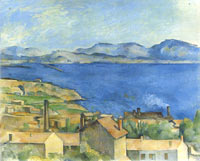
- The Bay of Marseille, Seen from L’Estaque, c. 1885
In 1907, the French painter Paul Cézanne’s posthumous retrospective astonished younger artists, accelerating the experimentation of European modernism. Cézanne (1839-1906) became for Henri Matisse “a benevolent god of painting,” and for Pablo Picasso “my one and only master.” Cézanne’s inclusion in the Armory Show in New York in 1913 also offered American artists a new direction. Cézanne & Beyond (February 26 through May 17, 2009) will examine the seismic shift provoked by this pivotal figure, examining him as form-giver, catalyst, and touchstone for artists who followed. It will survey the development of an artistic vision that anticipated Cubism and fueled a succession of artistic movements, and will juxtapose Cézanne’s achievement with works by many who were inspired directly by him, showing a fluid interchange of form and ideas. It will place his work in context with more recent artists like Ellsworth Kelly, Jasper Johns, and Brice Marden, who in quite different ways came to terms with the master of Aix-en-Provence. His profound impact on successive generations endures to the present day. The exhibition will present more than 150 works, including a large group of paintings, watercolors and drawings by Cézanne, along with those of 18 later artists.
The works will be drawn from public and private collections around the world, including Canada, France, Germany, Italy, the Netherlands, Norway, Russia, Sweden, Switzerland, the United Kingdom, and the United States. It will be seen only in Philadelphia.
The artists included, in chronological order, are Henri Matisse, Piet Mondrian, Marsden Hartley, Fernand Léger, Pablo Picasso, Georges Braque, Charles Demuth, Max Beckmann, Liubov Popova, Giorgio Morandi, Alberto Giacometti, Arshile Gorky, Ellsworth Kelly, Jasper Johns, Brice Marden, and Jeff Wall, Sherrie Levine, and Francis Alÿs.
All of the artists in the exhibition have acknowledged Cézanne’s profound impact on their work. When Henri Matisse (1869-1954) donated his Cézanne painting of Three Bathers to the Petit Palais in 1936, he wrote: “in the 37 years I have owned this canvas, I have come to know it quite well, though not entirely, I hope; it has sustained me morally in the critical moments of my venture as an artist; I have drawn from it my faith and my perseverance…” Picasso (1881-1973) in his long and varied artistic career often used Cézanne as a lever in his critical shifts, from his Self-Portrait with Palette, through to the lyricism of La Rêve, and onto his later examination of bathing subjects both as painting and sculpture. Braque, who with Picasso used Cézanne as his principle touchstone early on, spent time at several of Cézanne’s painting locations. For him “it was more than an influence, it was an initiation.”
Piet Mondrian (1872-1944), who was drawn especially to the formal structure achieved by Cézanne, brings an analysis of Cézanne to an abstract conclusion, as reflected in his own words “… that beauty in art is created not by the objects of representation, but by the relationships of line and color.” “Cézanne taught me the love of form and volumes,” Fernand Léger (1881-1955) once remarked, and “the power of Cézanne was such that, to find myself, I had to go to the limits of abstraction.” In Russia, Liubov Popova (1889-1924) discovered Cézanne in the Moscow collections of Morosov and Shchukin and drew from him the pleasures of geometric fragmentation, which swiftly moved to pure abstraction.
In the United States, as modernism gathered force, members of the Stieglitz circle, especially Charles Demuth (1883-1935) and Marsden Hartley (1877-1943), became fascinated with Cézanne. Demuth’s still life compositions in particular show a deep connection to Cézanne’s bold late watercolors. In his autobiography, Hartley noted that Cézanne offered “ideas that were to make the world of painting over again and give modernism its next powerful start,” adding that “there is no modern picture that has not somehow or other been

- Arshile Gorky (Armenian, c. 1904 – 1948), Staten Island, 1927
built upon these new principles.” Arshile Gorky (1904-1948) studied Cézanne closely, and the exhibition reflects his keen engagement with Cézanne’s style, especially in the mid to late-1920s. Gorky affectionately referred to the French artist as “Papa Cézanne” and even in his later abstractions there is a profound sense of the lesson of Cézanne.
Later, looking back on his career, Max Beckmann said: “my greatest love already in 1903 was Cézanne.” He “revere[d] Cézanne as a genius” throughout his life, looking particularly at the dark, emotional early works and the heavy black outlining of some of Cézanne’s figures. In Italy, Giorgio Morandi (1890-1964) first saw Cézanne images in books in 1909 and then in person in exhibitions in Venice and Rome. His path as an artist of both still lifes and landscapes was set. Alberto Giacometti (1901-1966) was introduced to Cézanne by his painter father, but had to wait until the Venice Biennale of 1920 to see his work face-to-face. For him the attraction was the sense of process rather than arrival. Cézanne is firmly linked to an existential sense of doubt and anxiety that permeates Giacometti’s explorations of objects and people in space through two or three dimensions.
In this sense Giacometti is akin to Jasper Johns (b. 1930), for whom Cézanne has been a continuous point of reference and has served over the years as a sort of eminence. The exhibition presents numerous works by Johns that make overt and oblique references to Cézanne, including drawings inspired by Cézanne’s bathers and paintings of figures that are referenced in Johns through such works as the Seasons and In the Studio. Ellsworth Kelly (b. 1923) first discovered Cézanne as a student in Boston and is quick to explain that Cézanne is often at play in his art making. Kelly’s exploration of the relationships between form and color, figure and ground, take on an immediacy and constancy for our understanding of both artists. Brice Marden (b. 1938) commented “that Cézanne almost made the perfect painting.” In Marden’s own works, Cézanne’s pursuit of an essentially unobtainable goal of distillation, often through repetitions on the same motif, is a shared journey.
The exhibition places substantial emphasis on artists of the present day, including long established masters such as Kelly, Johns, Marden, and Jeff Wall (b.1946), and younger artists responding to the idea of the show such as Francis Alÿs and Sherrie Levine. Wall’s magnificent light box photographs show that Cézanne’s influence transcends the medium of painting. While working in an entirely different medium, the photographer Wall is a life long admirer of Cézanne either through direct quotations or more often through implied transgressive references.
During the preparation for the exhibition, Anne d’Harnoncourt, the Museum’s late Director, said: “Cézanne is a rare artist whose work touched so many artists and contributed to shape a broad spectrum of talents and who, remarkably, continues to find fresh resonance today. Philadelphia, like Aix, has long been a major destination for Cézanne lovers because the Museum and the Barnes Foundation hold such comprehensive collections of his work. This exhibition presents an opportunity to fully appreciate both Cézanne’s art and its impact over time, offering visitors the experience of participating in the extraordinary conversation among artists that has engaged many of the major talents of the last century.”


Recent Comments