Tag: Jeff Bridgeman
The Glossy and the Rusty — Visiting The American Antiques Show
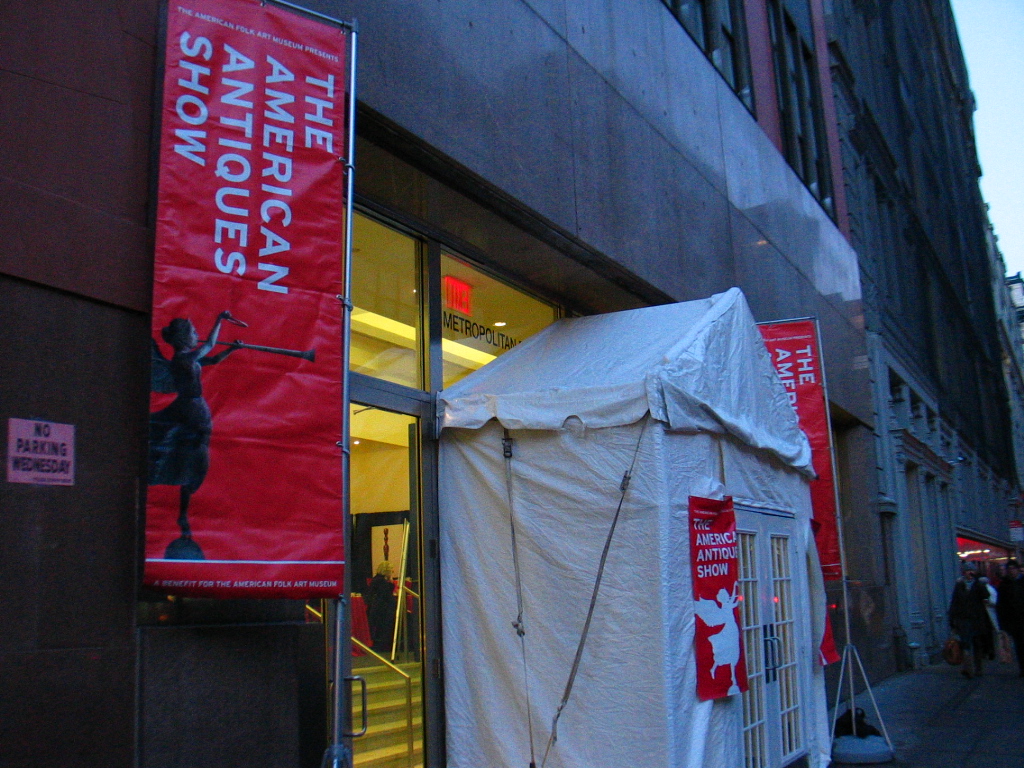
The American Antiques Show, presented by the American Folk Art Museum, started from Wednesday, Jan 19. By the time we visited the show on late Friday afternoon, we have found many things we would like to take a close look had a red dot beside them. Unlike other shows such as the Winter Antiques Show and Antiques at the Armory, the show largely on Americana. Selected items from selected dealers attract selected customers. Judging from the number of sales, it seemed that for elite shows at this level, who attended the show is more important than how many attended the show for the financial success.
As this was our first visit to such a prestigious show, we could only recognize a few familiar faces such as flag dealer Jeff Bridgeman or Connecticut dealer Roberto Freita, whom we have met in THETA antiques show in Houston. (Interestingly, both presented mostly different merchandise: Jeff took away the Confederacy flags from the THETA Show, and Roberto brought more signs and baskets onto the wall.) But the official pamphlet showed that there were only four new dealers in this year’s show. Thus in the early evening of the Friday night, when visitors began to thin out, exhibitors walked around to get involved in an agreeable discussion, like old friends.
The fact that we are not hard-core Americana collectors made it hard for us to fully comprehend the depth of the show. For non-trained eyes like mine, even with about 50 dealers, which took the first floor of the Metropolitan Pavilion on the 18th street between 6th and 7th Ave, after the first round of walking tour, I began to feel (under the influence of low sugar probably) that there was such a continuity and flow between most booths as if they were all set up by one master dealer.
Unlike shoppers in fine-art or highly polished decorative art, whose discrimination against faults and imperfection can often lead to exhibitor’s defense; most Americana collectors take it for granted that Americana is anything but perfectionism. The rusted copper, the worn gilt or the peeling surface are records of material’s past. To embrace things as they are is a priori for a wholehearted Americana collector. The show’s jolly and relaxed atmosphere proved it. Maybe those transactions are just natural results from those long congenial conversations.
However, repurposing is definitely a NO-NO in a pure Americana show like this. Painted furniture (fancy chairs or Pennsylvania dower chests) are great, but repainted furniture such as those Victorian chairs with Martha-Stewart-color seen at Antiques at Armory would not possibly be accepted here. The intricate interplay between original bold patterns and the naturally aged surface texture has an undeniable air of authenticity that none of the artificially worn products can rival. Such nuance became evident when I walked around with the fresh memory of those repurposing items from the armory show. At the detail level, it became clear to me that great Americana antiques is beyond old patinas or funky carvings: sincere, bold, non-conventional yet unpretentious, it is no wonder that collectors in this field seem seldom fall out.
It is in Americana where aesthetics may conflict with rarity. Even though aesthetics is extremely personal, there is in general consensus about some golden rules for creating visual pleasure from trained hands. In Americana, those rules (such as linear perspective, airy perspective or human anatomy) are meant to be broken. The rarity largely lies on unique forms or objects depicted, a certain level of betrayal of faults and inadequacy, plus strong individual styles. But rarity alone won’t win a collectors’ nod. When I took a look at a small unsigned portraiture of William Gray Jr (offered by Gary R. Sullivan Antiques), I first felt laughable that his large head is sitting on his disproportionally shortened body; yet the detail of his facial feature disclosed sincere efforts of precision and the grand background of burning clouds from the setting sun may indicate the painter’s ambition to incorporate popular yet technically difficult style into this small panel.
There were perhaps more weathervanes than dealers in the show. And roosters seemed to dominate the field. Yet nothing was more dramatic than the one brought by Allan Katz Americana from Woodbridge, CT. The copper rooster, once gilded, has turned uniformly green except a few spots. The fluidity in transforming volume (body) into forms (tail), the efficiency in use of large and repetitive patterns and the genius adoption of succinct curves that integrate the symbolism with naturalism, made it the proudest rooster one could ever have — except that it was already taken when we got there.
A pair of andirons, also from Allan Katz, was designed to steal the spotlight in the most unflashy place of a house. At first, I thought the andirons were in some abstract form. But a close look revealed that each andiron was embodied into a sea horse with a snake around the head. Another pair of snakes, tightly tangled links the pair andiron together. The imaginative power to use such obscure animals with their unexpected gesture and movement highlight what I deemed as the irresistible feature of Americana: Instead of following the convention, it creates convention.
Not long ago, Eric lamented that a period classical sofa was sold for less than an IKEA one. Yet a rural sofa with a classical form in the show had a stunning price tag that may trigger some dealers to reconsider whether it is a bane or blessing for period furniture to have a metropolitan root. The sofa, tall, deep, mostly rectilinear, is accentuated with consistent diagonal-line-carving, yet collectors looking for sophistication or metaphors may be disappointed. Although I would be out of place to argue here, for or against each school of collectors, I do feel that consummate techniques of New York or Philadelphia furniture may dampen Gen X’s collecting enthusiasm. They neither wholeheartedly accept the formal and somber tones of such furniture, nor do they aspire to decorate homes to imitate museums. This folkish looking sofa, however grand it was designed to be, is less “antique” than unusual. It is the latter word that may comfortably bring young people in.
Charles and Rebekah Clark’s booth, in contrast, is filled with glossy mahogany-veneered furniture and shimmering light, most from federal and classical period. With all honestly, this is where we felt most at home. It’s also curious this formal city furniture was on display in an Americana show, yet somehow it seemed to fit. Perhaps that’s because the designs for much of the folk art resulted from these classical designs. Just as it’s argued that Ammi Phillips, as an example, was not operating in a vacuum, rather striving to imitate trained artists, so the makers of many folk art and crafts were often imitating trained artisans and cabinetmakers. The designs may be painted rather than carved, or simplified and given regional characteristics, they have common soil, if not roots. The classical style seems to have such a elite following these days, I imagine it’s difficult to find a show that’s just right for a booth like this one.
Chinese export decorative art has been traditionally regarded as part of Americana. Tucked at one corner of the booth of Samuel Herrup Antiques from Sheffield MA was a small ink wash painting (on silk) by an unknown Chinese painter, with an immaculate Americana subject — a cat. I had an interesting conversation with Sam on this piece of work. Sam pointed out that the detailed realistic rendering of the cat on top of a suggestive, nearly formless rock may be the result of the unique combination of traditional Chinese school and western art brought in by Giuseppe Castiglione in the first half of the 18th century. The jarring contrast between the fullness of the fur (especially some tightly controlled folding pattern above its feet) and calligraphic, freehanded expression of the rock within this 15 by 15 inches square is a wonder to behold. Was this by some pupil of the famed western court painter? Or was this from somewhat later period? Without dating or signature, hardly can one garner any information. But I tend to think it is a blessing for the future owner when a piece of a “puzzle” has not been found. Besides the curious eyes of the cat, the painting will always be shrouded by its mystery of provenance.
Sam has been dealing with Chinese export decorative art for many years. Another item was just a tureen lid, which was made to commemorate Washington’s death for Judith and Robert Lewis, Washington’s nephew. The absence of tureen’s body actually helped me focus on the memorial pattern. Would I accept that the body is perhaps broken and would never be united with the lid if I had the money to buy it? (It has AGAIN a red dot.) I am not sure. It reminded me another feature of Americana antiques: the unconscious change in perception — from practically functional to purely decorative and to ultimately served as rare extant of our material past. To some degree, the hard-core Americana collectors are themselves sort of “repurposing” conceptually, by usurping item’s own pragmatic past with the aesthetics and rarity focus.
At the center of Sam’s booth was a mahogany twelve-sided candlestand made in New York, dated around 1790. Its center has an inlaid eagle placed within an oval, like an Egyptian cartouche, proudly declaring its royal heritage. The 13 stripes on the shield, the olive branch and arrows held by the talons are quite accurate with respect to the Great Seal of the United State which made its first public appearance in 1782, presumably not long before the table was made. Yet the eagle head is turning to the left, a minutia abberation from the majority. It would be hardly to believe that the artisan created the inlaid image from his imagination; possibly the available samples then all had some difference and the one he had at hand happened to have the eagle head turning left.
Nothing was better than viewing this stunning piece alone as the last stop before heading out. It is neither glossy nor rusty, instead it has aged gracefully. Most of all, all Americana pays tribute to the patriotism and this particular piece was made when the country was just founded. They provide a time window for Americans to discover the grand ambition of ordinary people of a new nation.
Perhaps, when President Obama delivered his State of the Union address yesterday, he should have brought several pieces from the show. They are the material evidence of what he declares:
We do big things.
From the earliest days of our founding, America has been the story of ordinary people who dare to dream. That’s how we win the future.
An Unusual William Trost Richards at PAFA
Only two short blocks away from the City Hall of Philadelphia, the Pennsylvania Academy of the Fine Arts (PAFA) is perhaps one of the most under-rated museums in the Northeast.
Unlike the National Academy in New York City, which holds one of the most comprehensive American art collections but does not even have a permanent place for exhibition, PAFA is situated in a grand Gothic Revival building built in 1876 with plenty of exhibition space.
This was our second visit to PAFA. Compared to our first visit approximately one year ago, some paintings have been rolled in and out. In particular, the Gross Clinic, co-owned by PAFA and Philadelphia Museum of Art, was not there.
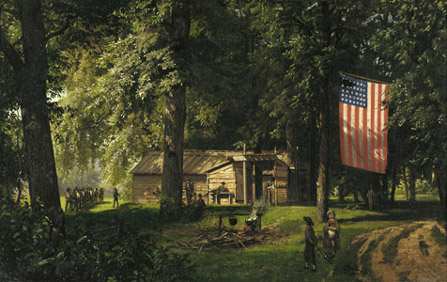
Not surprisingly, William Trost Richards, a native of Philadelphia, who was given an award by PAFA, is well represented in the museum. From their website, there are eleven in total works by Richards in the collection. When I was there, which was literally 40 minutes away from closing on Black Friday, the light was dim and some walls were buried in the gray darkness. Richards’ painting “Recruiting Station”, unfortunately, was on such a wall. Painted in the middle of the Civil War (1862) at Bethlehem, Pa, it was totally different from his realistic, almost factual paintings of woodlands in this pre-Raphaelite period.
Without this painting, Richards’ political view would be vague through his early 1860′s Ruskinian works.” Linda Ferber, in her book “Pastoral Interlude: William T. Richards in Chester County“, discussed the dense allegories of horticultural and agricultural symbolism in those close study of woodland paintings. His awareness of antebellum tensions was also indicated in his letter – “The country is in a very bad state. There is an important crisis approaching. God only knows what will follow. I have little sympathy with politics however.”
If so, Richards’ “Recruiting Station” made it clear that his political stance six years after his wrote that letter. In the painting, with an almost narrative tone, he depicted a lively scene in a recruiting station. In a bright sunny day in the wood, villagers encounter and talk perhaps about the war. Not too far, a group of new recruit solders are walking out of the shade. The most dominating object is the oversized flag hanging in the middle ground. Its striking colors pop out of deep greenery.
Knowing Richards as a painter who possessed the great prowess to render objects with exactness and full details, I was confident that the number of stars in the flag must be correct. (Imagine counting the stars on one of Childe Hassam’s flag paintings!) In a recent trip to the Theta antiques show, Jeff Bridgeman, the antique flag dealer, discussed some flags made in France during the civil war period had the wrong number of stars as the makers would not pay attention to such nuance.
Richards, regardless of his meticulous rendering of the wooded interior, understood the emblematic weight of the flag, echoing those faceless solders, who would serve and sacrifice the nation, made no mistake of accuracy in detail. What he painted was a flag in the design of Old Glory. In 1861, one star was added to the existing 33 stars, representing Kansas, bringing the total number of stars to 34. There were thirteen stripes representing the thirteen original colonies. The flag would be incorrect one year after this painting as the 35th star representing West Virginia was added making each of five rows having exactly seven stars.
“Recruiting Station” also differs in perspective compared to his typical pre-Raphaelite paintings in the same period. Unlike the close-up view or worm-eye view of the fauna wonders, he picked a slightly higher vantage point, with certain distance away from the actual scene. Compared to the genre paintings by Mount, which elicits human’s senses by staging the scene upfront, the aloofness that Richards adopted seems to indicate that his view of artist’s role in the war: supportive, nevertheless distancing from the actual involvement. In this serene picture, the villagers quietly see off the new recruit solders as if with the same restrain of the painter himself. In between the two groups, the water is boiling and someone must stay to tend the fire. Thus in such a subtle way, Richards tells his own anxiety in the turmoil of the civil war, his firm stance in the political party and perhaps his belief in each citizen’s own tangible and intangible values toward the union, including his own.


Recent Comments