Tag: Kaminski Auction
A Gaggle of Interests, December 27, 2009
In this series, the UAA team will list some of the interesting items that we have found in auctions, antique shops or eBay. We neither own the items or have the capability of examining the items in person in some cases. It mainly serves as an inventory record of what interests us (not necessarily in terms of value or investment opportunities) and possibly how much it fetches (if the result can be obtained). If you are serious about some lots, please contact the auction houses, dealers or eBay sellers directly.
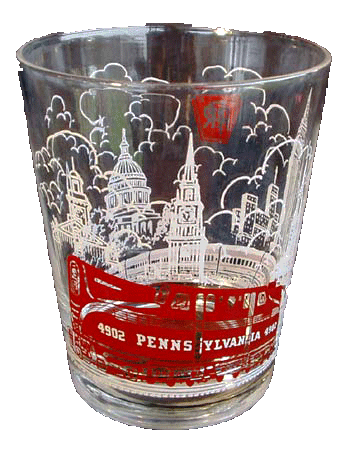
1. Set of Six PRR Highball Glasses
Imagine yourself speeding along an electrified east coast line from New York to Philadelphia sipping a mixed drink from one of these glasses. I don’t imagine you can get a real mixed drink from a dining car these days—I do recall a recent pre-mixed pina colada from a can, and I don’t imagine it will be served in a glass as nice as this. Items from the Pennsylvania Railroad dining cars are quite collectible, and while these seem to be somewhat readily available, the $50 price for a set of six is exceptionally attractive. I wouldn’t put them in the dishwasher. Available at General Heath’s Antiques, Reinholds, PA (717) 484-1300
2. Western Electric Model 302 Telephone
This looks to be a Bell Labs model 302 produced by Western Electric sometime between 1941 and 1958. Most of the Model 302 sets came in black, but eight other colors — ivory, bronze, silver, gold, rose, blue, green and red — were added toward the end of the phone’s production run. The cord appears to have been replaced, or else the phone is from a later production run. The WE 302 appeared in many films from the time of its introduction through the 1960s, and was ubiquitous in television shows of its time, such as I Love Lucy. Thus, it is sometimes called the “Lucy phone” by modern collectors. The 302 phone was designed by Henry Dreyfus, who also designed what is perhaps the most known form of the telephone even today, the Western Electric model 500 telephone. As one of the celebrity industrial designers of the 1930s and 1940s, Dreyfuss dramatically improved the look, feel, and usability of dozens of consumer products. As opposed to other contemporaries, Dreyfuss was not a stylist: he applied common sense and a scientific approach to design problems. In 1955 Dreyfuss wrote Designing for People and was the first President of the Industrial Design Society of America. If you were to purchase this phone, it would almost assuredly still work. They were rugged and reliable. You might not want to use the dial—and you can’t enter account numbers and such, but the sound of these phones is much improved over most of the available ring tones on modern phones. Available at an asking price of $48 from Lancaster County Antiques & Collectible Co-op, Adamstown, Pa 717-336-2701
3. Pabst Blue Ribbon Matchbook
I’m not sure what I could do with this, but it is a neat design. The match heads are the beer bottle caps. Taking this photo also lead me to the American Matchcover Collecting Club. According to the club’s web site matches and their convenience date back to 1827. Joshua Pusey, a Philadelphia lawyer and patent attorney, is credited with the first matchbook in 1889. The earliest known commercial advertising on matchbooks was whimsically created in 1895 and distributed with the compliments of the Mendelson Opera Company. Skip forward to the Diamond Matchbook Company and a salesman named Henry C. Traute who approached none other than Pabst Brewery about advertising on matchbooks. The story is longer, but at this point leads us to a display cabinet in Time Matters Antique Mall in Adamstown, Pa (717) 484-1514. Drink Pabst (know known as PBR) and the world drinks with you.
4. Kaminski Auction, Dec 28, 2009. Lot 4270, Antique Chinese Cinnabar covered round box
Sometimes when lacquer was applied as a thin layer on top of bamboostrips or woods, the craquelure was formed because of the difference in the speed of material shrinkage. Such craquelure can be desirable in antiques collecting. In China, it is called “Duan” or break. The natural forms of craquelure usually have different patterns based on the materials. It is in my mind a little bit too absurd to look for the beautiful craquelure on a piece of antique object. and use it as a measure. Luckily very often than not, like this one, the age of a lacquerware is hard to tell. Such lacquerware is time-consuming to make even with state-of-art technology. In early times, two thin layers of lacquer can be applied in each day because of the slow drying process. (You cannot apply thick layers of lacquer at once because the gravity will drag down the material. Similarly if the previous layer is not dried yet, additional layer will only make a thicker layer instead of a new layer.) At minimum, a couple dozens of layers are required to make one object, sometimes hundreds of layers of lacquer were applied before carvers made their touch on the still-soft surface. This one is probably made of lots of layers in order to achieve three dimensionality. The style is called “Zhi” in Chinese, which means raised relief. (The sunken relief is called “kuan”.) This one has more depths that differentiates foreground, middle ground from background mountains. There is a small damage on the body which discloses the material used for the core. It is something that some cannot live with, But for me, it is a showcase of the making of lacquerware. Another interesting observation regarding lacquerware is that there are not many great examples in China therefore the lacquerware collecting is more avid in the international market, but Chinese are catching up quickly.
5. Lyon & Turnbull, Jan 13, 2010, Lot 70, Charles Dickens, A Christmas Carol
Although Christmas has passed, the famous book should still demand a lot of attention. In fact, a similar book is on display at the Morgan Library. The book was an immediate success: according to the Wikipedia, the first run of 6,000 copies sold out by Christmas Eve and the book continued to sell well into the New Year. This particular lot is the third issue of the first edition.
A Gaggle of Interests – Dec 20, 2009
In this series, the UAA team will list some of the interesting items that we have found in auctions, antique shops or eBay. We neither own the items or have the capability of examining the items in person in most cases. It mainly serves as an inventory record of what interests us (not necessarily in terms of value or investment opportunities) and possibly how much it fetches (if the result can be obtained). If you are serious about some lots, please contact the auction houses, dealers or eBay sellers directly.
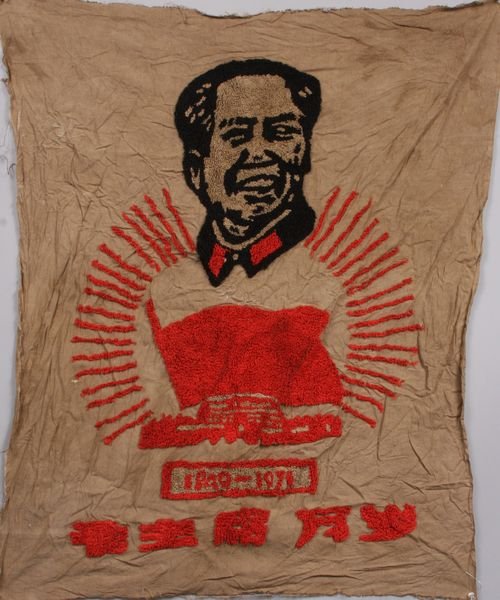
1. Kaminski Auction, Dec 28, 2009. Lot 4236 Chinese cultural revolution banner
Although propaganda posters under red iron curtains are hot, especially after the exhibition “Art and China’s Revolution” in 2008 at the Asia Society, I have always been dubious about the true value of such banners or posters. It is ironic that the commonest print always becomes the scarcest. Anybody can buy a Whistler etching, but try to find a Victorian matchbox or a Chinese cultural revolution banner! The scarcity of such items, not their immediate visual pleasure that has given them a special niche in the market.
Similar to the experience for another banner that were auctioned in the same auction house in July, 2009, I am very curious about the dating of the banner. A Cultural Revolution banner does not necessarily mean that the banner was made in the Cultural Revolution period. 1849 does not make any sense for Chairman who was born in 1893. The Opium War happened nine years earlier. Neither is clear about the year 1971. In the age when a wrong word used in a speech will put one in jail or even cost one’s life, such mistakes would hardly happen on propaganda materials. (From the picture, the red color seems to have withstood aging and fading very well while the cloth itself looks being preserved carelessly. ) I would ask about the provenance if I were the potential buyer.
2. The Music of the Federal Era, Boscobel Restoration’s Barrel Organ CD
At one time you had to hire a servant to crank the barrel organ to hear this music. This organ is housed in Boscobel, a Federal-era home that overlooks the Hudson River in Garrison New York. At one time the organ was turned for guests touring the home, but in recent times recorded music played on a cd replicates the sound. The barrel organ consists of pieces of music encoded onto the barrel using metal pins and staples. Pins are used for short notes, and staples of varying lengths for longer notes. We were told on the tour these were sometimes called “hurdy gurdys.” While true, they were mistakenly referred to as such. A hurdy gurdy is a different instrament also operated by the turning of a crank. The cd is a great way to bring a little of the Federal era and Boscobel home. It’s available in the gift shop at a cost of $9.95.
3. Kaminski Auction, Dec 28, 2009 Cattle in Stream Painting, Lot # 4065
Here’s a very affordable way to add an air of sophistication to your living room. You may think good antiques are expensive, but that’s not always the case. This seems like an exceptional painting and the estimates are low because the painter is unknown. If you’re looking at it as an investment, it might not be the safest way to go. Most people collecting antiques today do so not to make money, but because they enjoy them. Moreover, antinges and art, even by unknown artists will maintain their value better than a brand new painting on canvas. You may also enjoy the hours of research and inspection trying to determine who the artist was. If you are able to come up with an attribute, everything changes. That can’t happen with something from the mall.
4. Handel lamp base with Van Erp shade, Kaminski Auction, Dec 28, 2009, Lot 4110
While the auction description says this is a Van Erp shade, the lamp is by Handel. I don’t know if they were sold together or assembled later. My hunch is they a married later in life. Philip Julius Handel established the Handel Company in Meriden, Connecticut in 1876 and specialized in reverse painted lamp shades considered a less expensive alternative to the Tiffany. Handel bases were most commonly made of a zinc alloy, spelter with a bronze patina or finish. More rarely are they found in bronze. Both handel lamps. At auction, both names, Handel and Van Erp command premiums above the estimates given here, it remains to be seen what both in one lot can do. Here’s an Antiques Roadshow episode that features a Van Erp lamp.
5. Don Swann, Artist proof, etching of Monument Hill, Baltimore
Samuel Donovan [Don] Swann (1889-1954) studied art in Munich and in Rome but lived and worked in Baltimore. The focus of most of his etchings was historic Americana, particularly views of Maryland and Washington, DC. In 1939, Swann issued an illustrated book, Colonial and Historic Homes of Maryland, dealing with 18th century Maryland. The forward for the book was written by F. Scott Fitzgerald.
This is an artist proof. I have checked this particular etching with the numbered print and has found some interesting difference. For example, the upper left corner is darkened to indicate the sky, this was probably done by the artist who intentionally left somewhat a slim film of ink (manually) on the plate which was subsequently transferred to the paper. The commercial etchings tend to have a very dramatic sky while this one looks calmer. A close examination of the middle ground snow also indicates that he was in the process of burnishing to better suggest the snow on the top of bushes. If you don’t like the numbered prints issued by the publisher, an artistic proof is more or less one of the kind, mostly done or monitored by the artist, which in general leads to a better market appreciation. Link to item
Touching the Taboo – Chinese Cultural Revolution Banners at Kaminski Auction
On July 25, 2009, Kaminski is going to auction two Chinese Cultural Revolution needlework banners. I have not been looking for such items in auction houses before because they are neither of aesthetic values nor extreme rarity in my mind. Born at the (tiny) tail of the Cultural Revolution, I remember those “Litter Red Books” of quotations from Chairman Mao Zedong when I was little. In the early of 1990′s, when I visited my relatives in countryside, there were still walls painted with slogans praising the People’s commune in which everything was shared. In a period of social upheaval and economic degeneration, almost everything became scarce except the posters, banners and other publications. But such items showing up in an American auction house still brought up my interest in the topic.
If the subject matter attracted me at the first place, a close look at these two lots shocked me because of the crude quality. Big-character posters played an important role in the Cultural Revolution not only because of the relative large-sized font, but also of accessible images which could be understood by people with different educational background. The icon images of Chairman Mao with a few other important leaders were symbolic and could allow no mistakes. But the average working class people were also rendered in general ideal physiques and countenance par excellence. The proletariat were called the owners/leaders of the communism country and their portraiture reflected a nation’s aesthetics of the period. The alpha-male characteristics include squared face, bright and big eyes, thick eyebrows, broad shoulders and most of all youthful and optimistic countenance.
None of the features can be found in these two banners. In fact, the tilted slim eyes, the sharp nostrils and other squeezed facial elements on neckless shoulders remind me of the caricature images that the western countries used to mock and offend Chinese. Should have such needle works been released to the public, the creator may have been sent to the labor camp for the reason of intentional degrading the working class.
There are other factors that lead me to doubt the authenticity. For example, the faces of Chairman Mao and Premier Zhao in lot 4131 were very unsuccessful. There is a mistake in the sentence written in front of the front girl in lot 4130. The rural area in Chinese is 农村,but the word was written opposite as 村农. (Isn’t it rare for an American to say sidecountry instead of countryside?) And the last two words of the slogan at the bottom of the lot 4131 were printed awkwardly that were unlikely to appear in a public poster.
But my serious suspicion came from the content of the lot 4130. The sentence in the black area said “it is necessary for young intellectuals to the countryside to receive re-education from the peasants”, a quotation from Chairman Mao. But it was not until the December of 1968 that Chairman Mao started the famous “Down to the Countryside Movement” with that famous slogan which created a lost generation who wasted their youth in the field. This poster with the year of 1967 would not be possible unless it was created much later as a pastiche.
The banners, regardless of their authenticity, lead me to think of the collectibility of Chinese Cultural Revolution propaganda publications. In comparison, Americans began to commemorate the Civil War around the turn of the century when much of the bitterness of the war had faded away and national heroes retired from the central stage. Nowadays, Civil War related antiques such diary, letters or medals become a staple in Americana sale. Almost 35 years passed after the end of the Cultural Revolution, Asia Society opened the first-ever exhibition on “Art and China’s Revolution” last year, showing the first sign that scholars and art historians in the west began to examine art in a period of art vacuum in China. And the grand children of the lost generation are now in the colleges where the taboo topic of their grand parents has become archaic and irrelevant. The lost direct connection to the pain may bring scholars in China to revisit the period with renewed energy and different perspectives.
But the cultural revolution didn’t ended with a winner like the Civil War and the Chinese government is less likely to ruminate the errors. It is fairly to say that it may take 50 years for Chinese to be able to study the period with neutral attitude and objectivity. (That’s about the time when the lost generation bring their bitter memory into the tombs.) Therefore my guess is by 2025, the post-cultural-revolution generation would feel the necessity to explore the Cultural Revolution and examine the roles of their parents without feeling being pressed by their stern eyes. If so, starting collecting now could possibly beat the market because there are still a lot of items available which can be acquired directly from the first owner with their fresh yet painful account.
PS: each of the banners is estimated at $1000 to $1500.


Recent Comments