Tag: Martin Johnson Heade

Rare Still Life by Duncanson Enters Collection of National Gallery of Art

Filed in Art, Museums by on February 6, 2012 0 Comments
Rare Still Life by Duncanson Enters Collection of National Gallery of Art

Robert Seldon Duncanson, Still Life with Fruit and Nuts, 1848, oil on board, National Gallery of Art, Washington, Gift of Ann and Mark Kington/The Kington Foundation and the Avalon FundThe National Gallery of Art has acquired one of fewer than a dozen known still lifes painted in the late 1840s by African American artist Robert Seldon Duncanson (1821–1872). Classically composed, Still Life with Fruit and Nuts (1848) depicts fruit arranged in a tabletop pyramid in which the smooth surfaces of beautifully rendered fruit contrast with textured nutshells. The acquisition was made possible with funds from Ann and Mark Kington/The Kington Foundation and the Avalon Fund.

Measuring just 12 x 16 inches, Still Life with Fruit and Nuts is on view in an intimate room (Gallery M-69A) of the American collection alongside other still-life works by such American artists as Joseph Decker, William Michael Harnett, Martin Johnson Heade, James Peale, Raphaelle Peale, and John Frederick Peto. Like Duncanson’s other still lifes, it is spare and meticulously painted, reflecting the tradition of American still-life painting initiated by Charles Willson Peale and his gifted children—particularly Raphaelle and Rembrandt Peale.

Self-taught and living in Cincinnati when he created his still-life paintings, Duncanson exhibited several of them at the annual Michigan State Fair. During one such exhibition, a critic for the Detroit Free Press wrote, “the paintings of fruit, etc. by Duncanson are beautiful, and as they deserve, have elicited universal admiration.” The artist’s turn from still-life subjects to landscapes conveying religious and moral messages may have been inspired by the exhibition in Cincinnati of Thomas Cole’s celebrated series The Voyage of Life (1842). Cole’s allegorical paintings were purchased by a private collector in Cincinnati and remained in the city until acquired by the National Gallery of Art in 1971. Exposure to Cole’s paintings marked a turning point in Duncanson’s career. Soon he began creating landscapes that incorporated signature elements from Cole and often carried moral messages. Visitors can also see The Voyage of Life in the American galleries, not far from Duncanson’s painting.

Following the outbreak of the Civil War, Duncanson traveled to Canada, where he remained until departing for Europe in 1865. Often described as the first African American artist to achieve an international reputation, Duncanson enjoyed considerable success exhibiting his landscapes abroad. His achievement as a still-life painter has only recently garnered attention. The exceptional quality of Still Life with Fruit and Nuts suggests that much remains to be learned about this little-known aspect of his career.

Different Wyeth, Different Ending

Filed in Art, Artists, Auctions by on December 2, 2009 1 Comment
Different Wyeth, Different Ending

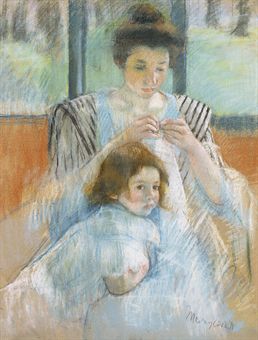
Mary Cassatt's Study for "Young Mother Sewing" was sold for $2.1 million

Mary Cassatt's Study for "Young Mother Sewing" was sold for $2.1 million

On the morning of Dec 2, 2009, three generations of Wyeth paintings were auctioned in the Christie’s Important American Painting and Sculpture Sale. A large egg-tempera on panel by Andrew Wyeth Above the Narrow was the top lot of the sale.  When the auctioneer hammered down the price of 6.1 million dollars given by a floor bidder, there was a floor-wide applause. The top lot, in this sale, was not only sold, but also exceeded expectations, beyond the five million dollar high estimate.

On the other hand, the result of 14 paintings of Rubinson Crusoe series by N. C. Wyeth, consigned by the Wilmington Institute Library was a mixed bag. Only five of them were sold (1.83 million dollars in total) beyond their reserved values, which may leave the complete series disassembled.  However, Christie’s has 30 days by contract to find private buyers for the paintings, and hopefully will eventually bring 3.8 million dollars to the library.

The Robinson Crusoe series was purchased directly from N. C. Wyeth in 1922 and have been hanging in the reading room of the library built by Pierre DuPont since then. The series, in fact, contain 17 paintings. The library holds 14 of them, while two paintings are in private hands and one missing.

The library, which was hit hardly during the recession, is hoping to raise $4 million to $5 million to renovate the neoclassical building and help replenish the library’s endowment. Based on the original plan, quality prints will replace the oil paintings by Wyeth; but now the board will meet to decide the fate of the remaining unsold nine paintings.

The only painting by Jamie Wyeth was sold for $110,000.  Most of the lots, especially those deaccessioned from art institutes were sold with solid results. But a few stand out. Mary Cassatt’s large pastel works have always been blue chips in the art market and this lot, a study for Young Mother Sewing, was sold for over two million dollars. The Water Lily by Joseph Stella brought $190,000, much more than its high estimate of $70,000. UAA team overheard the conversation between a staff and Michael Quick during the preview that it was one of the most inquired-about paintings in the sale, the result proves so. The rare Raphaelle Peale which sold for $700,000, also beating the presale estimate.  (Other still paintings faced a different fate: Neither Joseph Decker not Martin Johnson Heade attracted enough bids.)  A phone bidder spiced up the sale by giving bids much higher than necessary and drove the price for a painting by Thomas Hart Benton to $520,000.  It was one of the moments that both the auctioneer and the audience laughed in spite of some fierce competition between bidders, but such optimistic moments are too rare in the current market in which only the best quality works bring up the right values.