Tag: National Academy Museum
New York Ceramics Fair Releases Numbers
Changing locations is usually difficult for well established antiques events and event organizers always prefer to remain in their established venue and hope, if they must move, that the cloud will have a silver lining. But for this year’s New York Ceramics Fair, loosing the lovely surroundings of the National Academy Museum on 5th Avenue after more than a decade didn’t just result in a silver lining – it led to a “bright sunshiny day.”
The 2011 New York Ceramics Fair, closed Sunday, January 23, with attendance on par with last’s years number of visitors despite the new location, which, while not on tony 5th Avenue is much closer to the Winter Antique Show at the Park Avenue Armory and to Sotheby’s.
Combined with what seems to be a strong year for the other New York Americana Week shows and it would seem that it’s possible we may look at the cold winter of 2011 as the time when the market began its comeback. No matter what the numbers we’ll only be able to see that a few years down the road, but for now at least there’s reason to be optimistic. The Ceramic Fair reported attendance above 2010 on four of the six days. Averaged out, attendance was on par with 2010 despite the venue change.
And sales reports suggested that not only were the stalwart fans of the Fair present but that they were actively shopping.
Despite snow, sleet and rain on Tuesday, January 18th, the Fair’s preview was a bustling event where stalwart ceramics collectors, decorators, journalists and curators were joined by members of the New York Diplomatic Corps in the stunning fourth floor Ballroom of the home of the 73rd St. the Czech Consulate, where, nearby, a reception for the Czech Ambassador to the UN was also taking place. Opening night visitors were uniform in their praise for the charm and style of the new venue, a two story hall lit with grand chandeliers bringing added flair to the already exceptional offerings of the 30 Galleries exhibiting. Added star power that evening was provided by the dean of Interior Designers, Mario Buatta, His Excellency Martin Palous, Czech Ambassador to the United Nations, and actor Jim Carrey.
Cara Antiques, Langhorne, PA, said that visitor response to the new venue was very positive and reported sales considerably better than last year, including a large decorative charger in Palissay (Majolica) sold to the Columbia Museum of Art, Columbia, South Carolina.
Mark Murray, of Sylvia Powell Decorative Arts, London, said “I wish we had done this kind of business at Olympia in November,” continuing “we not only saw our regular clients but made some important new friends as well.” Sylvia herself reported major sales including their catalogue piece, a Martin Brothers stoneware jar and cover, modeled as a sloth-like creature in glazed ochre and brown, 1903; and the Fair’s catalogue cover, Les Trois Yeux, France, 1958, and edition plate by Jean Cocteau.
Another major English dealer, Santos, a specialist in Chinese Export reported his best overall Ceramics Fair sales in five years, with many sales to new clients, but he also said that his business was primarily in the lower price ranges. In the field of exceptional Export porcelain, the lower price ranges would from $5,000 to $20,000.
The Boston ceramic artist Katherine Houston, who creates “18th Century porcelain objects for the 21st Century” reported a show considerably better than in recent years, selling not only her catalogue piece, a pair of 16” Tall Iris figures, but a pair of large parrot tulips. As important as her sales were, the highlight of Katherine’s show was an invitation from the curator of the Fair’s loan exhibit to be a guest lecturer at the Czech Ceramic Design Institute in Dubi,. Work by artists studying at CDI comprised the Fair’s loan exhibit and Houston is eager for the opportunity to work with the gifted students tasked with the continuation of Bohemia’s long tradition of excellence in glass and pottery.
Marcia Moylan of Moylan-Smelkinson / The Spare room, of Baltimore said both they and their customers loved the new venue, and that among their sales was their catalogue piece, a very rare English Bristol Factory Soft Paste Biscuit Porecelain Birds Nest with Eggs, c 1770.
Lynda Willauer, of Lynda Willauer Antiques, Nantucket, MA, said the new venue was very popular with her clients and that while she sold mostly in the mid-range of her extensive Chinese Export inventory, the Fair generated a “fair profit.” This was a sentiment echoed by first time exhibitor Martyn Edgell from Cambridge, England, who also posted a comfortably profitable Fair.
Peter Rosenberg of Vallin Gallery, Wilton, CT, said the show was profitable and concurred that his clients enjoyed the new venue. Rosenberg reported that most of his businesses was in the lower end of his inventory, however, and that for him sales weren’t quite as strong as at the 2010 Fair.
On the other hand, Fair veteran John Suval of Philip Suval, Inc., Fredericksburg, VA posted stronger sales than last year, and was pleased with the commercial strength of the Fair. He said the venue worked very well for him, and that his customers thought it was excellent.
English dealer John Howard of Woodstock, Oxfordshire, was very pleased with the 2011 Fair, where he had strong sales, including an exceptional 43 piece table service in 18th Century Creamware. The service, typical of what is seen in the country houses of 18th Century English aristocrats was remarkable not only for its beauty but for its pristine condition.
First time vendor, Elise Abrams of Elise Abrams Antiques, Great Barrington, MA, who’s vast array of stunning 18th C. dinner ware dominated a corner of the ballroom, was pleased to report a small profit derived primarily from regular clients of hers who were also fair patrons.
New York dealer Jill Fenichell, returning to the fair for the first time in five years, said sales were not what she had hoped but that she was pleased overall and delighted to be “back in the fray.”
Alan Kaplan and Susan Kaplan Jacobson of Leo Kaplan Ltd. reported that despite a weaker show than last year, they did sell a very important “Littler Blue” salt glaze bowl with pierced boarder, c. 1750-55.
Iznik Classics, the Istanbul pottery based on rare 14th Century Turkish designs reported sales as strong as last year, as did Oriental Treasure Box from San Diego. First time Fair participant, Antiques Van Geenen, the prominent Delft gallery from The Netherlands, encountered shipping difficulties leaving them with no material until only two hours before the opening, but was able to post a sale to a major US museum sale and considerable interest in their impressive presentation.
The Fair’s eight lecture series was heavily subscribed and very well received in the recently completed Bohemian National Hall theatre
A solid representation of museum curators was again reported by dealers with including those from The Corning Glass Museum, Winterthur, The Metropolitan Museum; the St. Louis Art Museum; Colonial Williamsburg; Stratford Hall (the birthplace of Robert E. Lee); the Reeves Center at Washington & Lee University; Chicago Art Institute ; the Carnegie Museum of Art, Pittsburgh; the Cleveland Museum of Art; The Museum of Fine Arts, Boston; Museum of Fine Arts, Houston; Gunston Hall Plantation (home of George Mason) and Oatlands Historic House and Gardens.
The New York Ceramics Fair is produced by Caskey Lees of Topanga, Canyan, whose next New York City event is Arts of Pacific Asia at 7 W, opening Wednesday evening, March 23 and running through March 27th. The New York Ceramics Fair will return to the Bavarian National Hall to again launch Winter Antiques Week on January 17th, 2012.
Highlights of The New York Ceramics Fair January 19th-24th 2010
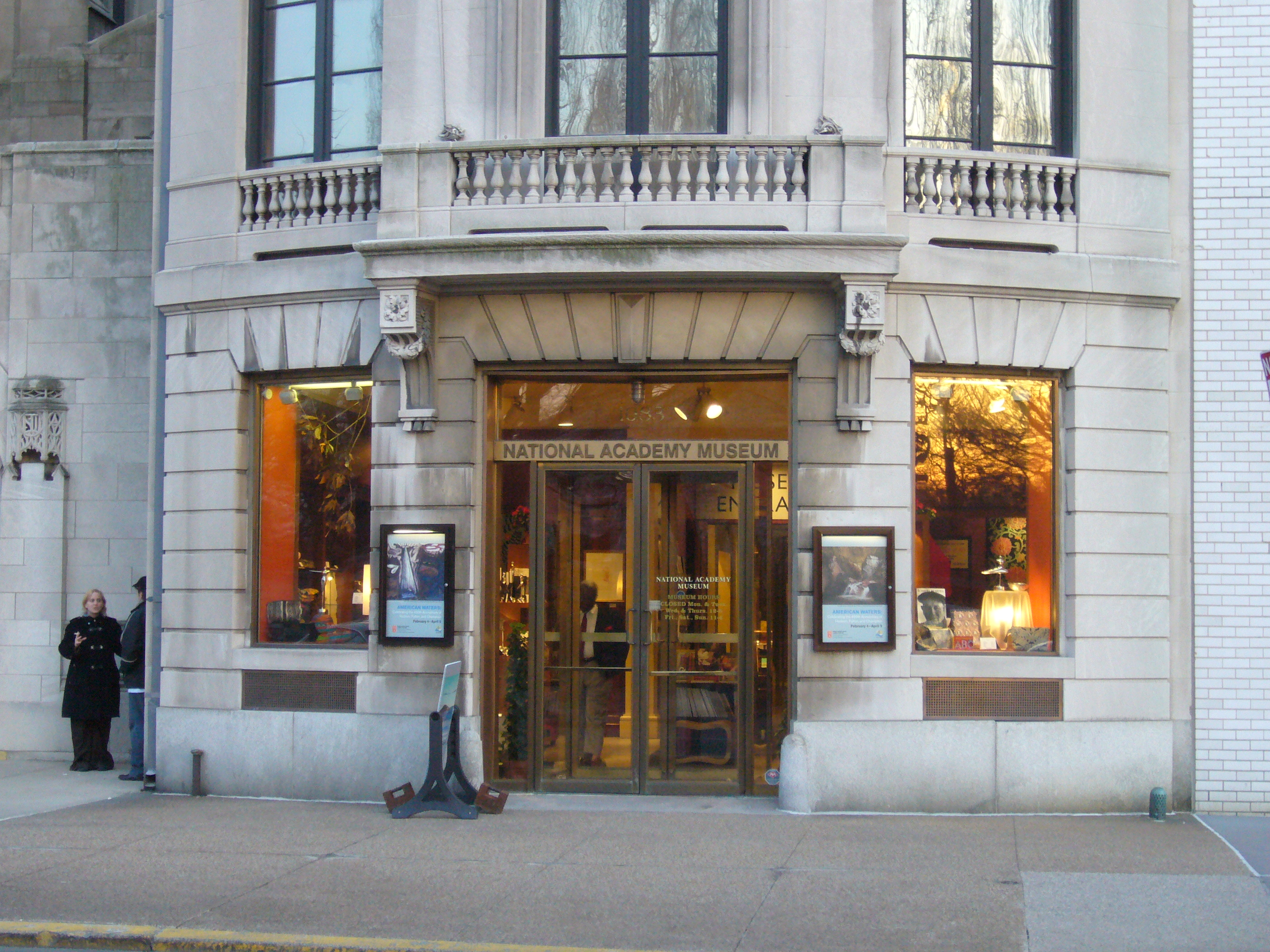
If you have never been inside The National Academy Museum it stood as a stately backdrop for the annual New York Ceramics Fair produced by Caskey Lees Inc. of Topanga, California. With the spiral staircase winding around to bring the attendees to the rare and valuable pieces above it more than fulfilled its purpose.
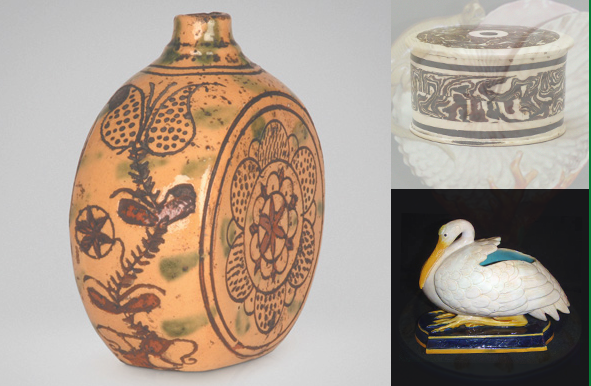
The opening reception was held on Tuesday, January 19th from 5:00 until 9:00 p.m. In the hall in front of the Rotunda was the exhibit from North Carolina of the Monrovian Potter’s. Its unique quality resonated with the attendees. Amongst the early pieces there were squirrel, lady and fish bottles, molds and other items. These items are quite rare and hence quite valuable.
In the Ross Gallery, Garry Atkins of England, specializing in Early English Pottery had some extraordinary pieces. Such items included beautiful Agateware and a 18th century plate of King George 1. His pieces deserve an honorable mention.
Leo Kaplan LTD. Located at 114 East 57th St., New York, NY was also present in the Ross Gallery. In his display he featured some fine ceramics. One in particular was a very rare English Salt glazed stoneware teapot painted with a marbled design.
Ross Gallery 28 had world renowned Earl D. Vandekar of Knightsbridge Inc. located in Maryknoll, NY. Particularly intriguing was a pair of English Figurines of a family, mother, father and children riding a pair of goats. The mom had the children, one nursing, and two in a back pack. The dad had a couple of baby goats in a pack on his back. The intricate detail was striking.
One more of the principals whose items stood out because of the bright vibrant colors and designs were in Gallery East 1 from Solisbury, PA., Charles Washburne. He is a well known Majolica provider. In his booth was a wonderful monkey teapot, a beautiful peacock and many other items.
Garrison Strandling a very well known purveyor of fine quality ceramics and a regular part of the Antique Road Show was on site. Amongst his pieces was an early Mochaware cream pitcher that was identified as once belonging to Jonathan Rickard, author of Mocha and Related Dipped Wares, 1770–1939. Later in the evening Jonathan was present in The Strandlings booth, rumor has it he may have been trying to buy his piece back?
The Ceramics Fair offered a lecture series organized by Paul Fox. One of the topics covered were Dutch Jugs and Flint Wares: Salt Glazed Stoneware in Early America by Janine Skerry a curator at the Colonial Williamsburg Foundation and Surprises in American Stoneware by Suzanne Findlen Hood, associate curator also from Colonial Williamsburg. Suzanne and Janine coauthored a just released book: Salt-glazed Stoneware in Early America.
Another topic covered was Wedgewood: 250 years of Innovation and Derivation by Dr. Jeffrey Tulman President of the Wedgewood Society of New York. Dr. Tulman is a very interesting speaker with great wit and a wealth of information. Other topics covered were, Chinese Export Porcelain Coffee Wares by Ronald W. Fuchs 11,The North Carolina Monrovian Earthenware Tradition by Johanna M. Brown Curator at Old Salem Museum and Gardens. The last and final class was given by Michelle Erikson she demonstrated the making of a squirrel bottle from the mold to the piece ready for firing.
The New York Ceramics Fair was well attended and well organized. Praise to Caskey Lees Inc. and all who worked hard to bring another fine event. The Fair is considered the Gem of Antique week in New York City and it truly sparkled as a Gem should.
Melody Howarth, Mel’s Belles Restorations

Janine E. Skerry and Suzanne Findlen Hood, Colonial Williamsburg

Jonathan Rickard

Garrison Strandling
Free Admission to Fine Art Fair and Lecture at National Academy
The American Art Fair will debut December 1-4, 2008 at the National Academy Museum & School of Fine Arts, 1083 Fifth Avenue at 89th Street, New York City with a gala preview on Sunday, November 30. The Fair focuses on the grand tradition of American art established early in the 19th century and gathers more than 200 works in a virtual “group show” by National Academy members and their circle.
On Wednesday, December 2, 5:00PM, there will be a penal discussion “Collecting in the Age of Technology” hosted by the National Academy Museum in conjunction with The American Art Fair running from Nov 30 – Dec 3. The panel will discuss the advantages and pitfalls of various popular online resources and the latest specialized technology.
A Pomegranate You Can’t Afford

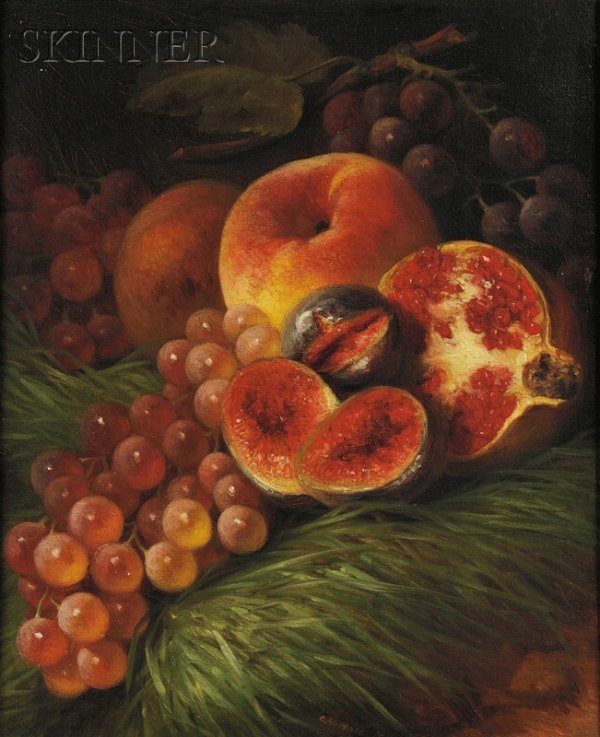
Still Life by George Henry Hall in 1862, estimated between $700 to $900 and sold for $6500 at Skinner's Auction
OK, don’t blame me: Blame William Gerdts. It is in his book “For Beauty and for Truth: The William and Abigail Gerdts Collection of American Still Life” that he wrote “if you both write and collect, collect first and then write – not the other way around!” Thus even though we have a series of “A Gaggle of Intererts” which records things that have caught our eyes, we occasionally write after the auction is over. Our rules of collecting is simple: 1. It is not just we can live with, but we cannot live without. 2. We can afford it, more importantly we can still pay our bill if we buy it.
Thus when we find something extraordinary not only for its quality, but also for its possible final price, we hold our breadth and faintly hope no one else has seen it. But too often the deal was too good to be true. With the advent of internet applications (such as artfact or liveauctioneers), the auction information and their relative market values (such as artfact, askart or artnet) have been democratized. If everyone is bargain-hunting for items whose availability is widespread, then there are no real bargain.
So I dropped our phone bid last time for a painting by William Coventry Wall at Treadway with a low estimation of 500 dollars because we knew it was futile and naive to think it would be sold near that. But the final price $22,000 plus premium was still a shock.
Tonight we encountered another similar case. A still life painting by George Henry Hall was auctioned at Skinner’s “American & European Paintings & Prints” sale. It was estimated between $700 to $900 and bears a label from the Grand Central Galleries.
I admit it was not the most stunning still life painting by Hall I have seen, but I abhor giant sized food-porn like still life and prefer a more on-the-study-side smaller painting. Such a gem (10 by 11 inches) would be inviting for an intimate study. It has everything that characterizes Hall as a still life painter. The dramatic lighting and vertical complex composition contribute a lively dynamics to the still life; the lush colors created by a range of red lying on top of soft green grass are marvelous to view; and pomegranate, his specialty fruit, is in the picture although the seeds do not have the chance to spill out in the Ruskinian nature setting. Above all, this could have been the only Hall I could afford (although still with some stretch) if the painting had been sold for what it had been estimated at.
Eric was more or less aloof to the half eaten fruits on a staged setting, but I managed to convince him that it was the trick used by still life experts to showcase the texture and in a different degree add the lure of appetizing. Hall painted this one in 1862, two years after the first successful auction of his still life paintings. And the old hand-written label from a distinguished yet closed gallery in New York only added more charm.
At 5:25PM, the phone rang, from Skinner. Then as I waited (in sweat) for a couple of preceding lots, came lot 423A. Before I had the chance to say “yes”, the starting bid roared to $1900. Eventually it went for $6500 plus premium.
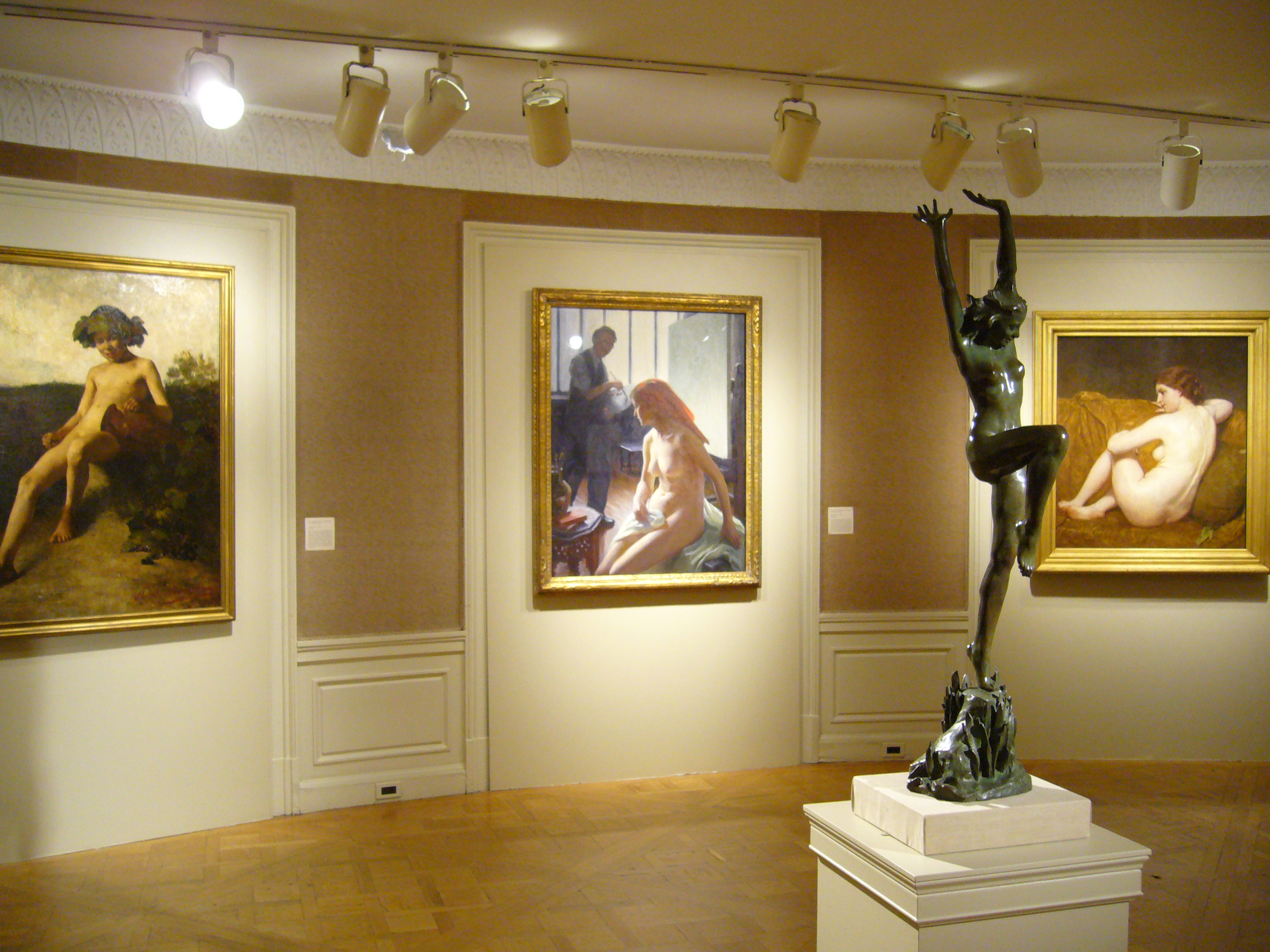
Afterwards I headed to the National Academy Museum for a gallery talk by Curator Bruce Weber on the current exhibition “Reconfiguring the Body in American Art, 1820–2009“, my second visit to the same show. It was there that Dr. Weber talkd about the half nude figure of a Dead Rabbit Gang member, probably Irish, painted by George Henry Hall, NA. It was a portraiture of social and historical significance. The Irish young man leaned his head slightly toward the back, defiant and aloof; yet his body exudes energy and power echoed by fires seen in the background, a reference to the gang riot near the five points not long before this picture was painted. The solid modeling of the body is an evidence that Hall, trained in Düsseldorf Royal Academy, possessed imagination and skills to all types of genres, and perhaps chose still life only because it was closer to his heart. Bruce pointed out although Hall, already well known for still life, substituted this painting for an unidentified fruit painting. Such a practice reflects what the artists of the time conceived the academy, a place for high arts for historical and figure paintings. In 1985, a group of drawings by Hall was given by James Craig to the institute, still there is no single still life painting by Hall in the inventory of the Academy. “I would not trade a still life for this one, ” Dr. Weber emphasized in the end although he commented that he loved Hall’ still life when I told him just hours ago a still life with a pomegranate was sold at Skinner.
I took it as a comfort that even a museum with the fourth largest collection of American art is on the hunt (perhaps through donation) of a George Hall’s still life. On the second thought: I can’t afford it, but whoever owns it can’t eat it. That is a real comfort.
Reconfiguring the Body in American Art, 1820–2009 — A Slideshow
Holding the fourth largest collection of American Art, the website of National Academy Museum before “successfully” hid its breadth and depth of its vast collection and shun away a lot of visitors who glimpse online before going. There used to be one web page naming the members of the Academy. But the museum seemed shy to admit that a lot of the collection came from the diploma paintings, which are required for every newly elected member. The controversy about their deaccessioning works last year had brought a lot of attention to the nature of this special museum, whose collection came as a by-product of membership and whose artistic talented members are not keen to marketing or daily operating.
When I checked the National Academy Museum’s website this morning, I was happy to find out that finanlly there is collection search function available now. BUT: Not perfect. In fact far from perfect. First the paintings are listed by the titles, which do not make too much sense compared to the creators’ names. Secondly, the so-called “enlarge image” function merely magnifies a thumb-nail picture to a name card size. I can understand there are copyright issues around the 20th century artworks. But for those of the 19th century, I would appreciate one that can do justice to the painter.
Around noon time which seems to be the first hot day in this Summer at New York City, the line in front of Guggenheim was so long that almost reached the door of NA. But NA was a different scene: About thirty something people in total were in the galleries. Perhaps foreigners and out-of-towners are more likely to hear about the famous Guggenheim collection instead of diploma paintings of NA members, perhaps the Wright building looming out of the 5th ave is more aggressively inviting than the elegant yet reticent townhouse of NA, but perhaps their PR and marketing need more effort. For me, an exhibition of human figures from one of the leading American Art museums is a must-see, even though their website shows few of the more than 150 paintings nor there exists a catalogue. After years of abstract modernism and hybrid installation taking over New York art scenes, the most fundamental and enduring, yet the most challenging art form: human figures and portraits spanning almost two century are a recollection of humanity which pushes us to examine people as posed sitters, subject in actions or self reflection.
The rest is a slideshow which is intended to bring some of the pictures to those who are curious about this exceptional show, something that is not available through books or official website. No picture can do justice to real artworks, and I would hope those Guggenheim goers may find the neighboring smaller yet older museum has much if not more to say, with the t benefit of being surround by artwork, not visitors.
A review blog will come soon. Stay tuned.
The American Expansiveness — American Waters Exhibition at National Academy Museum
I did remember that the calendar of National Academy Museum (NA) of last year showed that an exhibition highlighting its permanent collection would open in early 2009. Perhaps permanent collection is such a sensitive word for NA that the museum decided to embrace the opportunity of celebrating the 400th anniversary of Hudson, Fulton and Champlian instead. “American Waters”, an exhibition based on NA’s permanent collection, shows the expansiveness and variety of marine paintings by generations of American artists.
The title is somewhat misleading because not only Hudson River but also Niagara Falls, Bash-Bish Falls in Massachusetts and Sweetwater River in Wyoming were celebrated in the exhibition. In fact, the pure American identity of the waters in the exhibition could be dubious because the locale in the painting by Charles Temple Dix could be Cornwall, England.
Nevertheless, the exhibition does show the depth of the collection at NA. In particular, one school – Pennsylvania Impressionists and one artist – William Trost Richards are presented with more weights.
Geo’s favorite is “Source of the Susquehanna” by Louis Remy Mignot, probably because he is familiar with the wide open water space of Susquehanna River in Harrisburg, Penna. The exclusiveness and wildness of the Susquehanna River near its source was painted with a palette of jewel-colors by Mignot: emerald green, topaz yellow, and turquoise blue. Even the cascading water was rendered in a surreal deep blue as if the burning sunset in the background could never touch the virginity of the “mirror” in the forest.
My favorite is “On the Sweetwater, Near Devil’s Gate“, a painting on a millboard by Albert Bierstadt. Even on a small scale, Bierstadt’s talent of transforming lakes and mountains into miracles of light and air can be felt as much as his 8-foot canvas. The clouds and sunlight play an unpretentious role in this magical painting. The light has just broken through the clouds and illuminates sides of the tree trunks of the middle ground. Three deers are wandering nearby. In a moment they will be bathing in the sunlight too. Viewers who are placed in the shadowed grass foreground would anticipate a change in color and warmth as what they have seen in the thematic transition depicted in the picture.
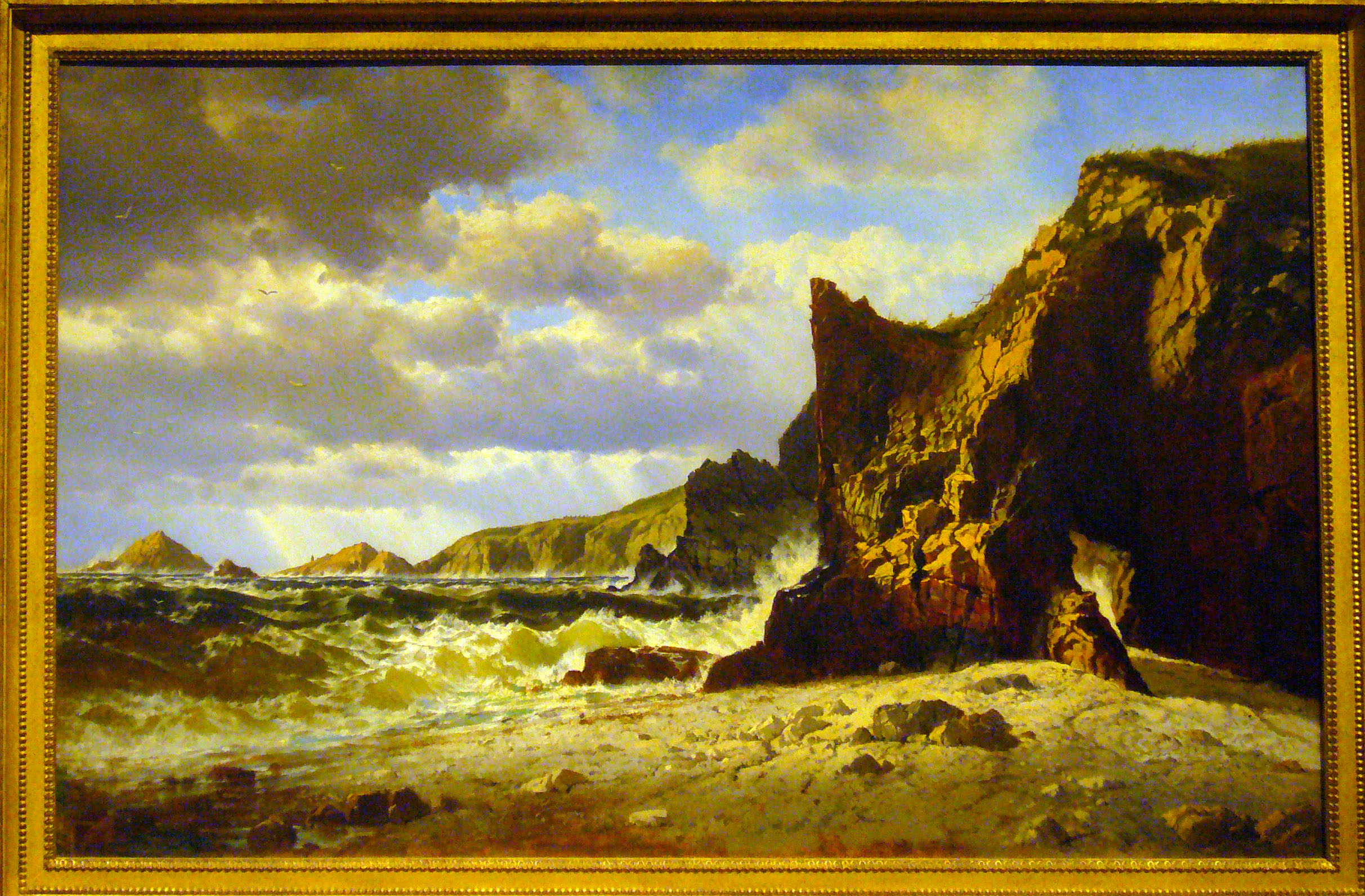
There are eight works by William Trost Richards. It is unusual to see an artist of that period with such a caliber of mastering colors (as shown in his painting “Coastal Scene” in 1862) with an almost puritanical restrain. In his marvelous watercolor works such as crushing waves or white masts under stormy clouds, nothing would be associated with romanticism like those done by Thomas Moran. The simplicity and clarity in his marine works has a factual tendency, which I found is very enchanting. If Charles Temple Dix found the beauty of seas from the excitement of traveling, then Richards praised rocks and waves that he owned and lived with with unassuming sincerity.
The urban scenes are presented by Guy Carleton Wiggins and Ernest Lawson. Wiggins’ night scene of New York City with bold slahses of dash lines is eerie in my mind since the sharp edged skyscrapers lit at night contradict to his signature vagueness in the snow scenes. Lawson’s choice of urban scenes (with his rivers, bridges and cliffs devoid of crowd) are always bordering suburban. Perhaps that is why he chose to live in Washington Heights. It is funny that National Academy now exhibits the works of “The Eight” who rose against the institution in the early 20th century.
American Waters: Celebrating the 400th anniversary of Hudson, Fulton and Champlain is now on exhibition at National Academy Museum from Feb 4 to April 5. For those who could not squeeze into the jammed door of Guggenheim Museum next door, NA, in the Huntington mansion, is much more cozy and relaxing.


Recent Comments