Tag: National Gallery of Art

National Gallery Accepts Important Works by Adams, Whistler, Others

Filed in Art, Museums by on August 4, 2012 0 Comments
James McNeill Whistler, White and Pink (The Palace), 1879/1880, pastel and black chalk, National Gallery of Art, Washington, Paul Mellon Fund and Patrons’ Permanent Fund

James McNeill Whistler, White and Pink (The Palace), 1879/1880, pastel and black chalk, National Gallery of Art, Washington, Paul Mellon Fund and Patrons’ Permanent Fund

The National Gallery of Art’s Board of Trustees recently announced acceptance of a number of new acquisitions, augmenting the collections of paintings, sculpture, works on paper, and photographs. These new works included a collection of 169 photographs by Robert Adams hand-selected by the artist; the Gallery’s first watercolor by Thomas Moran; its first paintings by Giorgio Vasari and Hendrik Willem Mesdag; a newly attributed portrait drawing by Michael Sweerts; and a major sculpture by Barry Le Va. “There are a good number of ‘firsts’ in this exciting round of acquisitions, ranging from Giorgio Vasari’s larger-than-life paintings of Saint Luke and Saint Mark and Thomas Moran’s extraordinary watercolor Mountain of the Holy Cross, to Barry Le Va’s post-minimalist sculpture,” says Earl A. Powell III, director, National Gallery of Art. “We are also pleased to add an important group of gelatin silver prints of America’s changing landscape by Robert Adams, which joins the Gallery’s major holdings of works by fellow luminaries of American photography such as Alfred Stieglitz, Robert Frank, and Harry Callahan.” The board also received news that Mrs. Paul Mellon has released her life interest in eight works to the Gallery: William Merritt Chase (1849–1916), Gathering Autumn Flowers (1894/1895), oil on canvas; Winslow Homer (1836–1910), East Hampton Beach, Long Island (1874), oil on canvas, and Three Fisher Girls, Tynemouth (1881), pencil and watercolor; Eastman Johnson (1824–1926), Lambs, Nantucket (1874), oil on board; Odilon Redon (1840–1916), Village by the Sea in Brittany (c. 1880), oil on cardboard laid on masonite; Georges Seurat (1859–1891), Seascape (Gravelines) (1890), oil on panel; Eugene Boudin (1824–1898), Crinoline sur la plage de Trouville (c. 1865), watercolor; and Pablo Picasso (1881–1973), Verre, as de trèfle et poire coupée (1914), collage, charcoal and gouache.

Mighty Minimalist Herbert Vogel Dies

Filed in American Art, Art, Museums, News by on July 22, 2012 0 Comments
Mighty Minimalist Herbert Vogel Dies
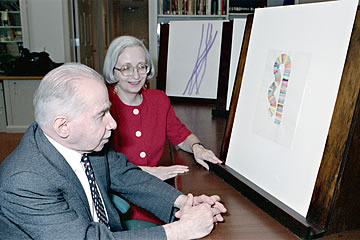
Dorothy and Herbert Vogel look at a drawing by Richard Tuttle from their collection in the Print Study Room, National Gallery of Art, 1992. Photo by Lorene Emerson, National Gallery of Art, Washington, D.C., Gallery Archives.

Dorothy and Herbert Vogel look at a drawing by Richard Tuttle from their collection in the Print Study Room, National Gallery of Art, 1992.
Photo by Lorene Emerson, National Gallery of Art, Washington, D.C., Gallery Archives.

If you think you can’t afford to collect art, consider the story of Herbert Vogel. Vogel was an art collector who with his wife Dorothy amassed more than 5,000 works, mostly drawings, on a civil service income. Vogel was the son of a Russian Jewish garment worker, never finished high school and worked as a clerk for the United States Postal Service until retiring in 1980. His wife Dorothy worked as a librarian. The Vogels kept their collection of minimalist work in their one-bedroom New York apartment, then in 1992 donated it to the National Gallery of Art. Works from the collection have appeared in numerous exhibitions throughout the world, including two major exhibitions organized by the National Gallery that were selected solely from their collection. In late 2008, they launched The Dorothy and Herbert Vogel Collection: Fifty Works for Fifty States, donating 2,500 works to 50 institutions across 50 states and also that year an award-winning documentary about their story, Herb and Dorothy, was released. Vogel died recently of natural causes at the age of 89.

Rare Still Life by Duncanson Enters Collection of National Gallery of Art

Filed in Art, Museums by on February 6, 2012 0 Comments
Rare Still Life by Duncanson Enters Collection of National Gallery of Art

Robert Seldon Duncanson, Still Life with Fruit and Nuts, 1848, oil on board, National Gallery of Art, Washington, Gift of Ann and Mark Kington/The Kington Foundation and the Avalon FundThe National Gallery of Art has acquired one of fewer than a dozen known still lifes painted in the late 1840s by African American artist Robert Seldon Duncanson (1821–1872). Classically composed, Still Life with Fruit and Nuts (1848) depicts fruit arranged in a tabletop pyramid in which the smooth surfaces of beautifully rendered fruit contrast with textured nutshells. The acquisition was made possible with funds from Ann and Mark Kington/The Kington Foundation and the Avalon Fund.

Measuring just 12 x 16 inches, Still Life with Fruit and Nuts is on view in an intimate room (Gallery M-69A) of the American collection alongside other still-life works by such American artists as Joseph Decker, William Michael Harnett, Martin Johnson Heade, James Peale, Raphaelle Peale, and John Frederick Peto. Like Duncanson’s other still lifes, it is spare and meticulously painted, reflecting the tradition of American still-life painting initiated by Charles Willson Peale and his gifted children—particularly Raphaelle and Rembrandt Peale.

Self-taught and living in Cincinnati when he created his still-life paintings, Duncanson exhibited several of them at the annual Michigan State Fair. During one such exhibition, a critic for the Detroit Free Press wrote, “the paintings of fruit, etc. by Duncanson are beautiful, and as they deserve, have elicited universal admiration.” The artist’s turn from still-life subjects to landscapes conveying religious and moral messages may have been inspired by the exhibition in Cincinnati of Thomas Cole’s celebrated series The Voyage of Life (1842). Cole’s allegorical paintings were purchased by a private collector in Cincinnati and remained in the city until acquired by the National Gallery of Art in 1971. Exposure to Cole’s paintings marked a turning point in Duncanson’s career. Soon he began creating landscapes that incorporated signature elements from Cole and often carried moral messages. Visitors can also see The Voyage of Life in the American galleries, not far from Duncanson’s painting.

Following the outbreak of the Civil War, Duncanson traveled to Canada, where he remained until departing for Europe in 1865. Often described as the first African American artist to achieve an international reputation, Duncanson enjoyed considerable success exhibiting his landscapes abroad. His achievement as a still-life painter has only recently garnered attention. The exceptional quality of Still Life with Fruit and Nuts suggests that much remains to be learned about this little-known aspect of his career.

Woman Screaming “This Is Evil” Attacks Gauguin Painting at National Gallery

Filed in Art, Museums, Shows and Markets by on April 4, 2011 1 Comment
Woman Screaming “This Is Evil” Attacks Gauguin Painting at National Gallery

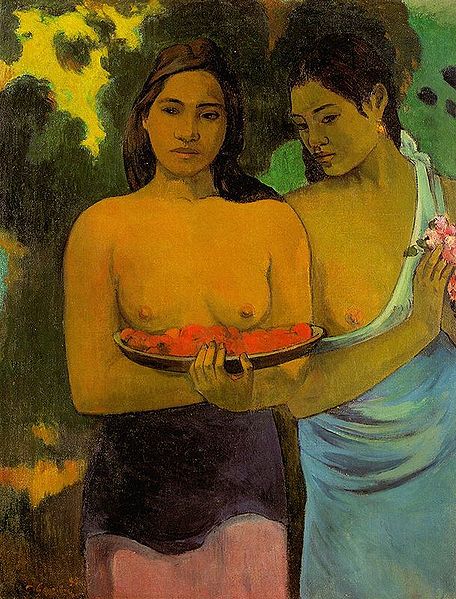
Two Tahitian Women by Paul Gauguin, Metropolitan Museum of Art, Gift of William Church Osborn, 1949

A painting by Paul Gauguin on loan from the Metropolitan Museum of Art and hanging in the National Gallery in Washington D.C. was attacked last week. Reports indicate there is no apparent damage, but the work will be inspected more closely. The attacker apparently pounded the painting with her fists then tried to pull it from the wall screaming “this is evil” and was detained. Reports indicated a social worker from the Bronx came forward in an attempt to stop the woman from damaging the painting, which was covered by a clear plastic barrier. Gauguin: Maker of Myth opened at the National Gallery of Art in February.

You Don’t Have to Be Wealthy to Collect Art

Filed in Art, Museums by on June 8, 2010 2 Comments
You Don’t Have to Be Wealthy to Collect Art

Guest column by Lynn Zelevansky, The Henry J. Heinz II Director, Carnegie Museum of Art

Whenever my husband and I watch a procedural on television that involves an art dealer, artist, or other art-world denizen, we always nod to each other as soon as the character appears because we know he did it. (It’s usually a man.) We haven’t been wrong yet. Why is this? Why is the art world endlessly depicted as a mercenary place populated by craven characters with vaguely European accents who are at once effete and sleazy?

One reason is that the vast sums sometimes spent in galleries and at art auctions make headlines, creating the picture of a wholly elitist subculture. Art’s value as a commodity is difficult to quantify, so people hearing about the art market may reasonably assume a closed, inaccessible system. The life-changing capacity of art—that it can add meaning to existence beyond mere entertainment and consumption—is replaced by a vision of status seeking and insider trading.

Last February, Walking Man, a 1961 sculpture by Alberto Giacometti, set a record auction price of $104.3 million. There was celebration in Pittsburgh because the first—so arguably the best—cast of this bronze belongs to Carnegie Museum of Art. In a feature article on the front page of the Post-Gazette, I appeared in the galleries gesturing toward the museum’s cast. Acquired the year it was made for a price in the low five figures, Walking Man I has stood in our galleries ever since, an almost ethereal presence, alone, striding forth into the void.

A scant three months later, the record set by the Giacometti was broken by a Picasso, which sold for $106.5 million. It’s OK. While it is nice to own an acknowledged masterpiece, high prices do nothing for a museum but increase its insurance bills and make it more difficult to acquire new works for the collection.

The prices you read about obscure the fact that the vast majority of artists cannot eke out a living from their work but persevere anyway. Museum workers, and even most dealers, are far from rich; the field is filled with idealists who, in order to do what they believe in, work for lower salaries than they could command at other jobs.

What many don’t realize is that you don’t have to be wealthy to collect art. A prime example is the Vogels, subjects of the 2008 documentary Herb and Dorothy; in the 1960s and ’70s, on the salaries of a postal clerk and librarian, they amassed a vast collection of contemporary art, most of which now resides at the National Gallery of Art in Washington, DC. There are many areas in which art is affordable. If contemporary art is your interest, as you get to know the field, you may decide to buy artists’ works early in their careers, or to purchase prints and photographs, which are less costly. There are few mistakes except missed opportunities.

In order for Pittsburgh to sustain and expand its lively art world, we need more galleries and collectors to support our artists. I encourage you to join the ranks. And come often to the museum to see what our curators are acquiring; we promise we haven’t been portrayed on past episodes of Law and Order.

Movie Review: The Mighty Minimalists

Filed in Artists, Museums by on June 17, 2009 1 Comment
Movie Review: The Mighty Minimalists
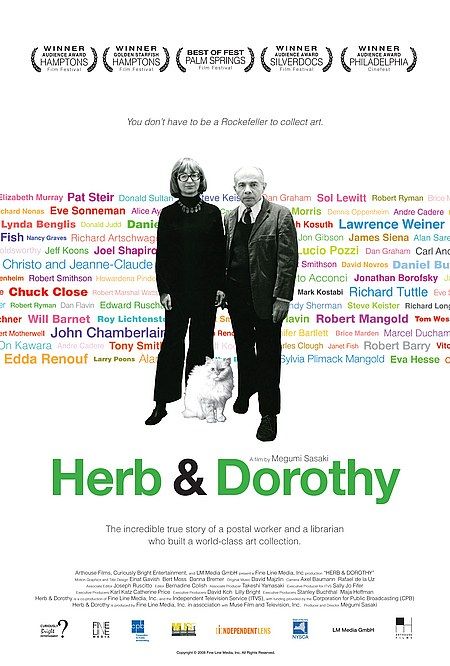
Herb & Dorothy

Herb & Dorothy

The documentary “Herb & Dororthy” is not only a story about how to amass a world-class collection with a minimal income, but also a story of an exceptional couple whose passion for art and obsessiveness of collecting outshine others with deeper pockets and bigger stature.

Although the income from jobs as a postal clerk (Herb) and a librarian (Dorothy) maybe small, the stable jobs at least guarantee their income was not fluctuating with Wall Street. The jobs also necessitated they could pursue their passion in the afterwork hours. Moreover, there are too many collectors who are swayed by the market trends and buy artworks as if they are stocks. It seldom works because as Sister Wendy says, contemporary works need more time to be digested and understood. The greatest collectors buy ahead of the market with their eyes and hearts. By the time when certain artists or schools claim media and market appreciation, little room is left for opportunity seekers.

The Vogel’s bought what they like and what they could afford to fit in their budget and living space. I expected the movie would shed light on how Vogel’s judge the quality of or interpret the meaning of minimalism and conceptual art. But too few clues can be found in this film. On one occasion, you can hear Herb — the driving force of the collection (based on Dorothy’s comments)– remarking on a photo of “Keith” by Chuck Close as a process of the process, which would be used to choose crop marks for the larger work. Another case appears when Herb thought the small sculpture was placed wrongly and exclaimed that it is hard to make a small sculpture that feel like a big one. However, most of time the only diologue heard is to the tume of general comments like “they are beautiful” or “they are great.”

This is different from some adult museum-goers who feel disoriented and stupid in the contemporary galleries and walk away from the works before the resonance of the same comments die out in the gallery. The Vogel’s look. They look long enough as if there is a universe inside the artworks. And they look more, sometimes directly from the artists. They look not only completed works, but also processes and sketches. They may not paint, but they want to look at the artworks from the artist’s point of view.

Such understanding can be deeper than what words could purport. Thus whatever words they use to describe their feelings are not that important.

I have not been a fan of abstract art. For most of the modern or contemporary art, I either get it or could not stand it. But what Herb and Dorothy have shown is that the intellectual quality and interpretability is less important than the instinct stimuli and instant aesthetic enjoyment. Abstract artworks, even in the form of pure texts should be approached first as an assembly of lines & patterns, light & shades, colors and movements. In the least subjective manner, such works demand the most subjective, almost primeval comprehension. In short, words fail.

As much as I admire their fortitude in collecting, I disagree the way they pile up and hoard the collection in their one-bedroom apartment. Without National Gallery of Art, they would have probably never figured it out exactly how many pieces of artworks they had. Nor could they have displayed artworks properly. Modern and contemporary artworks need room to breathe, a proper premise they could not follow. In the documentary, I saw piles of folders next to the bed. What if the cat jumps onto the pile or scratches some papers? An art guardian should not only preserve the works, but also pursue to the best way to show their beauty. With more than 4,000 artworks in the one-bedroom apartment, I doubt they could even look at them frequently since they are in the perpetual hunting of the next one.

The final decision to select 50 museums in 50 states to donate their collection is a wise one since National Gallery of Art cannot absorb more than 1,000 artworks from their collection. True, NGA never deaccessions their works, but what is the purpose if those arts cannot be shown?

Again, I like to quote Miron True, the former curator of antiquities of the J. Paul Getty Museum. “But if we don’t show those things, and we don’t interpret them and we don’t use them to educate people, what are they surrounded by? Plastic and bad design and things that have no aesthetic quality at all.”

From Youtube: Herb and Dorothy: Philadelphia Film Festival Q&A

Megumi Sasaki director of the documentary film Herb and Dorothy and Ann Webb executive director of the Canadian Art Foundation discussed what inspired Megumi s interest in the story of the Vogels.

Reel Artists Film Festival: Megumi Sasaki, director of the documentary film Herb and Dorothy from Canadian Art on Vimeo.

A Gift to the Nation and a Loss to Pittsburgh

Filed in Museums by on April 17, 2009 0 Comments
A Gift to the Nation and a Loss to Pittsburgh
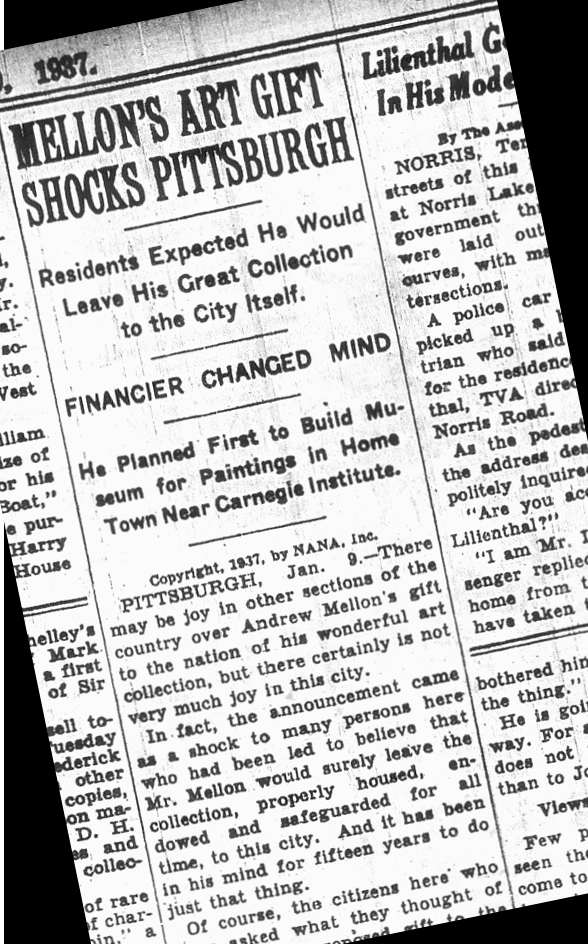
1937 New York Times Article

1937 New York Times Article

The lot was surveyed for as new museum beside the Carnegie Institute in Pittsburgh. Andrew Mellon was to locate his lasting tribute in his home city. The museum of old masters would have complimented Carnegie’s collection of “the master’s of tomorrow.” It would also have been an addition to a number of buildings in Pittsburgh that are directly or inderectly in attributed to Mellon including the Koppers Building, Aloca, Mellon Institute, the Mellon Bank Building and later, BNY Mellon tower.

The National gallery of Art website says only that during the 1920s, Mr. Mellon began collecting with the intention of forming a gallery of art for the nation in Washington. But a 1937 story in the New York Times indicates that almost to the end it was not clear the museum would be located in the nation’s capitol, in fact many thought it was to be in Pittsburgh.

“Mellon’s Art Gift Shocks Pittsburgh,” the headline reads.

There may be joy in other sections of the country over Andrew Mellon’s gift to the nation of his wonderful art collection, but there is certainly not very much joy in this city. In fact, the announcement came as a shock to many persons here who had been led to believe that Mr. Mellon would surely leave the collection, properly housed, endowed and safeguarded for all time, to this city. And it has been in his mind for fifteen years to do just that thing.

No exact reason was given for the change, but the article contends that one thing was for sure, that Mellon likes Washington and would spend the Winter of 1937-’38 there. Seven years before, Mellon was quoted as saying, “If I were given the opportunity to exchange my own period of time for any other, I would choose, without hesitation, the next three quarters of a century and, needless to add, I would live it in America and preferably in Pittsburgh.”

In retrospect, I am sure consensus would be that Mellon made a wise decision. Given the opportunity to provide the nation with a fine art museum is a much bigger statement than a art-filled monument to himself and his legacy in Pittsburgh. One more thing, for Andrew Mellon, the winter of 1937-’38 was not to be. He died in August, 1937, seven months after giving his gift to the nation. Had he delayed that decision, such an article may never have appeared and the collection would be in Pittsburgh.

Thomas and Turner

Filed in Art, Artists, Museums by on September 7, 2008 0 Comments
Thomas and Turner

It wasn’t “two for Tuesday,” but none-the-less the Met offered back-to-back lectures on Turner this afternoon. Turner and the Romance of Britain given by Simon Schama, University Professor, Department of Art History and Archaeology, Columbia University was the first, followed by Turner and America by Franklin Kelly, Senior Curator of American and British Paintings, National Gallery of Art.

If there’s one thing I haven’t learned about New York yet, and especially about the Met, it’s get there plenty early or you may not even be able to find standing room. Indeed the theater was too crowded for the first lecture, so we headed to the American Galleries and returned for the second. By then a few sould had given up their seats and we secured some for Kelly’s talk.

I am sorry I missed Schama’s talk, seeing the end of it I could tell he was very animated, often hitting the microphone with his moving hands while speaking. (this is another thing about Met lectures, I recall a gallery talk by Ronald Freyberger after which folks were grabbing for a lecture schedule like signatures from a celebrity).

On to Turner and America… While England learned of Turner from his paintings, Americans learned of him from black-and-white prints, in which his work might not look so different than say Constable. The American painter Thomas Cole went to Britain to learn history painting, and seems to have picked up some cloud techniques from Turner, although Kelly said he was shocked by the man himself and referred to his work as “lacking solidity.”

While Turner belongs to England, it may be American painter Frederick Edwin Church and Thomas Moran (born in Britain, moved to America) who picked up where he left off. As Kelly demonstrated, several of Moran’s paintings are strikingly similar to works by Turner. The effect is intentional, and on occasion it’s difficult to discern the work by Turner from Moran.

This is the third time I have seen this exhibition, the first being in Washington, DC. Mich of it goes back to Merry old England in a few weeks, so head to the Met soon to see the painter Queen Elizabeth called “Mad.” “J. M. W. Turner

A Visit to the National Gallery of Art

Filed in Museums by on August 5, 2007 0 Comments