Tag: Pennsylvania Academy of the Fine Arts
PAFA Receives Unprecedented Gift of Art by Women from Philadelphia Art Collector and Artist Linda Lee Alter
The Pennsylvania Academy of the Fine Arts (PAFA) recently announced a gift of the collection of art by women from Philadelphia art collector and artist Linda Lee Alter. This collection includes approximately 400 works of art spanning the 1910s to the present in all media and by a wide range of artists from the well-known to the underappreciated.
It includes works by artists PAFA does not yet have in its collection such as Louise Bourgeois, Kiki Smith, Joan Brown, Viola Frey, Ana Mendieta, Christina Ramberg, and Beatrice Wood (among others) to complementary works by artists already in the collection such as Alice Neel, Louise Nevelson, Gertrude Abercrombie, Edna Andrade, Sue Coe, Janet Fish, Sarah McEneaney, Gladys Nilsson, Elizabeth Osborne, Betye Saar, Nancy Spero, and many others.
Realizing that art by women artists was underrepresented in most art museums, Linda Lee Alter started collecting art by women artists in the 1980s, creating a significant collection of art by women with a distinct character and diversity museums would want. Alter states, “My hope was to find a museum emphasizing inclusion and diversity; one working toward greater representation of art by women and artists of color in its permanent collection, exhibitions and outreach programs; where the art by women would be fully accessible to students, teachers, scholars and the general public; and where my collection would be enthusiastically welcomed because it embodied the institution’s vision.”
Robert Cozzolino, PAFA’s curator of Modern Art, says, “Over the years, we have been impressed with the depth and reach of Lee’s collection, and her commitment to adding the voices of women to the story of American art. The gift greatly enhances our holdings of work by women and allows us to more fully examine the place of women artists in the canon of American art.”
“Lee has decided that PAFA is her preferred institution, and we are truly grateful for this very important gift,” adds David R. Brigham, PAFA’s president and CEO. “At PAFA this work will be integrated into how we present and teach art history, featured in rotating installations, highlighted in special exhibitions, brought to bear on the studio and liberal arts curriculum, included in public programming for all ages, and will be digitized and published in its entirety.”
Linda Lee Alter, whose collection includes ceramics, photography, painting, sculpture, assemblage, as well as works on paper, believes that her goal has been accomplished: “The Academy has warmly welcomed my collection. It is the home for the art by women I’d always hoped to find.”
Works from the Linda Lee Alter gift will be on view at PAFA by late spring, and a comprehensive catalog of the collection is planned in the near future.
Ryder and Inness at Christie’s
Three paintings on display at Christie’s by Albert Pinkham Ryder were the draw to New York this weekend. It’s not often works by this artist come up for sale. The three were a disparate lot, one somewhat resembling a painting in the Smithsonian Museum of American Art (The Lorelei, lot 87), the only other place I’ve seen several Ryder paintings together, one entitled Night (lot 89) which showed significant deterioration, but that doesn’t seem to have much impact on the price evaluation, and the most attractive in my view, a small painting showing a horse and rider (the Lone Horseman, lot 88).
Before I headed to New York to view the paintings, I wanted to read something more about the artist and so I had ordered a book, Albert P. Ryder (The Great American artists series) by Lloyd Goodrich of the Whitney Museum published in the late 1950s. Ryder may not be on the tip of your tounge when you hear the word modernist–in fact his paintings are somewhat sentimental and even nostaligic. Many others may look at his paintings, particularly those that have deteriorated and wonder just what they are looking at.
As Goodrich explains it, Ryder pictured the inner reality of the mind, and out of this deep unconcious world brought forth the deepest poetic imagery in our art of the century. This fact is expressed quite clearly in the response to a question posed to Ryder on his painting in the Cleveland Museum of Art named The Race Track. Asked if it depicted night or day, Ryder responded tha he hadn’t thought about that.
The best quote in the book quoted the artist himself explaining his work. “Have you ever seen an inch worm crawl up a leaf of twig, then clinging to the very end, revolve in the air feeling for something to reach something?,” he asked. “That’s like me, I am trying to find something out there beyond the place on which I have a footing.”
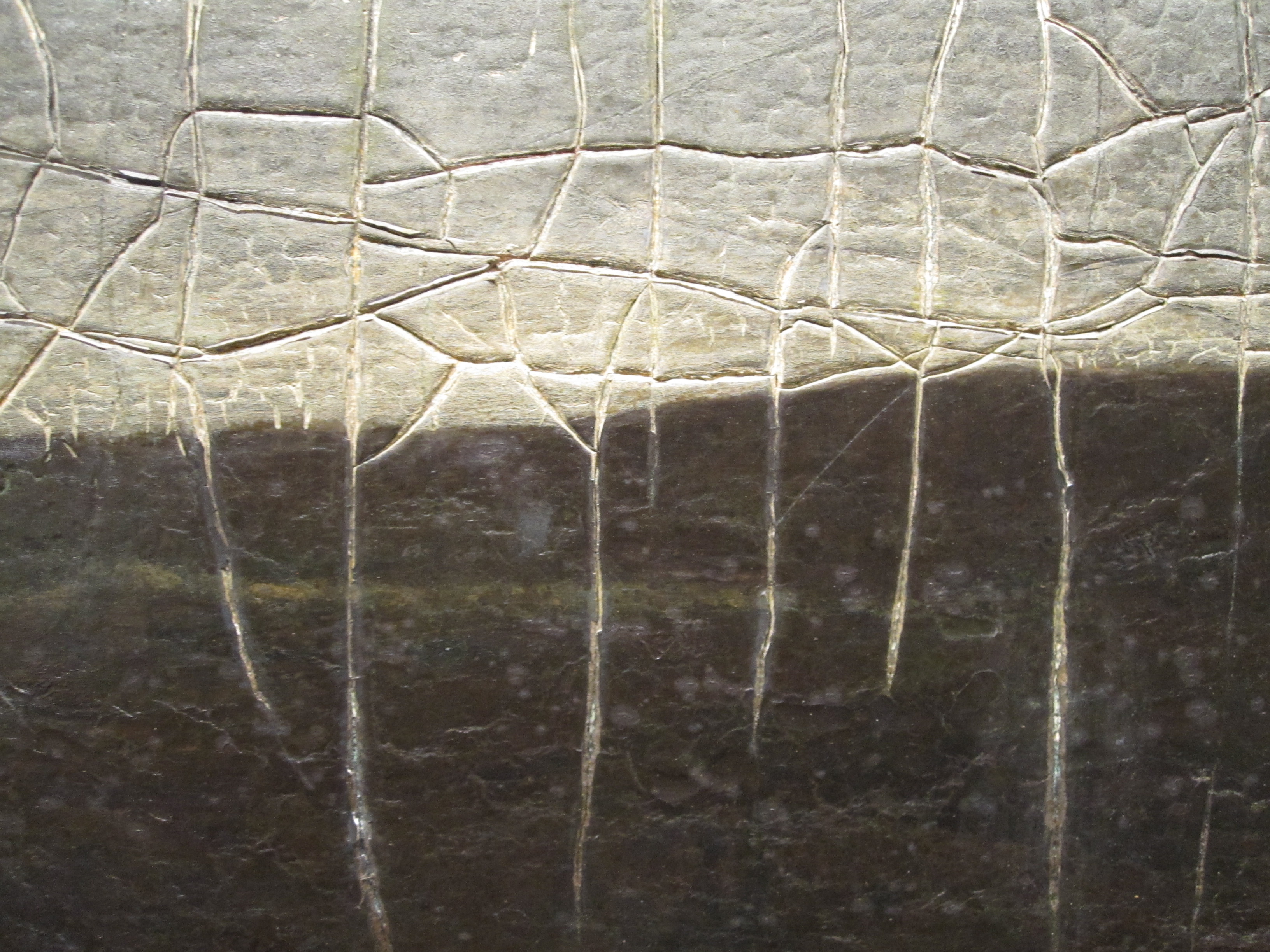
The painting at Christie’s entitled Night demonstrates the fact that Ryder experimented with unconventional materials such as wax, painted very thick and had little technical knowledge of painting in a way that would assure stability. Experts say many of Ryders works are painted so thick they are still drying today. Ryder himself however explained that something great is still great in part or whole.
Ryder is an artist who did not believe in imitation. He said “the least of a man’s original emanation is better than the best of a borrowed thought.” And so with that he helped sew the seeds of modernism. It was well worth the trip to see these three paintings from an American artist able to forge a new path and help create not only modern art, but aide in the enabling of the creation of the first international art.
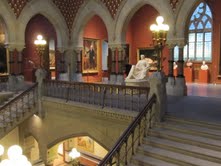
Another artist well-represented (six paintings) at Christie’s is George Inness. A brief stop in Philadelphia on the way to New York allowed for forty short minutes in the Pennsylvania Academy of Fine Arts (PAFA). Several works by this artist I hadn’t seen before were adorning the walls of this splendid building and institution. These are some of the best of works by Inness, and I have to say the ones currently up for auction in New York come at least very close to matching the quality.
When we see paintings and we know we like them, we may not immediately know why. I have stood in front of Ryder’s The Race Track in the Cleveland Museum of Art perhaps more time that with any other painting. It’s taken some years to begin to figure out why I like it. It was later in life I began to notice the work of George Inness. Yet while the works by Ryder may at times touch on being allegorical and the works by Inness may appear at first glance to be mere landscapes, they have in common their roots in the mind, in memory and the subconcious. In his prime, Inness was painting the place where the physical and spiritual worlds meet. The paintings are very personal and rooted in the impressions left by a time and place in his memory. As one of the labels at PAFA suggests Inness was painting nature as if he was nature.
These are personal qualities that tie an artist to a painting more than any subject or skill, and something existing for only a brief moment when considering the great span of things, that was lost as we moved into the age of modern art. These are images of something that is not there, was not there, but is none-the-less is very real.
Important American Paintings, Drawings and Sculpture takes place at Christie’s December 1.
Newly Restored, Eakins’s ‘The Gross Clinic’ to be Centerpiece of Exhibition Shedding New Light on Artist’s Original Vision

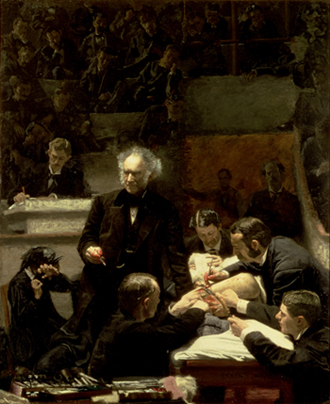
Portrait of Dr. Samuel D. Gross (The Gross Clinic), 1875 (pre-conservation image). Thomas Eakins
The Gross Clinic of 1875 is one of the most significant works created by the great Philadelphia painter Thomas Eakins (1844-1916) and a landmark in the history of 19th-century American art. A new exhibition—An Eakins Masterpiece Restored: Seeing ‘The Gross Clinic’ Anew (July 24, 2010 – January 9, 2011), to be presented in the Pennsylvania Gallery of the Perelman Building, will enable visitors to see and understand this painting—its creation, its critical reception, and the physical changes it has experienced over time—in new ways.
In late 2008, the Philadelphia Museum of Art and the Pennsylvania Academy of the Fine Arts, joint owners of The Gross Clinic, initiated a plan to evaluate the condition of the painting, to research its conservation history, and assess the potential benefits of an effort to clean and restore it. The resulting study of The Gross Clinic and numerous other Eakins paintings made clear the potential of a new conservation treatment that would address the problems caused by an aggressive cleaning of the painting’s surface in the 1920s.
On July 24, 2010, The Gross Clinic will be placed on view as the centerpiece of this exhibition, newly restored in the paintings conservation studio of the Philadelphia Museum of Art. Based on emerging evidence that yielded a comprehensive understanding of the painting’s original appearance and the changes that had occurred to it, the sensitive treatment carried out by the conservation staff of the Philadelphia Museum of Art and the Pennsylvania Academy of the Fine Arts will enable audiences to see this masterpiece as Eakins intended it to be seen.
“We carefully evaluated the history and condition of this remarkable painting, and the treatment plan that this museum developed in collaboration with our colleagues at the Pennsylvania Academy of the Fine Arts enabled us to see the painting in a new way and then to recover, through the restoration of toning glazes and of passages where paint losses had occurred, the appearance that Eakins clearly sought to achieve in the finished work,” said Timothy Rub, The George D. Widener Director and CEO. “We applaud the fine work of Mark Tucker, the Vice Chairman of Conservation and The Aronson Senior Conservator of Paintings, and his colleagues at the Pennsylvania Academy of the Fine Arts for their thoughtful and well-researched approach to this task and their sensitive handling of the conservation of The Gross Clinic.”
The exhibition will explore the history and initial reaction to The Gross Clinic, using source materials from the 1876 Centennial Exposition in Philadelphia, including photographs and didactic panels, as well as the responses of contemporary viewers, which ranged from horror and revulsion to awe-struck praise. Three surviving preparatory studies for the painting and a new full-sized X-radiograph of The Gross Clinic will be presented to provide insight into Eakins’s painting process, supplemented by texts explaining the artist’s commitment to the academic ideal of correct pictorial tone and color. The exhibition will also include a documentary film produced by the Philadelphia Museum of Art, examining the artistic ideas that informed Eakins’s approach to painting, the way in which he used certain materials and techniques to achieve specific pictorial effects, and the reasons that many of his paintings—including The Gross Clinic—were altered by aggressive conservation treatments in the decades after his death in 1916.
This exhibition will include other important works such as The Agnew Clinic of 1889 (owned by the University of Pennsylvania) the artist’s second great clinic painting, as well as his Portrait of Dr. Benjamin H. Rand of 1874 (Crystal Bridges Museum), which was Eakins’s first full-length portrait of a doctor.
The Gross Clinic is owned jointly by the Philadelphia Museum of Art and the Pennsylvania Academy of the Fine Arts, thanks to the successful campaign launched by the two institutions in 2006 to keep the painting in Philadelphia when it was offered for sale by Thomas Jefferson University. The Gross Clinic will move to the Pennsylvania Academy of the Fine Arts for a period of three years following the close of this exhibition in January.


Recent Comments