Tag: Qing

Seal Sets Record, Prove Popular With Collectors, Tourists

Filed in Antiques Business, Asian Art by on October 1, 2011 0 Comments
Seal Sets Record, Prove Popular With Collectors, Tourists

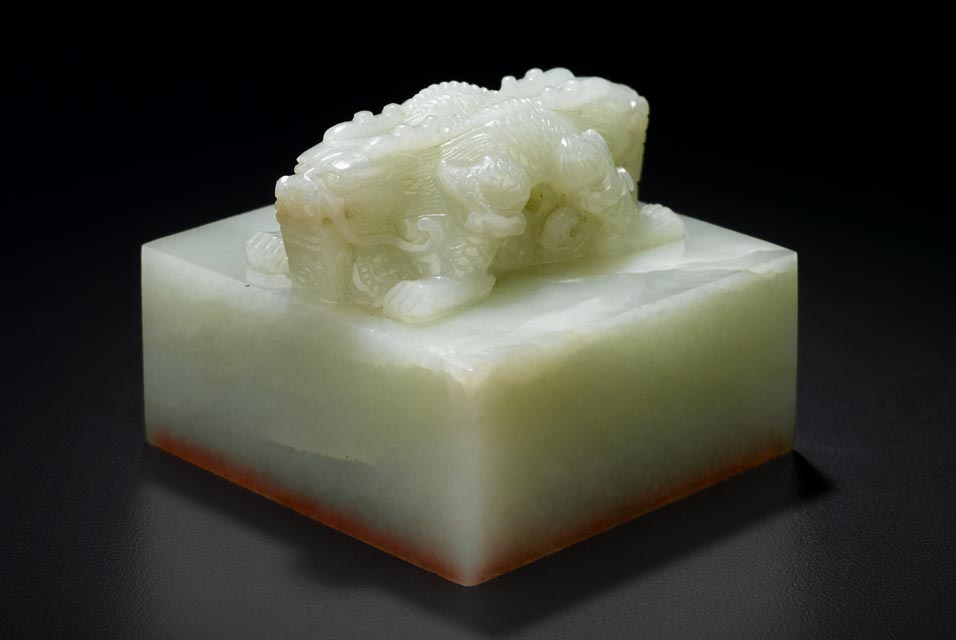
Chinese Seal at FreemansI’ve been in the room when an unnoticed or misidentified piece of Asian art hammers down at ten or more times the estimate. Chinese art and antiques having been owned by collectors for some time in America has a good chance of being the real deal, but it appears the most knowlegable people on the topic don’t work at auction houses-they work for the buyers.

Last Saturday afternoon, with a full and energetic saleroom, the ‘double dragon’ white jade seal in the galleries at Freeman’s realized over $3.5 million, making it the highest selling lot in the biannual Fine & Decorative Asian Arts auction. Other reports indicated it was Freeman’s highest lot ever.

The Qing Dynasty seal was sold to a bidder in the room by auctioneer and head of Asian Arts department Robert Waterhouse.

“The jade seal had good evidence for an imperial attribution, though it was only the final selling price that could have confirmed it,” Asian Arts Associate Specialist Richard Cervantes said in a press release. ” Of course we are overjoyed with the result.”

Shanghai Museum SealsOn a recent trip to China I had the opportunity to visit some exhibitions on Chinese seals at the Shanghai Museum, the Suzhou Museum and at the source, the site of a society of seal carvers near Hangzhou.

These seals are art. I am not an expert, but there appear to be three major components that make a seal desireable. The first is the stone itself. The second is the carving on the stone- the decorative part you see when the object is just sitting there. Finally is the quality of carving on the seal part itself, the stamp used for a signature.

Seals were first used around 1600 B.C. by officials in China to validate documents. Emperors of China, their families and officials used large seals known as xǐ (璽), later renamed bǎo (寶, “treasure”), which corresponds to the Great Seals of Western countries. These were usually made of jade (although hard wood or precious metal could also be used), and were originally square in shape.

By the mid Ming Dynasty (1368-1644), the art of seal engraving entered a new phase, assimilating literati calligraphy and painting techniques. This “literati seal engraving” prevailed through the Qing Dynasty (1644-1912).  Prior to the literati engravings, official standards were imposed with little attention paid to artistic merit.

Suzhou Museum SealsAccording to Wikipedia, the most popular style of script for government seals in the imperial ages of China (from Song to Qing) is the jiudie wen (“ninefold script”), a highly stylized font which is unreadable to the untrained.

Most people in China possess a personal name seal. Artists, scholars, collectors and intellectuals may possess a full set of name seals, leisure seals, and studio seals. A well-made seal made from semi-precious stones can cost between 400 and 4,000 yuan.

Official seals are also still used today. The government of the Republic of China (Taiwan) has continued to use traditional square seals of up to about 13 centimeters each side, known by a variety of names depending on the user’s hierarchy. Part of the inaugural ceremony for the President of the Republic of China includes bestowing on him the Seal of the Republic of China and the Seal of Honor.

The seal of state of the People’s Republic of China is a square, bronze seal with side lengths of 9 centimeters. The inscription reads “Seal of the Central People’s Government of the People’s Republic of China.”

West Lake Hangzhou Gift ShopSeals are also often used on Chinese paintings and in books. Owners of paintings add their own studio seals to pieces they have collected. This practice is an act of appreciation towards the work and you can find examples in most any museum that has a Chinese art collection. Some artworks have had not only seals but inscriptions of the owner on them; for example, the Qianlong emperor had as many as 20 different seals for use with inscriptions on paintings he collected. This practice does not commonly devalue the painting. In fact, certain seals can make it infinitely more valuable.

Seals are widely sold to tourists in China, and are available in the United States as well. The quality of the stone and carving is hit or miss, more often miss. If you should make your way to West Lake at Hangzhou, China, someone from the society of seal carvers is sure not to miss. The gift shop has a large collection of stone seals from which you can choose and one of the expert carvers will be on site to personalize your seal. Many carvers will put your English name on the seal in addition to Chinese characters. Mine initials translated to words that mean “looking for the light” in Chinese, and so that is the source of my Chinese seal signature. I got it some time ago and it is not of the best quality. Someday I will have a new one carved.

What can Record Prices From China Say About the Market for American Antiques?

Filed in Antiques, Antiques Business, Art, Auctions by on November 19, 2010 2 Comments
What can Record Prices From China Say About the Market for American Antiques?

By Hoomivas (Own work), via Wikimedia Commons

The recent sale of a mid-18th century Qing dynasty vase for $68 million to a Chinese buyer is appearing with some frequency in the media. It’s also the latest in a long list of high-price heirlooms that have headed back to China. I’ve had some success selling items with Chinese origins, although much less significant, that have headed back to China.

A Decade or more ago if an expert in Chinese studies was asked what were the top ten things consumers in the country were fond of, the answer would have been unlikely to include antiques. Now even some items with minimal significance are selling for lots of money. Why is this and what can it tell us about the market for American antiques?

Here are several lines from an article that appeared today on CNN.com

Flush with cash, these buyers now consider antique collecting a status symbol and a source of national pride.

“Patriotism and antique collecting are now tightly linked,” adds Gong Jisui, a professor at the Central Academy of Fine Arts. “Collectors are happy to identify themselves as patriotic.”

It’s not surprising: antiques have traditionally been prized possessions among wealthy Chinese families. China’s nouveau riche entrepreneurs have now amassed great wealth and are reverting to old ways.

First, national pride seems to be the theme that occurs most often, not only in this article, but in a number of recent articles on the market for Chinese antiquities. More than ever, in recent memory anyway, people in China have disposable income and they are proud of living in China.

Thinking back on the heights in the American antique market, periods of relative strength were times when we felt good about the United States. The 1920s, the 1960s, as well as the mid 80s and 90s were all periods when national pride and economic prospects were in plentiful supply and the market for antiques was good.

Moreover there seems to be a somewhat universal point in time when dealers say the market for antiques and collectibles dropped off in the U.S. and that was a date that’s used for a lot of things, September 11, 2001. Certainly the events of that day can be seen as a kick to national pride, and a kick that we’ve yet been able to recover from.

The phenomena in the third quote can also be used to compare markets in the U.S. in China. In the case of the U.S., I’m not sure we’re at a point where the wealthy are looked to with any degree of reverence. Certainly there are enough scandals in the news to influence that in the negative. The wealthy who are somewhat revered, Warren Buffet for example, are revered in part for living a simple, no-nonsense life, not for amassing large collections. The ones who do collect antiques aren’t widely known to do so, but the bulk are known for collecting contemporary and modern art.  And that’s being collected in part because its being looked at for its investment value, certainly not as often because love of the objects or of pride in the international marketplace.

The prevalence for American modern and contemporary art also feeds into the vicious cycle of the international art market. America had fine artists and craftsmen before 1940, but it was after that when the country was a strong permanent player on the world stage (although you could argue this date to be somewhere post WWI), and items produced or created after that time are the ones with the most international appeal. Items made before that time do not and probably will not have significant international appeal and the market for them won’t return until the United States has both recovered economically and regains a sense of national pride.

You might say the same thing about the antiquities from China, and in one sense you would be right. The market for these items is based largely on the strength of the Chinese economy and national pride there. It’s not rooted in international appeal for these products. An important difference, however which may or may not come into play is that China has both ethnic and national identities, where the U.S. only has a national identity. Moreover as the population in the U.S. becomes more diverse and as a percentage the people with European and in some cases African ancestry become a smaller percentage of the population, the connection with items from 1750-1900 is also minimized and thus its demand is minimized. That said, I don’t think it’s a foregone conclusion that the newest immigrants and their children will never feel a connection to American antiquities. It’s just not going to happen overnight.

I know you may be looking for a solution, and I’m not sure there is one ready-made. There’s lots of indication of urgency floating around out there, and ideas from forming an association to having a luxury conference on antiques. Both are good ideas worth implementing, but in the end may only nip at the heels of our problem.

Skinner’s Auction of Asian Works of Art Nets $4.8M

Filed in Art, Auctions by on July 6, 2010 1 Comment
Skinner’s Auction of Asian Works of Art Nets $4.8M

The auction house Skinner reported its auction of Asian Works of Art held in late June grossed $4,822,312.50, including buyer’s premium. Of the 1,700 works offered, 95 percent sold by lot and 99 percent by value, many far exceeding pre-sale high estimates.

Chinese material was especially sought with all four works exceeding the $100,000 mark of Chinese origin. The auction’s top seller was a large jade vase in the shape of a double gourd, which sold for $578,000. Another large jade vase of flattened hu form sold for $501,000. A Huanghuali cabinet from the late Ming/early Qing dynasty sold for $292,000. Finally, topping $100,000 sale price was a Handscroll, “Si ji shang wan tu” (Appreciating the Four Seasons) from the 18th century selling for $106,650. The scroll was part of the personal collection of the late Charles J. Chu, admired professor, painter, calligrapher, curator, scholar, and educator. In total the Chu estate did very well with 120 lots bringing in more than $562,000.

According to James Callahan, director of Asian Works of Art at Skinner, “The market continues to be strong, driven by extreme interest in Chinese work.” Callahan continued, “Skinner’s strategy to keep estimates low works well in attracting the widest possible audience of buyers. For many sought after lots it was an all out bidding frenzy. Such an opportunity truly benefited the consignors.”