Tag: Remington

At Blanton Museum of Art – Connoisseurship with a Touch of Cool

Filed in Art, Museums by on January 2, 2012 0 Comments
At Blanton Museum of Art – Connoisseurship with a Touch of Cool

Blanton Museum of Art Interior Jan 2, 2012Austin feels young, so does its museum. The American collection at the Blanton Museum of Art does not cover the first 100 years’ art of the nation, not to mention colonial times. Yet the presentation succeeds in holding an inviting angel that solicits comparison, connection and communication.

In one room that features works of the Ashcan School, social realism, and regionalism, three pairs of human figures are hung together. On the left is Oil Field Girls by Jerry Bywaters, painted in 1940. In the middle is Thomas Hart Benton’s Romance painted between 1931 and 1932. From 1925 Yasuo Kuniyoshi’s Waitresses From the Sparhawk flanks the right side.

Bywaters Benton BlantonBoth Bywaters and Kuniyoshi utilize a rather somber palette and both accentuate the human bodies with some degree of distortion that annotates their profession. Yet Bywaters has chosen to stay neutral by projecting the incongruity directly to the viewers while Kuniyoshi challenges viewers by mixing his own consciousness and commentary with the subjects. There is much openness in Bywaters’ setting. What is suggested is often contradicted by other elements – the bleak scenery of an oil field is jested with Coke and beer signs. The forlorn wheels accompany the invitation for dance and dining. And the two females, slender and tall from the exaggeration and the low perspective, seem to ponder their own life being surrounded by uncertainty. Kuniyoshi’s two females are enclosed in a tighter setting. Here the sexuality is subdued, if not denied, by the flattened figure form. Clumsy and stiff, they bear an intricate affinity to the sinister land. As pressing the backdrop landscape is, the raw power the two waitresses possess is greater still. If the coherent angularity between figures and landscape is not evident enough in Kuniyoshi’s painting, Benton’s Romance has interlocking patterns of sharp contours that bridge the slenderness of Bywaters’ and clumsiness of Kuniyoshi. Hands clutched together, the black couple walk in a tilted plane as if they were gravitated into slow downward motion despite the tiredness. The lush green may sooth the bare feet, yet the house, tilted backward from the low angle, looks even more shabby and remote. Are they walking in a southern night dream? The spatial dislocation has a profound impact on the viewer, and their perception of the title. If all three works could be accused of making caricatures of human figures, the fluidity in artistic expression and the tenderness and sympathy shown in the black couple make it the most intriguing of the three.

Russell Medicine Man Jan 2, 2012The only gallery that is dedicated to art of the American West is snug between some 19th century Greek and Roman plaster statues and European art galleries. Most came from the collection of C. R. Smith, alumni of UT Austin and CEO of American Airlines for many decades. Influenced by his fellow Texans Amon Carter and Sid Richardson, Smith began to collect western art when he lived in a small apartment in New York City. The gallery keeps the cozy and intimate feeling with respect to the living space where these relatively small works used to hang. The nostalgia these works convey resonates with Smith’s own homesickness. Charles Russell’s Medicine Man was painted in 1916, eight years after he painted the same subject on a much larger canvas, now owned by the Amon Carter Museum of American Art. If the larger canvas strikes viewers with the artist’s faculty of bringing iconography and geology into his vision of man and spirituality, this small work speaks of poetry and endows a greater dignity and humanity to the central figure.

The main focal point of the room is a gigantic canvas The Charge by Frederic Remington, depicting an epic fight between the Calvary and American Indians. This painting came from Ima Hogg’s collection. Painted in 1906, three years before his death, the painting is a tour de force of Remington’s full embrace of impressionism in his signature subject. From afar, it does not look too much different from A Dash for the Timber, another masterpiece now hung at the Amon Carter Museum of American Art, but the loose brush strokes makes the chaos and menace even more pressing. How many New Yorker’s had actually looked at the painting beyond the stereotyped western images in their own mind when it was hung at the Knickerbocker Bar Club of New York City? I am glad it resides in Texas now.

La Viligia Josefina GuilisastiA contemporary work which takes a prominent space in the museum is La Vigilia by the Chilean artist Josefina Guilisasti. The work consists of a number of cubes where small painting of aluminum pots, pans and kettles in a variety of shapes sit. On the surface it simply puts common objects, often stored in a scattered manner in a cabinet, in an orderly and esteemed setting as if they were precious objects. The work is more complicated, however. It’s all about perspective.

These pots and pans it turns out are often used in government protests. The cacerolazo, or cacerola, meaning saucepan, gained notoriety in Chile in 1971 when thousands of women took to the streets of Santiago to protest shortages of basic household necessities. The empty pot is a symbol of the government’s failure. Signage at the exhibit identify the women who went into the streets as upper-class, perhaps drawing distinctions on the connotated meanings of the saucepans for members of different classes in Chile.

The monumental work is composed of 62 oil paintings and offer six different perspectives of the everyday pots. The work is a recent acquisition and a gift of the artist.

As a University art institute, Blanton Museum of Art may not be as comprehensive as other Texas museums, but it reflects a young and energetic city, that’s sure to make its mark on the art world.

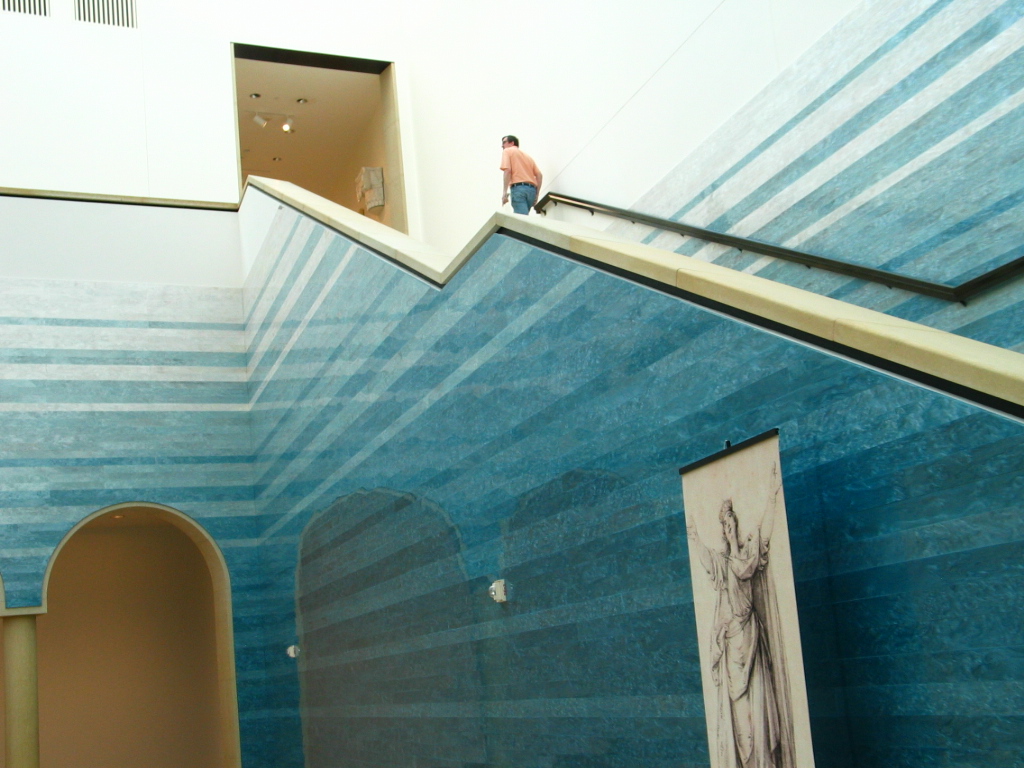
Blanton Museum Interior Jan 2 2011

A Visit to the Grand-daddy of Antiques Shows

Filed in Antiques by on February 23, 2011 0 Comments
A Visit to the Grand-daddy of Antiques Shows

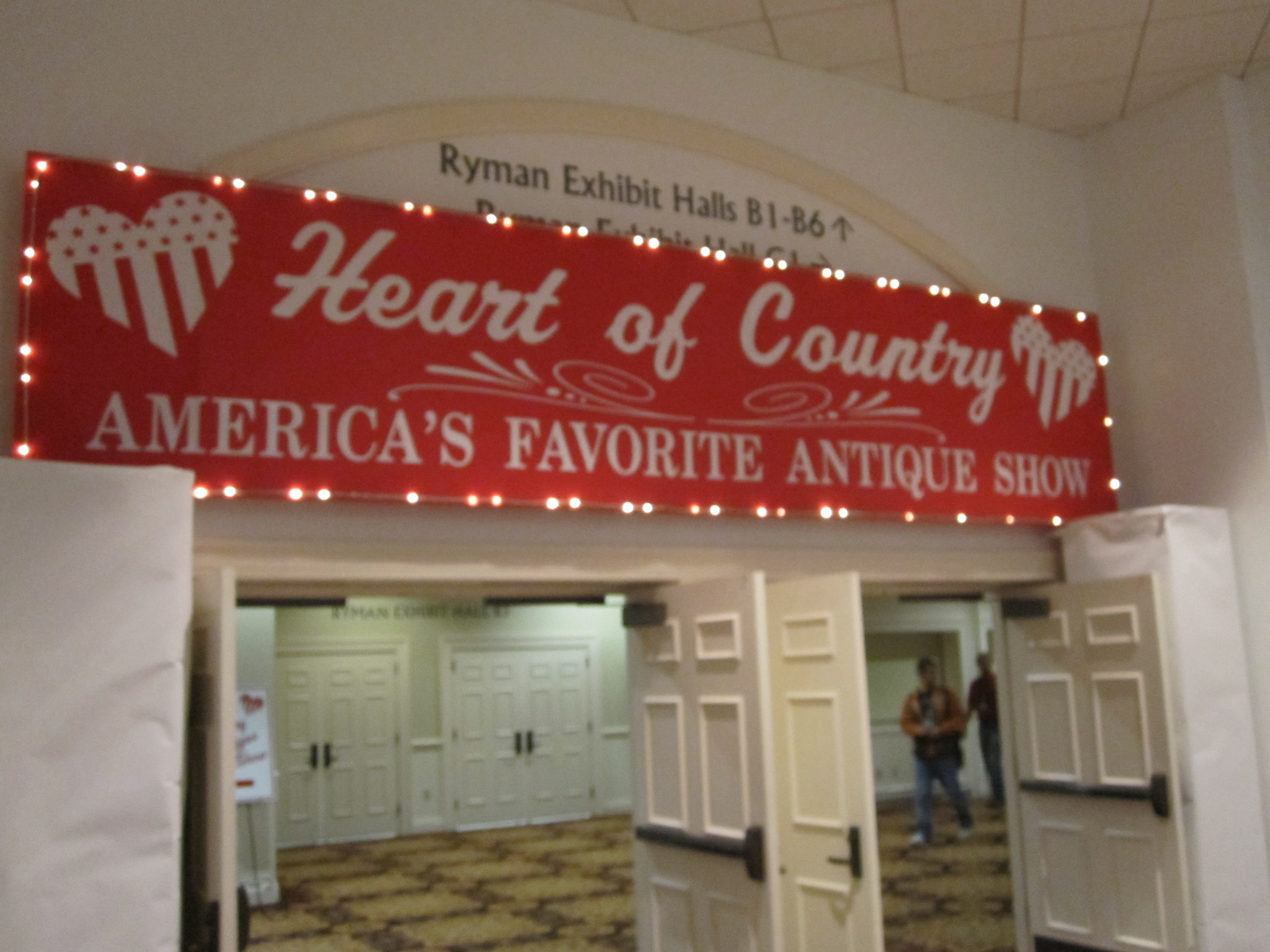
Heart of CountrySince the show’s beginnings in the early 1980s, the Heart of Country show has been one of the premiere destinations for fans of Americana in the Country. This year dealer Bettianne Sweeney, who promotes her own Americana-themed show the weekend after Thanksgiving in Virginia, was crossing having a booth at the Heart of Country off her “bucket list.” This seemed like a good year to cross it off of mine too.

It can be debated whether the last day is a good time to visit the show. By the time we arrived Saturday morning, the show had been running since the Thursday preview.

If you’ve never been to the Gaylord Opryland Hotel, it is in itself a treat. I had heard this show had it’s heyday some years back, but a conversation with promoter Susan Hunkins and the promoter of a coinciding show, Jon Jenkins spelled out the efforts to revitalize Antiques Week in Nashville. Heading from the airport to Opryland, a line of traffic was encouraging about 30 minutes before the opening, but most of that turned out to be for the National Wild Turkey Federation conference. Walking through the show we would frequently hear the sound of an auctioneer and turkey calls.

That’s not to diminish the crowd at Heart of Country. Word was a lot had sold during the Thursday preview and the floor seemed busy Saturday. Most of the dealers we spoke to were upbeat and there were plenty of sold signs to be spotted.

With little time on the floor, a voice over a loud speaker momentarily gave pause to the sound of the human imitating wild turkey to announce a dealer panel with dealer’s Woody Straub, Bev Norwood and Bruce Rigsby. Less we thought the recession had ended, the panel’s moderator Woody Straub recounted the history of the show adding this was the third such slump in the antiques market in his lifetime. And each time they wondered if it would end. This strained period in the business would be overcome, as before by personal passion for the objects.

Straub, Norwood, RigsbyNorwood spoke of the regional interest in antiques and of the attachment they have to people. She gave an overview of several objects including a small drawing of lady liberty with an excerpt from the Star Spangled Banner written below, and several objects made to memorialize George Washington after his death. Often these were created by young girls who were taught both to stitch and paint.

Straub gave a short “furniture detective” lesson telling the dozen or so collectors at the event to assume it is fake, then prove otherwise. Moving on to paintings, Straub gave some additional tips on what to look for and then some insight into his personal taste. Holding a naive landscape Straub said “I’m not fond of them as an art dealer, but I do sell them because I am an art dealer.”

There was plenty to look at on the show floor. Entering the show, the first item we spotted was a small painting by George Innes offered by Harrison Galleries. Gordon Harrison Jr. mentioned the painting had come from an estate in Houston. It seems to me to be a rare small-sized late work by the artist.

At the Amon Carter Museum in Fort worth, there is often talk in the galleries about the painter and sculptor Remington showing horses with all four feet off the ground in running mode. Apparently there was some debate about whether or not the animals kept any feet on the ground when running until the photographer Eadweard J. Muybridge showed conclusively horses did raise all four hooves. I was looking at weather vanes at the show and noticed that while most seemed to show all four feet in motion, a few had two feet on the ground.

One of the more unusual items were sections of a switchman’s shack that hobos had carved their assumed names such as Portland Charley and Idaho Jim into. Offered by Ron Christman Art & Antiques, this Hobo Wall was from Waterville, Wisconsin and was disassembled several decades ago. People who collect Americana seem to do so primarily because of the connection it provides with the people. While these hobos may not have thought they were creating art, this certainly qualifies as Americana and makes an unsurpassable central decorative piece that would fit into a modern home or condominium nicely.

Another interesting item that made itself known by it’s singular placement on a table is a Bristol glazed with cobalt blue pottery shelf piece, 1890-1920. Dealer Jane Langol told us these were popular in German families and this piece was particularly sought after because it was in the shape of a lion.

Hemingway CatMaine Dealer Bill Kelly had his own rare feline species in his booth–what appeared to be a six-toed cat. The condition seems to be most commonly found in cats along the East Coast of the United States and in South West England. Known as Polydactyl cats, these creatures have been extremely popular as ship’s cats. The prevalence of polydactylism among the cat population correlates with the dates when they first established trade with Boston. Ernest Hemingway was one of the more famous lovers of polydactyl cats, after being first given a six-toed cat by a ship’s captain. So much so that these creatures are now commonly referred to as “Hemingway Cats.” The cat was not for sale.

At the booth of Bev Norwood, a calligraphic drawing of an eagle caught our eyes. The exquisite drawing was emphasized by the artist’s own signature – “With a Pen by C.P. Zaner, Columbus, O. 1891.” Neither Bev nor I could figure out why the letter “h” was missed. Polished, controlled and expressive, the lines that contributes both the shapes and shadings (in the style of roulette engraving) possess such marvelous fluidity that seem to stand against the rest of Americana artworks in her booth. I have never looked at such calligraphic drawings in auctions before, partially because online pictures can hardly do justice to the details which are essential in differentiating the great from the mediocre. But thanks to Bev, we would definitely keep a keen eyes on such objects in future.

As for Bettianne, she seems pleased with her experience at the Heart of Country. While we were there on Saturday she sold two major items and mentioned she’s gotten a good rate on the hotel. In total, she says she took home ten times her booth rent in sales. Most everything she bought specifically for the show didn’t go home with her to Virginia.

If you fly in for next year’s Heart of Country show or any event at the Gaylor Opryland, I should mention something about the shuttle bus. In addition to the antique show and wild turkey event, there was a meeting of the International Society of Appraisers. One of the appraisers addressing the conference flew in on the same plane from Dallas. He took the shuttle from the airport to the hotel at a cost of $40 round-trip. We rented a car and drove there for around $30. Parking was free for Heart of Country, but I heard was $18 for ISA attendees.


Enjoy the video!