Tag: Stonewall Jackson
Civil War ‘Gallant Pelham’ Ambrotype Lost and Found, Ready for Auction in Dallas
Iconic photograph of Alabama’s revered Confederate warrior descended through Pelham’s family; possibly the single most important Civil War photograph extant.
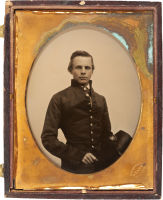
When a circa 1858 Half Plate Ambrotype of Confederate Lt. Colonel John Pelham – known to American Civil War buffs everywhere as “The Gallant Pelham” – comes to auction on June 26 as part of Heritage Auction Galleries Signature Arms, Militaria & Civil War Auction, it will mark the sale of what is possibly the single most famous Civil War photo extant.
Thought to be lost to history for more than a century, it turns out this oft-copied and reproduced likeness – contemporary copies were made from the original before it disappeared – has descended untouched in the Mississippi family of Pelham’s sister Betty, who have decided to auction the piece with Heritage in the hopes that it will go to a collector, or institution, with the means and the facility to take better care of the historic image.
“We’ve had it in our family for probably 80 years,” said Thomas Rogers, Pelham’s great-great grand-nephew and the consignor of the piece. “My mother had it in a fireproof safe at our home and her mother before her probably just kept it in a closet.”
The family was certainly aware of the role their famous ancestor played in Civil War history, and they would occasionally take the photo out to show to close family and friends. Rogers recalls the first time he actually saw the image.
“I could see the uniform, every aspect of it. I was probably 10 or 11 when my mother sat me down and told me all about who he was. After that, in school, I always did well in history because I’d always give reports on Pelham.”
This important and historic offering carries a pre-auction estimate of $65,000+.
“This is, without question, the single most important and visually moving Civil War photographic image I’ve ever had the opportunity to catalog,” said Dennis Lowe, Director of Arms, Militaria and Civil War Auctions at Heritage. “No one in the modern era has ever seen the original of this image until now, though it’s been copied hundreds of times.”
There are few Confederate figures as romanticized and venerated as John Pelham. He was a brilliant leader, a genius tactician and one of the bravest men who ever fought in an American war. Pelham’s confident demeanor in the image, taken by legendary early photographer Matthew Brady in his New York City studio is handsome, verging on arrogance, but it foreshadows the strategic virtuosity and unrivaled bravado that he would eventually show on the early battlefields of the American Civil War.
“What I’d always been told through the years was that he had this picture made to give to his mother prior to him going into the war,” said Rogers, “in case something happened to him she would then at least have a photograph of him.”
In 1861, just weeks short of graduation, Pelham – a native Alabamian – withdrew from West Point to offer his services to the Confederacy. Assigned as a Lieut. of artillery in Joseph E. Johnston’s Army, Pelham’s well drilled battery caught the eye of none other than J.E.B. Stuart, who transformed it into America’s first “horse artillery.” Pelham was thus engaged in every major action of Stuart’s cavalry, from First Bull Run to Kelly’s Ford, where he met his end.
“It is really extraordinary to find such nerve and genius in a mere boy,” said Stonewall Jackson in response to Pelham’s gallantry at Antietam. “With a Pelham on each flank I could whip the world.”
At Fredericksburg, where Pelham’s guns were critical in stemming the Federal advance, Robert E. Lee commended Pelham for his “unflinching courage,” and he is generally recognized today as the most capable commander of “horse artillery” in American military history.
“At Kelly’s Ford, on March 17, 1863, Pelham volunteered to lead a cavalry charge, his artillery not being engaged that day,” said Lowe. “The story goes that Pelham, rising in his stirrups, urged his men to ‘Press forward to glory and victory!’”
During the subsequent assault, Pelham was struck in the head, and mortally wounded. Stuart eulogized Pelham in a general order issued to the Cavalry Division, immortalizing him with the sobriquet “The Gallant Pelham.”
“You will be hard pressed to find a more important and historic offering in the annals of Civil War collecting,” said Lowe. “Pelham is one of the most highly romanticized figures of the entire War Between the States, and here we have the photograph that has, more than anything else, given that immortal aura to this pivotal figure.”
Also of note in the auction to those interested in Pelham is a Pelham-signed letter from Sept. 25, 1858, in which Pelham writes home to his brother in Alabama as he was beginning his studies at West Point. Undoubtedly this letter was written around the same time this legendary picture was taken. This letter is possibly the most important Pelham related document known to the Civil War hobby. It is estimated at $25,000+.
Abraham Lincoln Funeral Photograph Album Realizes $27,025
An album of carte de visite photographs of Abraham Lincoln’s funeral procession was the top-selling lot at Cowan’s December 9, nearly tripling its $8/10,000 estimate by selling for $27,025. Comprised of 97 CDVs, the album featured images of three of the nine cities on the funeral route— Columbus, Ohio, and Chicago and Springfield, Illinois. While valuable for its rarity as a whole, the album includes several cartes de visite which are exceptional individually, including an image of the processional arch in Chicago, and an image of Lincoln’s bedroom in his Springfield home. Additionally, several photographs are not illustrated in Twenty Days, Kunhardt and Kunhardt’s comprehensive 1965 account of Lincoln’s assassination and funeral.
A rare quarter plate daguerreotype of Seneca Chief Governor Blacksnake by artist F.C. Flint of Syracuse, New York, realized $22,325, well above its $10/15,000 estimate.
Born near Seneca Lake about 1753, this important Seneca war-chief was known to his people as Chainbreaker; to Whites he was Governor Blacksnake. A young warrior, Chainbreaker/Blacksnake was influential as a Seneca leader during the American Revolution, Indian conflicts at the end of the 18th century, and the War of 1812. He was also at the center of one of the great transformational events in Seneca history: the formation of the Code of Handsome Lake, which incorporated elements of Christianity and traditional Iroquois culture. Reproduced in several publications, this image that represents seminal events in American history garnered spirited bidding from collectors.
Western photography and ephemera made up a significant portion of the auction, with several lots represented in the top-selling items.
The Julia Tuell collection of 19 Plains Indian photographs brought $21,150, exceeding its $12/15,000 estimate. Tuell (1886-1960) settled in Lame Deer, Montana, with her husband, and became a keen observer of Northern Cheyenne daily life through her photographs. The collection offered by Cowan’s was comprised of several significant images, including photos of the Cheyenne Sun Dance and Animal Dance.
A California and Oregon Stage Line broadside on coated stock, circa 1866, described in Cowan’s catalogue as “a cornerstone piece for any Western transportation collection,” drew significant interest from collectors. Rare for its early vintage and compelling image, the broadside sold for $14,100.
A comprehensive archive of the California Gold Rush, complete with gold nugget, garnered $11,750, within its $10/15,000 estimate. Featuring approximately 175 items, including manuscripts and documents, the archive from an Ohio family provides a glimpse into the lives of Americans during the late antebellum years, when the great national issues of sectionalism and slavery met with an unprecedented mobility.
Not everything sold above estimates. A uniformed oil portrait of Stonewall Jackson sold below its $3,000-$5,000 estimate and seemed a bargain at $2,100. Reputed to have hung in the South Carolina capital building; this painting appears to be based upon Jackson’s Chancellorsville portrait, taken by a photographer from the Richmond Studio of Minnis and Crowell at Spotsylvania County Farm on April 26, 1863, seven days before being mortally wounded at the Battle of Chancellorsville.
Auction proceeds totaled $665,000, with 508 bidders from 6 countries vying for 400 lots.
“Overall, I was very happy with the results of the auction,” commented Wes Cowan, Director of American History. ”Though we offered fewer lots than we have in past American History sales, the quality of the merchandise was elevated, as evidenced by the high per-lot average.”


Recent Comments