Tag: Swann Auction Galleries

A Gaggle of Interests – Jan 16, 2011

Filed in Antiques, Art, Artists, Auctions by on January 16, 2011 0 Comments
A Gaggle of Interests – Jan 16, 2011

In this series, the UAA team will list some of the interesting items that we have found in auctions, antique shops, shows or eBay. We neither own the items or have the capability of examining the items in person in some cases. It mainly serves as an inventory record of what interests us (not necessarily in terms of value or investment opportunities) and possibly how much it fetches (if the result can be obtained). If you are serious about some lots, please contact the auction houses, dealers or eBay sellers directly.

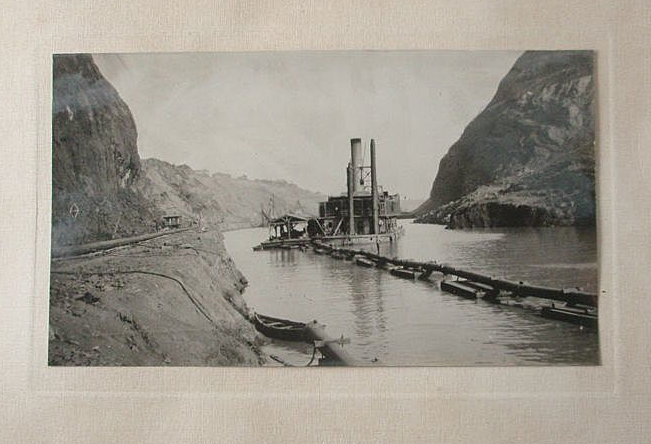
Panama Canal Photo1. Vintage Panama Canal Photo – “Dredge in Culebra Cut,” Ruby Lane Item ID: 2962.

The Amon Carter Museum in Fort Worth Texas currently has on display images from the building of the Panama Canal. The exhibit contains images from the museums own collection, as well as National Archives and Military Academy. The building of the Panama Canal was a well-chonicled event that made its way into books and stereoview cards. The rarity of photographs depends of course on a lot of factors. Currently being offered on Ruby Lane by R Young Antiques is a vintage view of the Panama Canal, obviously mass-produced as it seems to have come from a Pennsylvania department store. The image is of the opened canal rather than the building of the canal. I can’t comment much on the price or value, but to say an interest in photography seems to be on the rise. Historically interesting, aesthetically the canal doesn’t to me have a great deal of appeal outside the home or office of someone in the civil engineering profession. The exhibit at the Amon Carter runs through May 11.

1850s Marble Mahogany Sink2.Pair of Empire Mahogany Marble top Sinks Wedgewood Bowl, ebay item 150546932768.

Currently offered on ebay is a pair of mahogany cabinets with marble and porcelain sink tops. My first inclination would be to assume these were later adapted from pieces of furniture, but the marble also appears to have significant age. The listing says they are from an 1850s townhouse in Boston. Period sinks would have probably have had separate hot and cold faucets, so that throws in another question mark. In any case the single faucet would probably be easier to adapt to a modern fixture. These would make a fine addition to any sizable bathroom, and would probably prove a money-saver when comparing them to modern pieces of similar quality. The curiosity about the whole thing is I’d venture if these had at one time been stand-alone cabinets, they’re probably worth more today as sink cabinets.

3.Country Antique 1840 Bed and Empire Lion Paw Antique Carved 1835 Sofa, ebay items 400181350637 and 400186497880.

Two items offered on ebay are notable not only for themselves, but for the effort the seller has given to displaying them. An 1840s Country and a Classical sofa are shown in a room settings as they would be in a department store. Nothing like helping the buyer envision an antique piece in their home. At a time when convention has it that brown furniture, particularly mid-range value antique furniture isn’t selling well, helping a buyer see an antique in a room setting is a very powerful tool. Sure, it’s a lot of work, but it’s something the industry needs to work on. It appears the classical sofa is displayed in the same room with an attractive mirror above it. Hats off to Harp Gallery Antique Furniture of Wisconsin for making the extra effort.

4. Skinner Auction, Jan 28, 2011. Sale 2535B, lot 39 Town and Country, color lithograph by Ralph Goings.

Ralph Goings - TOwn and Country, color lithograph

Ralph Goings - TOwn and Country, color lithograph

A rather large (about 21 by 32 inches) color lithograph (out of roughly 300) from Ralph Goings, a super realism painter. This particular one, dated from his early career, shows a whimsical arrangement of colors and forms, yet also has an appealing narrative .

The palm trees and the bright light gives viewers a convincing impression of a California scene. The old pickup truck and sedan create a dynamic that leads the eyes to the title of this image, which comes from the name of the restaurant: Town and Country. The same motif, trucks and diners, were revisited many times in Goings’ career. In these outdoor settings, he found a proper theme that can unite the geometry of mechanical objects, signs and banners that challenge viewers beyond their linguistic functionality and cheerful California landscape, all within a miraculous sense of natural light that almost looks real.

The cultural undertone cannot be neglected either. The Interstate Highway System was authorized in the late 1950′s. By mid 1960′s, many US highways were removed from the map when they were converted to freeways and expressways. The road trip, epitomized by wagons or pickup trucks and numerous forgettable diners is an expression of freedom to pursue the future anywhere one likes, as long as it is accessible by wheels.

It is a rather mundane, although photorealistic scene, except the sign of the restaurant has a cynical tone for modern viewers. Yet mundane objects, intertwined together in our life, have their own beauty. When such a beauty is synthesized into a canvas by the vision of a great artist, it is essentially a snapshot of our own chaotic life, yet when we pause and look, we enjoy the forms and the order, of ourselves.

The color lithograph comes from the Brooklyn Museum.

Brook in Winter by Joseph Greenwood, offered by Skinner

Brook in Winter by Joseph Greenwood, offered by Skinner

4. Skinner Auction, Jan 28, 2011. Sale 2535B, lot 309, Brook in Winter, by Joseph H. Greenwood

Quite a few paintings by Joseph Greenwood are offered in this sale. This one has the quintessential characteristics of tonal impressionism,with rather narrow tonal range which were popular in the first two decades of the 20th century. The vigorous brushstrokes give the foreground snow and creek a live impression, yet it is the background that really captures my eyes. I think it is marvelous to look at the mythic depth of the forest that he created with those monotone bare trees.

I have not heard of Joseph Greenwod before. A quick internet search shows he is an important impressionism painter, mostly in Worcester area. The Worcester Art Museum held an exhibition of Greenwood’s work back in 2004. There is a short article on the museum’s website, which gives a great introduction to the artist. The painting originally came from Jerome Marble’s estate.

It is estimated between $800 and $1200.

5. Skinner Auction, Jan 28, 2011. Sale 2535B, lot 433,  City Center, by Keith McDaniel

A Moment of solitude: City Center, Philadelphia by Keith McDaniel

A Moment of solitude: City Center, Philadelphia by Keith McDaniel

Another painting relies on strong geometric architectural forms with a narrative undertone. I have found it fascinating, especially it is labeled as city center, Philadelphia, where I have walked many times. In this urban scene, the absence of human figures give me some mysterious feeling. The door, half open, recedes mostly in the form shadow. Who has entered? In this nameless store-front, the strong light deepens the intensity of red, aided with the cast shadow. Then the white linen, folded like an absent-minded cat under the warm light, looks sensual and full of life.

I am not familiar with Keith McDaniel, but I will definitely look more his works in the future. There is a biographic article about McDaniel in Smithsonian Museum of American Art website.

6. Two posters from Swann Galleries Auction, Feb 8, 2011, Sale 2236.

Lot 186 is a TWA poster by David Klein. There is a little bit condition problem, but this one is from 1956, not the later version. According to Nicolas Lowry, it is one of the most popular airline posters, even MOMA keeps one copy. Geometric, bordering abstract, the hussle-bussle of Times Square is reduced into collages of radiating squares. I am wondering why airlines have stopped using graphic images by artists and instead opt to coffee-table-book-like photos now.

Lot 278 is one of the largest posters every produced. Nearly two meters tall and more than two meters wide, it will command attention in any house interior setting. A few years ago, I was lucky enough to see another one offered in one of the New York galleries near the Met. The catalog gives a very detailed introduction of this particular poster, but nothing is better than watching Nicolas Lowry talking about this poster on the popular Antiques Roadshow.

Vintage Airline Posters

Filed in Auctions by on August 4, 2010 7 Comments
Vintage Airline Posters

While TWA is gone, its posters are still popular

To find ourselves, we have to lose ourselves.

Art and Air travel are both meant to free human beings. One mentally, one physically. In best case of each form, we lose ourselves from the mundane reality. A 18th Dynasty Egyptian limestone statue may transform our mind of being into a remote ancient civilization; and an exotic place, with its unique smells, colors, and customs, invigorates our sense and sensibility. When the two comes together, we find the pleasure in the artistic quality of vintage airline posters.

If travel posters have seen a great surge in demand because of their sensual beauty of natural or urban scenes, airline posters, still affordable in the vintage poster market, may call for a more determined mindset who sees that the virtue of these pictures also reside in the instilled old-fashioned loyalty. Surely you won’t want a United Airline posters if you are the victim of a broken guitar.

Today, Swann Galleries had its vintage poster sale. Among them, there are quite a few interesting airline posters.

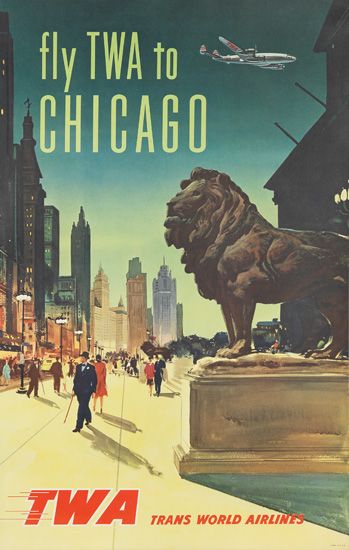
Interestingly, some higher-end posters tend to come from those airlines that are gone. Lot 197 is a vintage poster of TWA featuring Art Institute of Chicago and the Magnificent Mile. Its illustrative simplicity and usage of familiar pulse-quickening urban scenes can easily win one’s heart. A similar post (with B+ instead of A condition) was sold in the same gallery for 900 dollars in 2005. Now 10 years after TWA-American merger, this poster has doubled its value to $1800.

Lot 324 is a pair of American Airlines posters made for international market. In a conversation with an American Airlines poster collector, I learned such posters are more rare because of the targeted market. Unlike posters for Chicago, NYC or Washington DC (lot 248), “they belong to those hard-to-find ones for dedicated collectors.” Although he did not particularly like the design (geometric contour with near-abstract colors), he pointed out that these two were designed and signed by one artist (Edward Mcknight Kauffer), which helped in their value as a collectible.

Rare international market with artist's signature helped collectibility

The most intriguing lot is  No. 242, a group of seven posters. Six of them are vintage American Airline Posters with the remaining from Royal Dutch Airlines. “Royal Coachman Jet” service was introduced in the late 1950′s by American Airlines which brought up the concept of stewardesses with affordable fares to the airline business.

The one with the Texas longhorn has more artistic design than commercial advertisement. Texas is not known for its picturesque landscapes. A mysterious group of four Texas longhorns, not unlike Warhol’s non-representational colors, pop out of dark dearth ground.

Although not signed, the poster is designed by Joseph Charles Parker in 1953.  The same poster is now in the collection of MOMA.

Postersplease.com has a more detailed description:

At first glance, it’s the primary-colored longhorns that dominate this American Airlines’ promotion, but upon closer inspection, the viewer can clearly see that Parker has included-in unassuming relief-all the elements that set Texas apart from the rest of the “Lower 48″-oil rigs, refineries, the Dallas skyline, the “Yellow Rose,” the tall pines and plenty of room to grow. Parker graduated from the Manhattan School of Aviation Trades before entering the Navy. After his discharge from the military, he worked on a cattle ranch in Steamboat Springs, Colorado, as well as designing window displays in the late-1940s for Franklin Simon on 5th Avenue in New York City. As a part of the G.I. Bill, Parker traveled to Paris and studied graphic design with Fernand Leger and Paul Colin. When he returned to the United States in 1951, he opened a commercial art firm called Glanzman-Parker Studio in New York. In 1969, he left the city with his family to relocate to Hadley, New York, where he would devote himself full-time to sculpture.

Texas Longhorn, the one that MOMA collects

Now, American Airlines still serves DFW area with its hub moved from Love field, the airport used when the poster was designed. The CEO of American Airlines, Gerard Arpey wrote in the April issue of American Way magazine,  “like a great work of art,  air travel expands our horizons, fuels our imagination and deepens our understanding of our fellow man and of ourselves.” In the form of  airline posters, when more and more mundane photos are used to depict the immediate accessibility of destinations, it is that peculiar lack of immediate winning scenery in northern Texas that allow artists to find an inner voice and raise it up, up in the air.

Bannister At the Top

Filed in Art, Artists, Auctions by on June 8, 2010 0 Comments
Bannister At the Top
Edward Mitchell Bannister's painting was sold at Swann Galleries for $21600

Edward Mitchell Bannister's painting was sold at Swann Galleries for $21,600

Back in February, A large painting by Edward Mitchell Bannister was for sale in the Swann Auction Galleries. It was, according to the auction catalog, the largest painting by the renowned African American painter of Barbizon school came to auction, although Renwick Gallery (a branch of the Smithsonian American Art Museum near the White House) is showing several his paintings in the Grand Salon, all of which feature stunning size that devours viewers into his pastoral scenes.

When Geo and I went to examine the painting in person then, we noticed a few condition problems: discoloration, abrasion, craquelures and paint-loss. Had it in a better condition, it could have set a new auction record. Still, the painting fetched $33,600, a signal which disagreed with Mrs Straub’s remark that market availability is a key for growth as Bannister’s paintings rarely come to market.

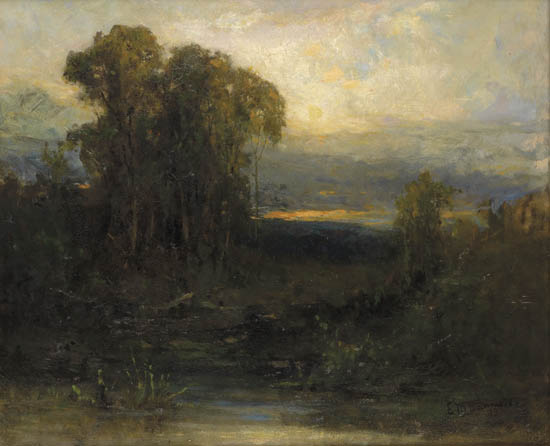
Today, another painting went under the hammer in the  Swann Galleries. Signed and dated in 1883, this painting is less about pastoral than American wilderness. Yet the nostalgia dusk clouds and the dark color pallet are undoubtedly the artistic language of Bannister’s era.

I have found the painting particularly charming. The sky is still lit by the setting sun, the glorious golden light can be felt from the colors of the  tops of the trees; yet the tree trunks and pond speak of the evening shades. Viewed from a perspective that one can neither walk into it, nor walk out of the ephemeral moment, the picture is an eerie combination of cold and warm, familiar and unknown, nostalgia and presentiment. Moving to Texas recently and living right by a lake, the wilderness in nature and geographical lonesomeness are brought up to me by a painter from Northeast.

Even with Charles G. Calder’s provenance, the auction house gave the medium-sized painting a conservative estimation, between $8000 to $12,000. Today it was sold for $21,600  (with 20% buyer’s premium).

A Gaggle of Interest – Nov 8, 2009

Filed in Antiques, Auctions by on November 8, 2009 0 Comments
A Gaggle of Interest – Nov 8, 2009
New York Central Poster from Bloomsbury Auctions

New York Central Poster from Bloomsbury Auctions

In this series, UAA team will list some of the interesting items that we have found in auctions, antique shops or eBay. Neither do we own the items nor we have the capability of examining the items in person in most cases. It mainly serves as an inventory record of what interests us (not necessarily in terms of value or investment opportunities) and possibly how much it fetches (if the result can be obtained). If you are serious about some lots, please contact the auction houses, dealers or eBay sellers directly.

1. Bloomsbury Auctions, Nov 12, 2009. Lot 78, Leslie Ragan, New York Central System Poster

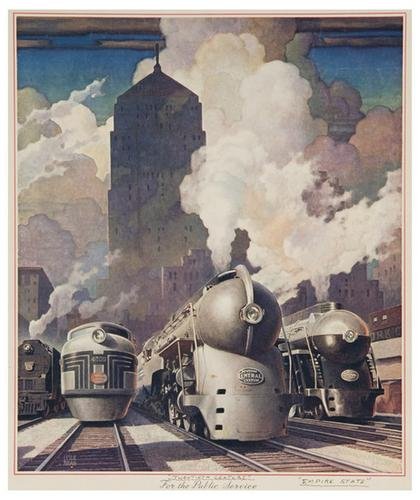
Geo commented several years ago he bought a similar poster (lot 81) for 40 dollars, but this one is backed on linen, thus can be preserved and hung easily. “It must be a good deal, because the frame store told me someone saw the poster and wanted to buy it immediately.” He commented. This is a powerful image of New York Central. Streamlined Hudson J-3a locomotives, featured here by the artist Leslie Ragan, was perhaps one of the most striking locomotives designed in the 1930′s, the workhorse that pulled the 20th Century Limited diverged markedly from the “inverted bathtub” form of the Mercury locomotive. The so-called low art – Illustration, posters from the era of Art Deco has become popular in recent years, in particular among those young generations. The futuristic stylization finds their true followers who regard it as the vintage in harmony of the present, thus possess a tremendous potential to become the next great thing.

American Classical Mahogany Sofa from Neal Auction

American Classical Mahogany Sofa from Neal Auction

For much of the artist, please refer to this blog “Leslie Ragan’s Visions of Progress”.

2. Neal Auction, Nov 21, 2009. Lot 317, American Classical Mahogany Sofa

If you can afford you, empire sofas are in general much more affordable than before. In other words, you can be picky about the condition and fabric color and patterns since re-upholster may cost more than what you pay for an antique sofa. At any rate, I cannot find anything to quibble about this handsome sofa. With the tubular crest rail terminating in volutes with sunflower rosettes, the scrolled arms carved with acanthus, the molded seat rail on fruiting cornucopia brackets and hairy paw feet, it can certainly be used for any magazine featuring furniture of classical period. More likely than not, the spring was installed to provide better cushioning. I do not think such alteration decreases the originality and the value of the sofa. At least I would want to a sofa to comfortably sit on, not one placed in a period room of some museums. Believe it or not, I am not the only one who can always fall sleep on my antique sofa. It is elegant, comfortable, and most of all not more expensive that the one you see in Macy’s. If only I had more room for it…

A Thai Buddha Statue

A Thai Buddha Statue

3.  Sloans & Kenyon, Nov 13, 2009. Lot 242, Thai Bronze Figure of Buddha, Bangkok Period

It is a little disappointing that the statue is dated to Bangkok period which lasted from 1767 to 1932. What interested me about this statue is its hybrid style. The thin ghostly drapery with tubular arms indicate it is directly influenced from India, which differs greatly from those in China where heavy folds of Buddha’s clothing  came from their interaction with Persians. But the Buddha looks more slender than most of the original Indian statues. The head knob, or ushnisha, has evolved into something like a flame.

Here is the moment when Shakymuni meditates under a Bodhi tree, at the dramatic moment of his final quest for enlightenment. He closes his eyes to reject sights of the source of temptation and distraction.  When evil forces leaded by Mara tried to distract hi, he calmly touched his hand to the ground to call support from the earth goddess. This is an image that even a non-Buddhist can enjoy the mellow and tranquil state of being.  Sometimes, I guess, you don’t have to exercise yoga to soothe your mind.

4. Swann Galleries, Nov 9, 2009. Lot 54, Eugene Delacroix, Un Forgeron.

From the auction catalog:

Aquatint on Chine collé, 1833. 227×160 mm; 9×6 3/8 inches, full margins. Either an undescribed intermediate state between the third and fourth states (of 6), with only the artist’s monogram in the image upper right; or the fourth state (of 6), with the letters masked. A superb, richly-inked impression.

Intensified drama - The Blacksmith by Eugene Delacroix

Intensified drama - The Blacksmith by Eugene Delacroix, offered from Swann Galleries

One of my favorite prints during the preview, this print, although fairly small, has tension and emotions that rivals big canvas works. (Note, the original oil painting has not been found yet.) Here the aquatint techniques enables the artist to work from dark to light, and thus put great contrast in the glowing melting meta and the reflected light that instantly renders the face of the blacksmith true characters. The different grayness of tonality and painterly skill instead of drudgery line works surely works well with Delacroix for his Romantic style.

The state is a different form of a print, caused by a deliberate ad permanent change to the plate or block. Artists often take prints from a plate and then do further work on the plate before printing more impressions. Thus two prints from different states may show (to discerning eyes) the progress how artists perceive perfection. Because of the nature of drypoint , not many impressions can be made before the details wear out. Specifically, Delacroix completed the plate in 1833. Only a very few impressions were pulled at that time and there was no formal edition. He had worked on the plate at the studio of Villot, and at the sale of Villot’s effects in c.1864 the plate was acquired, along with five others, by the leading mid 19th century French print publishers Cadart and Luquet.

Lastly, all the lots in this sale come from a single owner: James B. Parks.

William Dunlap Portrait

William Dunlap Portrait

5. Gene Shapiro Auctions LLC, Nov 22, 2009. Lot 76, William Dunlap portraiture

If it is true that best collectors buy ahead of market, portraiture perhaps is one of the areas that you can spend little to assemble a well-respected collection.  William Dunlap’s works seldom come to the market, perhaps because the demand is low and quality works won’t surface to the market. First of all, it is a portrait signed and dated. Secondly the sitter is known. Thirdly it has a good record of provenance. Lastly and most importantly, it is an excellent works of art from an important portrait painter with a colorful career. Here is a short bio from artfact.com

William Dunlap is an American painter, writer and playwright. After working in England with Benjamin West between 1784 and 1787, Dunlap concentrated primarily on the theatre for the next 20 years. His two main interests are documented in his large Portrait of the Artist Showing his Picture of Hamlet to his Parents (1788; New York, NY Hist. Soc.). He wrote more than 30 plays and was called by some the ‘father of American drama’. He was the director and manager of the Park Theatre in New York from 1797 until its bankruptcy in 1805 and again, in its revived form, from 1806 to 1811. He began to paint miniatures to support his family in 1805 and travelled the East Coast of America as an itinerant artist. By 1817 he had become, in his own words, ‘permanently a painter’.

As for the sitter — Henry Seymour, because of the back label from the painting, I can search information based on the year when he was born and the year when he died. Possibly, Henry Seymour is the New York banker and politician. Here is the information from Wikipedia.

A Gaggle of Interests – Nov 1, 2009 NYC Marathon Day!

Filed in Antiques, Art, Auctions by on November 1, 2009 2 Comments
A Gaggle of Interests – Nov 1, 2009 NYC Marathon Day!
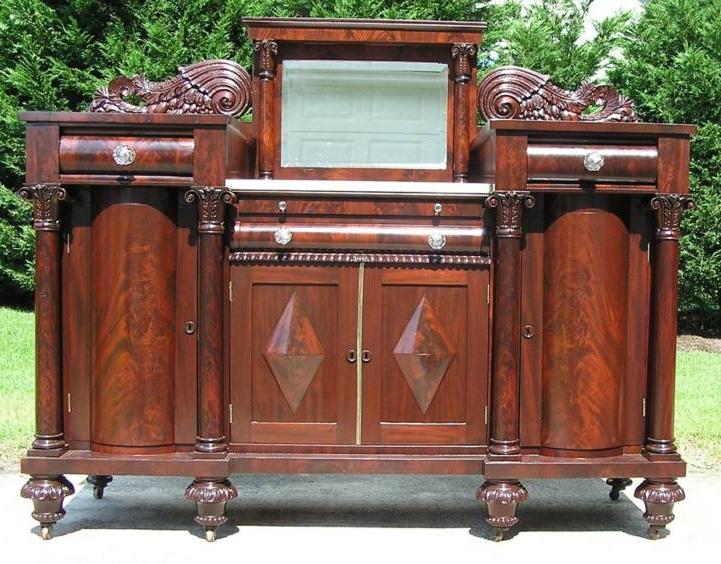
A Sideboard Attributed to Anthony Quervelle

A Sideboard Attributed to Anthony Quervelle

In this series, UAA team will list some of the interesting items that we have found in auctions, antique shops or eBay. Neither do we own the items nor we have the capability of examining the items in person in most cases. It mainly serves as an inventory record of what interests us (not necessarily in terms of value or investment opportunities) and possibly how much it fetches (if the result can be obtained). If you are serious about some lots, please contact the auction houses, dealers or eBay sellers directly.

1. eBay item: A sideboard attributed to Anthony Quervelle, item number: 220460749123

There are sideboards and then there are sideboards. The same is true on ebay where the fruit seems to be ripe for the picking right now. The price on this one at almost $10,000 is probably on the high side given there’s no label tying it to Quervelle. The seller states only that “This magnificent unlabeled sideboard has all the characteristics of an Anthony Gabriel Quervelle masterpiece including the central beveled mirror flanked by full flame mahogany columns, the luxuriously appointed cornucopias, the drop center marble top work surface.” Magnificent, I agree with. Quervelle, maybe or maybe not (See How do we know a Pittsburgh Sideboard when we see one? The seller references the book Philadelphia Empire Furniture where a “very similar” sideboard is found. Indeed it’s true; in fact there appear to be three similar sideboards, none with a Quervelle label, only attributions. I took a look at auction results for attributed Quervelle sideboards which appear to be in the $2500-$7500 range.   Here’s a rather plain looking one, but labeled, for $6500 that went through New Orleans Auction.  There is an example of a Quervelle attributed sideboard, this one with some gilding for more than $10,000, however. This one went through Neal Auction in 2004.  A conclusion: yes, it might be and you could say there’s a good chance it is a Quervelle sideboard, and even if it isn’t there are worse ways to spend $10,000.

An Art-Nouveau Gas Oven

An Art-Nouveau Gas Oven

2. Auction Team Breker, Germany, Nov 21, 2009. Lot 215: Art-Nouveau Gas Oven, c. 1900

In fact, the looking of heaters may play a role in buyer’s decision. “Ugly heaters” was one of the first few comments from Geo when he browsed pictures of houses for sell. This one, a portable heater, cast in iron and tin, looks very attractive to me. I would like to send this pictures to all oil heater and portable AC unit manufacturers. Just because they are small and portable does not mean consumers do not care about their looks. When Geo decided to buy a portable AC unit last year, he chose “the least ugly one”.  This is a century when cost-cutting comes first in consumer product design, it is no wonder that a heater of utilitarian purpose from the beginning of the last century strikes such a nostalgia tone on me.

3.  Swann Galleries, Nov 18, 2009. Lot 43: Alfred Crocker Leighton, Accross Canada by Canadian Pacific poster.

Across Canada by Canadian Pacific, poster by A. C. Leighton offered at Swann

Across Canada by Canadian Pacific, poster by A. C. Leighton offered at Swann

From the auction house catalog:

London-born Leighton began working for the Canadian Pacific before he even left Britain. A painter and an art teacher, he settled in Calgary in 1930. This dramatic nighttime scene captures the twilight hues of the Rockies and emphasizes the strength of the locomotive whose headlamp is cutting through the impending darkness.

In fact, Leighton’s first job at Canadian Pacific was public relations.  Leighton took advantage of the train and often jumped on and off to paint the scenery.  Of all the paintings produced at this period (1024-1027), the Canadian Pacific had first choice of any paintings and then the painter could have the remainder for himself. Around this lithograph was made, Leighton founded the Alberta Society of Artists and served as its first president.

Thus this poster strikes me that the so-called low-art by some people is one of the finest artwork I have seen.  The emerging locomotive is painted in perspective against towing mountains.  Both the train and mountain steepness have been exaggerated to create an impression of fleeting speed as well as dizzying height. It should be noted that Leighton essentially is a painter of Rockies, he was sensitive to noise and speed and preferred grandeur yet quiet landscape. But here in this poster, when he was a young and full-fledged artist, his artistic talent made a commercial advertisement a true work of art.

A Mahogany Corner Chair from Winter Associates

A Mahogany Corner Chair from Winter Associates

4.  Winter Associates, Nov 9, 2009. Lot 64: Late 19th C. mahogany corner chair

If you have read Geo’s previous post about the tip of antiques shopping (see “Turn Left, What’s Hot and More on Buying Antiques“), you will know one of the tips is to buy single chairs as they are more affordable. In fact, most houses probably don’t have room for two corner chairs, thus this one, with elegant pierced back rest can be both useful and decorative.  (Of course, I need more, since I imagine my cats will fight for a chair which provides an extra side to embrace their bodies.) Chairs of Aesthetics Movement from the Victorian time are less curvy and feminine compared to those of other styles, and the oriental motifs within them are no stranger to someone who grew up in Asia. The next question is: Do I have such an corner?

Railroad Suspension Bridge OVER Niagara Falls (even though it is actually half mile away)

Railroad Suspension Bridge OVER Niagara Falls (even though it is actually half mile away)

5. Thomaston Place Auction Galleries, Nov 8, 2009.  Lot 937: Currier & Ives Lithograph, Rail Bridge Niagara Falls

It is interesting to read at the bottom of this Currier & Ives lithograph, the inscription says “The Railroad Suspension Bridge, Near Niagara Falls; Length of Bridge 822 Feet, Height Above Water 240 Feet’, 1856.”

From the Wikipedia:

The Niagara Falls Suspension Bridge was the world’s first working railway suspension bridge. It spanned 825 feet (251 m) and stood 2.5 miles (4.0 km) downstream of Niagara Falls from 1855 to 1897. Connecting Niagara Falls, Ontario to Niagara Falls, New York (the two cities assimilated the towns at the ends of the bridge by 1892), the bridge carried mixed traffic on its two decks across the Niagara River; trains crossed over the river by way of the bridge’s upper deck while pedestrians and carriages used the lower. As the bridge was the result of a collaboration of two companies from two countries, it was also known by its American name, the International Suspension Bridge.

What really interests me in this print is how small the actual falls are depicted. In fact, the cataract is visible only under the bridge. This is a print not about the natural wonder as what Frederich Edwin Church painted in his magnificent canvas, what Charles Parson (the artist who painted the picture and was featured on his print) painted is a symbol of technology, progress and patriotism in the national consciousness.  If Church, by minimizing evidence of human habitation to minimum, still promoted the notion that God is the nature, then the stately structure in the print attracted onlookers at the lower left corners who marveled instead at a new utilitarian moment.

Read more from the book “The New Niagara: Tourism, Technology, and the Landscape of Niagara Falls, 1776-1917” about the bridge.

Celebreate New York Marathon

Celebreate New York Marathon

6. eBay, New York City Marathon Running Poster, item number: 310139071734

As I am typing this words now, 40,000 runners are pounding the roads of five boroughs of New York City. (Most by this time will be in Brooklyn.) Nothing is more rewarding than just simply saying “great job” to whoever finishes it, but a souvenir poster will not disappoint a participant. The view from Verrazano Bridge is stunning, as every NYC marathon runner will tell you. And their memory of the bridge is usually sweet because that is in mile 1 and their body is fresh and full of energy. Or if you know who is pondering of running the next year’s marathon, this can be really motivational.

OK, now I am heading to cheer on the runners.

All That Lost — Preview From Swann Galleries

Filed in Auctions by on October 22, 2009 1 Comment
All That Lost — Preview From Swann Galleries

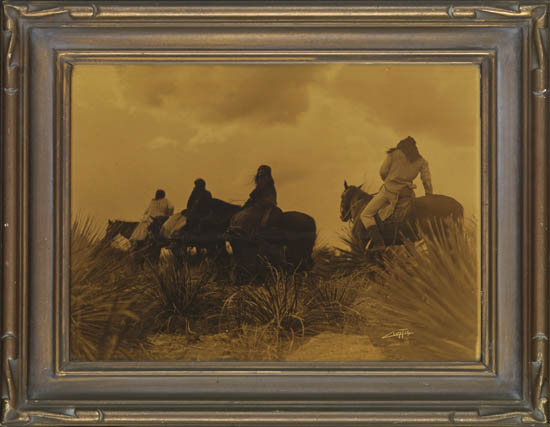
Lot 54, The Storm, Apache by Edward Curtis

Lot 54, The Storm, Apache by Edward Curtis

Swann Galleries is having an auction sale on photographs today. In the preview I have noticed that photographs were arranged not by the lot numbers, but grouped by scenes. Some pictures are beautiful, such as those of Ansel Adams or Harry Callahan, but I have never grown into followers of those artsy photographers. Interesting photos are timely but great photos are timeless. For me, the timelessness of photography cannot be achieved through elimination of any trace of events or narration, it is the opposite. Photographs is a form of capturing a moment which by the time shutter blades move back, becomes irreversible frozen past. That moment, thus, should be a magic world of opposite extremities,  specific to capture the immediate attention while never fail to make deeper and abstract notions tangible.

Interestingly the pictures in the sale which moved me the most all share the underlining reference to the past and the lost.

I have seen pictures of Edward Curtis’ native Indians before . There was even one featured in Antiques Roadshow. But it was a pleasure to see those pictures in their original studio frames. Lot 54, “Storm, Apache” is my favorite in the group. Unlike those portraiture of Native Americans, these landscape genre photos were taken with a near wide-angle lens and almost always in horizontal format. In this picture, Curtis chose a low vantage point and distanced the camera from the marching Indians. All but one middle desert bush is in focus: the rest gives much of the impression through their forms. Curtis carefully aligned the Indian horse riders so that they seemed to be going to submerge into far far-away. The increased stature due to the low angle and the exaggerated vanishing point from the wide angle lens  shape the group of Indians into a near abstract triangle, thus creating dynamics and illusion that such marching would soon disappear from the sights, momentarily or permanently (depending on viewer’s interpretation).

Lot 284, Rudolf Nureyev, Paris, France by Richard Avedon

Lot 284, Rudolf Nureyev, Paris, France by Richard Avedon

I am no expert on Curtis, but I was intrigued by the perfect detail. The balance is achieved through arranging the light-clothed riders in the end while the darker-clothed moving like a real storm on the ground. There is an ambiguity about the viewer’s own consciousness. Sure,  the low vantage point subconsciously sends viewers into a pryer’s mood and from that angle we have seen the wonderful naturalistic gesture of the last horse rider.  But then there is that one Indian who turned his head back at the moment we are looking at him: Did he know he would be perpetually recorded?

The title brings me back to the darkening cloud, which in an Orotone photo, is not the most obvious thing one would notice. But then the Apache riders were moving casually as if nothing needs to be hurried. Native American scholars may find this photo lacks ethnic details about the people, but what touched me the most is the nomadic souls glistering in golden color.

No one would pass by Rudolf Nureyev nude picture without a heart flutter: There is nothing in the picture but Nureyev’s naked body. His straight stare with his head slightly lifted and his athletic body relaxed clearly indicates his pride in his prowess and skill as a dancer. And a dancer’s asset is his body, thus nothing should be shamed of, not even a frontal view that may make viewers slightly uncomfortable.

Untitled (Kentucky) by William Eggleston, the last picture of the sale

Untitled (Kentucky) by William Eggleston, the last picture of the sale

Strangely, I feel nothing erotic in the photo, probably because Nureyev was at ease with his body and his sexuality. The gay playboy died of AIDS in 1993 and left his wealth to both dance and medical research. His personal friend and physician later recalled during his last stage Nureyev “was Petrushka, the disjointed puppet, broken and miserable.” But western audience long before had been disappointed when he could not dance as elastic and volcanic as before. We human inevitably age and for dancers every tiny bit of aging can be felt through each jump and squat. Perhaps Nureyev knew it too well and he eagerly wanted to be photographed at his prime time. It has been used as an iconic gay image, but what Avedon intended to show here is that we ought to see his body as a revered artwork, as a masterpiece of music to be executed. Because we know once the backdrop is installed and his ballet suit is put on, he would bounce and rebounce in the air with ease of a rubber ball or twirling around with the facility and precision of a spun wheel.

The sale concludes with a photo by William Eggleston taken in 1983. Geo said the hand intruding the picture like an accident. (Don’t we sometimes have those unwanted hands and legs in our souvenir photos?) But then there is a white horse galloping in the distance where the hand is pointing to. It is strange as if nothing is certain in this picture: Is the unfocused hand a planed element? Is the horse as much a surprise to the photographer as to the person on the left? Or simply is that galloping horse possible? (Probably yes, since the picture was taken in Kentucky.) Geo didn’t like it, but it was one of the few that he mentioned. It reminds me what Emy Whitaker writes in her book “Museum Legs“:

It is pretty hard not to think contemporary art is, at best, obsessed with novelty and, at worst, a inside joke of which you are the punch line.

The Sale starts at 1:30PM. Visit Swann Galleries for details or bid on artfact.com.

A Gaggle of Interests – Oct 4, 2009

Filed in Antiques, Artists by on October 4, 2009 0 Comments
A Gaggle of Interests – Oct 4, 2009

A Japanese Lacquer Storage Box from New Orleans Auction

A Japanese Lacquer Storage Box from New Orleans Auction

In this series, Geo and I will list some of the interesting items that we have found in auctions, antique shops or eBay. Neither do we own the items nor we have the capability of examining the items in person in most cases. It mainly serves as an inventory record of what interests us (not necessarily in terms of value or investment opportunities) and possibly how much it fetches (if the result can be obtained). If you are serious about some lots, please contact the auction houses, dealers or eBay sellers directly.

1. New Orleans Auction, Oct 10, 2009 Lot 63, Japanese Lacquer Storage Box

The gold, silver and red lacquer on top of the black one gives a shimmering opulent beauty to the storage box. To me, the intriguing part of Japanese decoration in Meiji period is that the patterned design flattens and denaturalizes the spacial relationship, at the same time the delicate layering of materials adds the depth into the design. Observing how the flowers, leaves  and circular panels superimpose and intersect with others is such a pleasure and a surprise of the rigid and meticulous craftsmanship behind this simple restrained design. The round corners and edges enable the flowers to extend and shift into a different plane, uniting all visible surfaces into a complete scheme. This box is fairly large, what would you store in it?

Pair of Chinese Tea Caddy from New Orleans Auction

Pair of Chinese Tea Caddy from New Orleans Auction

2. New Orleans Auction, Oct 10, 2009. Lot 307, Pair of Chinese Blue and White Tea Caddies

It is hard to talk about the quality of Chinese porcelain without seeing and touching the items, but this one with an unusual shape and a bold design can easily catch one’s eyes. The auction house did not give the date, nor the bottom of the rim has been taken picture of. Certainly it is very unlikely to be in the early Ming Dynasty or before when cobalt blue was so expensive that it was only used scarcely in the design. Seldom do I see Chinese porcelain objects with such lively images of compact designs, variety of blue and naturalistic depiction.  Both Geo and I simply cannot resist it.

Pair Marble Panel from Skinner Auctions

Pair Marble Panel from Skinner Auctions

3. Skinner Auctions, Oct 18, 2009. Lot 807, Pair of Shadow Marble Panels, China, 18th century

What would Thomas Cole have thought when the handiwork of the God is evident not only in macro-scaled panaromic grand views of mountains and valleys but also in miniature-scaled natural marble stones whose beauty rivals the best works of Chinese ink-wash painters? My friend who is an artist said he would have felt ashamed if he were a Chinese painter when an artist’s life-long effort to bring nature into a piece of paper is trivialized by what the nature gives itself. The two panels pair and compliment each other marvelously. The left speaks of mass and volume while the right delights us with economic curves and airy space. In other words, one grapples us into solemn gravity; the other frees us into rhythmic flows. Just notice how the artist created the sense of balance by adding variety in the inscription on each of the two: The left is horizontal and succinct while the right vertical and multi-lined. Quite often, western collectors who are well-versed in minimalism and abstract art show keen interests in the remote traditional Chinese art. But perhaps the artist (whose name could be identified from the seal) has the absolute right to say Jackson Pollock’s famous quote: I am nature.

Note: The lot was sold for $5500 plus premium.

Still life by Levi Well Prentice at Shannon's

Still life by Levi Well Prentice at Shannon's

4. Shannon ‘s Auction, Oct 29, 2009. Lot 21 Levi Wells Prentice, Still Life with Raspberries

Prentice began to focus on still life after he moved to Brooklyn, NY in the 1880′s when the still life painting became an established form of art and one that appealed to the decorative tastes of the middle classes. Unlike his neighbor William Mason Brown, who occasionally set the fruits in a soft atmosphere, Prentice’s crisp and hard-edged manner of painting as well as his equal handling of detail throughout the picture lends his works a stylized, primitive feeling. The green leaves are painted in photo-realistic detail. Looking at how each leaf curves, folds, sprawls, touches and overlays, one can feel a bigger-than-life vibrancy and beauty resulted from a uncompromising artistic mind. It is that unusually stubborn or even crude mentality that made his works unsurpassable and excites or even freaks modern eyes. Together in that meticulously painted tin pan with fresh picked raspberries we celebrate a plentiful harvest.

Igor Stravinsky at Swann Galleries

Igor Stravinsky at Swann Galleries

5. Swann Galleries, Oct 22, 2009. Lot 198, Arnold Newman, Photograph of Igor Stravinsky

The famous Stravinsky picture was the first Arnold Newman picture I have encountered. Back to college when I took photography class, this particular picture was used in the textbook as an example of composition. Newman didn’t compose this way originally, but he ruthlessly crop anything unnecessary and put the pianist and composer to the corner. Yet magically that tiny head seems to gain all the gravity to balance against the giant piano cover. It is, after all, a classic image of instant recognition.

I didn’t know who Arnold Newman was at that time, neither did I have any sense of the music of Igor Stravinsky. Stravinsky’s style moved through decades. Some of his music I like (The firebird, The rite of Spring), some I don’t. Yet no one can deny his pliability to adapt to the modernity and his willfulness to explore both unknown and archaic. In this elegant and simple black and white photograph, one can sense the strong personality of both artists, the one who created the image and the one who was portrayed. Yet because of their unyielding embrace of modernity, it is a striking picture with genuine coherence.

A Glass Bowl from William F. Reilly collection

A Glass Bowl from William F. Reilly collection

6. Christie’s Oct 14, 2009. Lot 196 of Sale 2273, a continental translucent-ruby glass bowl

This sale features a special collection from a single owner. From the press release:

This October, Christie’s is honored to present a special collection of fine art and furnishings from the Manhattan residence of the late Mr. William F. Reilly, a prominent philanthropist, collector, and former chief executive officer and chairman of the publishing firm Primedia. This superb collection of important 18th and 19th century furniture, rare antiquities, Old Master paintings, and decorative items was primarily housed in Mr. Reilly’s Sutton Square townhouse, located in one of Manhattan’s most fashionable neighborhoods. The three-story house with its dramatic river views and impeccably-designed interiors has been profiled in House & Garden and Architectural Digest, among other publications. The complete collection of over 230 items is expected to realize in excess of $5 million.

I am not sure that I would pay $600 for one giant glass bowl, but since this lot is offered without reserve the final price can be a wild card. There are some imperfections such as air-bubbles, cut roughly off the pontil etc, but none matters when you have your first glance at the sensual and sumptuous color. Yes, there is only one glass. That makes the moment when you sip the wine from it at the sunset special.

The Charm of Antique

The Charm of Antique

7. Book: The Charm of the Antique

I first noticed this book when walking through the galleries at Winterthur. The book, published in 1914, explores a number of charms including the charm of acquisition, the charm of the thing you didn’t get, the charm of specializing, the charm of the unexpected and finally the charm of possession. It’s this final charm I suspect the panelists would find most interesting. It touches on the differentiation between hoarding and collecting and the collector who hoardes. The book dates to the time when collecting American antiques came into vogue, the book seems to be a must for the shelf of every collector. It helps that it’s an antique in itself. Here’s one for $25 at Cats Cradle Books.

8. Hotel Room Key

By now almost everyone who has stayed in a hotel has had to make an extra trip to the front desk because a key card isn’t working. Indeed there are some advantages to old technology. (For example, writing something down on a pad takes far less time than turning on a device and typing on a minuscule keyboard.) Hotel room keys can make one of the most interesting collections ever assembled. Not only do they lead to conversations about different hotels, cities and eras, but also what has gone on inside hotel rooms! Interior decorators take note.

Here’s one from recent meory in Las Vegas.

And two from the Roosevelt Hotel in Pittsburgh.

The Key to the Roosevelt Hotel of Pittsburgh

The Key to the Roosevelt Hotel of Pittsburgh

Remorse From An Underbidder, or How I Could Have Owned A Piece of Gustav Mahler, But I didn’t. Yet I Am More Likely To Own One In Future

Filed in Art, Artists, Auctions, Music by on September 25, 2009 0 Comments
Remorse From An Underbidder, or How I Could Have Owned A Piece of Gustav Mahler, But I didn’t. Yet I Am More Likely To Own One In Future

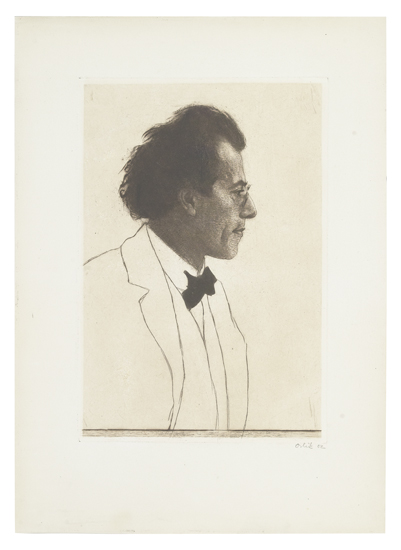
Lot 68 at Swann Galleries' 19 and 20 century prints and drawing sale, an etching and dry-point by Emil Orlik, was sold for $2,000 plus premium

Lot 68 at Swann Galleries' 19 and 20 century prints and drawing sale, an etching and dry-point by Emil Orlik, was sold for $2,000 plus premium

There are two kinds of regret as a collector. You regret things that you have just bought. Or you regret for things that you didn’t buy, which has haunted you ever since.

The latter case happened recently with Swann Galleries auctioning “19th & 20th CENTURY PRINTS & DRAWINGS.” Among them, Lot 68 featured an etching and drypoint print of Gustav Mahler by Emil Orlik.

————————————

The music of Gustav Mahler came late in my life. The Mahlerian Mahler-mania started from the middle of 1990′s in China. I have not grown to love his music unequivocally. (For example, I have yet to feel connected to his Symphony of a Thousand.) But enough of his music has influenced me profoundly. I may quibble a little about the abuse of Tchaikovsky’s Nutcracker Suite during the Christmas season or using Mozart’s string quartets as dining music. But the monumentality of Malher’s music commands listeners wholehearted attention and devotion. The irony, ambiguity, extremity and “lengthy” compactness of human emotions makes each listening experience a journey anew.

Just 100 years ago, Mahler was the music director of New York Philharmonic. The Mahler Symphony in Sequence was the pinnacle event in the last season at the Carnegie Music Hall. The companion brochures (which I didn’t throw away) contain pictures, stories and anecdotes. A quick search online shows that numerous photos, cartoons, paintings and letters are available for further study. Unlike Sebastian Bach, or even Beethoven, the number of first-hand materials related to Gustav Mahler is abundant. This is a true blessing for Mahler fans who can eventually own a piece of Mahler that freezes the music torrent into something more tangible.

————————————

Mahler was not attractive. His forehead is broad, his nose protruding, his eyes small but sharp. That makes an impressive portraiture, but also elicits temptation of exaggeration or caricature based on strong facial features. My first encounterance with Mahler portraiture was in the National Gallery of Art. A bronze statue made by Rodin was once treasured gift of Walter Bruno, the protege of Mahler. Without eyeglass, the composer, with his head tilted slightly upward, seems to fall into his own thoughts. It is a convincing work of art that penetrates Mahler’s physiognomy into a realm of his psychic predisposition. In fact it is hard to read this portraiture, as much as his music, but I could not deny the eminent presence of his peculiar spiritual and intellectual characteristics.

Auguste Rodin-- Gustav Mahler, 1909 Gift of Lotte Walter Lindt in memory of her father, Bruno Walter, from National Gallery of Art

Auguste Rodin-- Gustav Mahler, 1909 Gift of Lotte Walter Lindt in memory of her father, Bruno Walter, from National Gallery of Art

————————————

I knew nothing about Emil Orlik when I spotted the print in Swann Auction Galleries last Saturday for the preview. If I was immediately drawn by the iconic face, Eric could spare such sentimentality and delve into the artistic merit directly. It is a daring image. The modeling of the head is meticulous and intricate, yet his upper body is merely suggested through a few lines. The incongruity portends the prowess and discipline possessed by the artist to guide the viewers into a state of being higher than mere photographic realism. Those succinct lines, seemingly unconscious, are inspiration and spontaneity crafted to the highest degree of precision. Thus while my eyes didn’t move away from the profiled face, Eric admired as much the simple lines as the whole design.

Thanks to internet, it took me no time to find the information about Emil Orlik and his friendship with Gustav Mahler. The article – “Emil Orlik and Gustav Mahler: A Meeting of Minds“, written by Jan Hoeper is fascinating to read. I did not want to copy the article here although two important facts were more directly related to this print.

First, Orlik initially sketched Mahler during a live conversation on a postcard which not only pleased  the maestro but also was sent right away to Mahler’s sister. Orlik was then invited to visit him in Vienna, which probably led to this famous drawing.

Secondly, the fluidity in the “calligraphic pen-and-ink style” is the fruitful result from Orlik’s two years journey in Japan. Mahler’s own music is also influenced by the orientalism which consummates in his “Song of the Earth.” Both artists absorbed the oriental elements into the traditional western art. The wonderful portrait is perhaps the best record of the meeting of the two minds, with so much similar background (both Jewish, and both born in today’s Czech Republic) and shared taste.

————————————

Nor do I have enough knowledge in print-making to tell the quality of an impression. In fact, I didn’t know the difference between etching and dry-point  although I sensed the finer lines in this print provided some advantages to the artist and led to an almost chiaroscuro effect. Curiously, another group of prints that I loved in the auction were also done with dry-point technique by American print-maker Armin Landeck. Auction preview is a place to exercise and test expertise and knowledge in certain fields, but probably it was a little bit too late to learn the difference in print-making on-site.

Another question I had was the edition number. It is a natural and legitimate question to ask with regard to print collecting. The auction house told me that they didn’t know how many impressions existed based on their body of knowledge. A website devoted to the prints of Orlik confirms that there was no published edition.

With all these uncertainties in my mind, I left an absentee bid, which as the title said, was not high enough. From a collecting point of view, I always think it is actually preferable not to get the first hunting prize in a new field so that the interest and passion can be tested over time, while the knowledge can be further enhanced. Falling in love at the first sight is romantic, but collecting is not dating and marriage with the goal of life-long harmony and enjoyment (albeit sometimes “divorce” may happen”). In this case, the second look or third look is more important. The question is: Can I find another piece of Mahler by Emil Orlik?

The Next Wave – The Paper That You Do Not Throw Away

Filed in Antiques by on September 23, 2009 2 Comments
The Next Wave – The Paper That You Do Not Throw Away

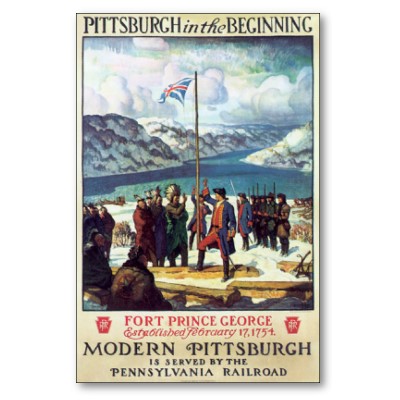
"Pittsburgh In the Beginning", a PRR poster illustrated by N. C. Wyeth

"Pittsburgh In the Beginning", a PRR poster illustrated by N. C. Wyeth

At the Brooklyn Flea in Fort Greene, I have been amazed by the young crowd in front of the poster booths. Movie posters are perfect for a modern-looking New York apartment. For young collectors who have just started their careers, spending 50 dollars or so on a giant picture of “Silent Lamb” or “Vertigo” not only decorates rooms beautifully, but also reflects personal tastes in a popular, yet no-nonsense way. There are also dealers and auction houses selling vintage posters including at the  Baltimore Antiques Show, Stella Armory Antiques Show, and reputable Swann Galleries. The vintage posters, although still affordable, are more much serious than reproduction ones sold at some souvenir stores or antiques malls. It is here that the expertise and experience are needed with regard to the valuation of vintage posters.

Modern reproductions are usually photo-engravings, which can be identified with their dot pattern. A magnifying glass can help, but probably expert explanation and comments work better. Also a lithograph is a drawing or design done with a grease pencil or crayon on a certain type of stone. Vintage posters are reproduced in limited numbers when using this technique. However, modern lithography uses chemicals and zinc or aluminum sheets, which creates a different feel that trained eyes can easily spot.

High-end collectible original posters range mostly from the 1880s to 1940′s. Popular topics include product advertising, travel, sports, beverages and food, and perhaps most desirable are those war posters from the first and second World War. Some posters were sold at auction for more than $10,000. Posters in other periods are also collectible, although their market value may be less.

Another important factor when buying a colored lithograph poster is the condition. In the industry standard, letters such as A+,  A-, B+, B, B-, etc are used to appraise condition and consequently affect their price. For those high-end posters (the criteria I pick here is that it should be valued for $1,000 or more), very often, dealers or auction houses will mount them on archival paper which is further mounted on canvas to prevent crease and tear. The treatment is seldom used for modern reproduction ones since the conservation itself may cost more than what a new poster is worth.

France is considered to be the cradle of the modern poster. Early French posters are extremely popular and can be expensive. In 1989, a “Moulin Rouge” poster by French artist Toulouse-Lautrec sold at auction for $200,000, plus a buyer’s premium of $20,000.  Other countries also have been prolific producers, including Italy, Switzerland, England, Holland and Poland. America was and is a gigantic creator of posters. A large part of early American poster production in colored lithography was produced by printers such as Strobridge Lithograph Co. in Cincinnati and Courier of Buffalo, N.Y.

With his familiarity with Pennsylvania Railroad, Geo has an interest in the PRR calendars and posters. Calendars are of different collectible species, which needs a separate article from Geo in future. But in general, they command less money in the market and a fair price is around $70 -$200, depending on the condition and rarity (which goes along with the age).

An interesting case is a 1930′s travel poster for the Pennsylvania Railroad with the title “Pittsburgh in the Beginning.”  The original artwork was done by N. C. Wyeth. The British began the construction of Fort Prince George in 1754, which when in April 1754 with the arrival of more than 500 French forces, was replaced by Fort Duquesne. The picture depicted the scene of a group of British soldiers planted their flag in front of native Indians. Perhaps a punch line here is indicated with the numbing wind (from the flag) and the throughout snow; thus PRR proudly says “Modern Pittsburgh is Served By the Pennsylvania Railroad.”  Such a poster appeared in Swann Galleries in 2000 and fetched near $1,500.

If you are interested in vintage posters, do not miss the blog posts from the authority:

Blog of the Swann Auction Galleries.

Vintage Poster Blog.

A Gaggle of Interests – Sept 20, 2009

Filed in Antiques, Art, Auctions by on September 20, 2009 0 Comments
A Gaggle of Interests – Sept 20, 2009
Henri Harpignies' drawing offered at Swann Gallerie

Henri Harpignies' drawing offered at Swann Galleries

In this series, Geo and I will list some of the interesting items that we have found in auctions, antique shops or eBay. We neither own the items and in most cases don’t have the capability of examining the items in person. It mainly serves as an inventory record of what interest us (not necessarily in terms of value or investment opportunities) and possibly how much it fetches (if the result can be obtained). If you are serious about some lots, please contact the auction houses, dealers or eBay sellers directly.

1 Swann Galleries, Sept 24, 19th & 20th Century Prints & Drawings, Lot 35 Henri Harpignies, Paysage.

One of the most long-lived and prolific French Barbizon painters, Harpignies’ pictures have a stronger contrast than those of Corot, with whom he befriended. The composition, with two diagonal hills and the atmospherical perspective provides a bounty, ageless beauty.

Another Barbizon subject painting at Cowan Auctions

Another Barbizon subject painting at Cowan Auctions

2. Cowan Auction, Oct 2, Lot 265, Fine 19th Century Barbizon Subject

Unsigned or illegibly signed paintings are risky to buy, unless the painter can be identified from other methods. But I have to succumb to this strong picture. The backlight is so strong that it devolves all the forms and colors of the landscape. What is left is the group of sheep like a textureless white sea that move away from us. Not everyone has herded in the rural landscape before, but we all have been there: when out of nowhere in the calm  yet bleary late afternoon, we were stunned and warmed up by some beauty momentarily, shimmering out of mindless boredom.

Wedgewood Statue of Agustus at Doyle

Wedgwood Statue of Augustus at Doyle

3. Doyle Auction, Sept 23, Lot 427, Wedgwood Black Basaltes Bust of Augustus

Black Basaltes is a hard black vitreous stoneware, named after the volcanic rock basalt and manufactured by Josiah Wedgwood from about 1768. Wedgwood’s black basalt ware was an improvement on the stained earthenware known as “Egyptian black” made by other Staffordshire potters. It takes some courage to decorate your house with “after antiquity” objects, knowing that not everyone can afford a real Greek marble bust and knowing mixing modern home deco with some sort of Romanesque elements or Greek statues have been used as a kitsch in chain Italian restaurants or the house of Soprano. But perhaps one can feel assured with the quality of Wedgwood, the black seriousness and most of all the solemn looking of Augustus.

4. eBay item: 330360472732, Old Victorian Opalescent Glass Flower Curtain Tie Back

Old Victorian Opalescent Glass Flower Curtain Tie Back at e Bay

Old Victorian Opalescent Glass Flower Curtain Tie Back at e Bay

We picked up two pairs of glass curtain tiebacks at the Baltimore Antiques Show. I had never seen glass tiebacks, but it just goes to show how you can be in a field of flowers and never take your eyes off the sky. At home, an internet search revealed the fact that they were readily available at slightly better prices. At $75 for the two pair, it’s not the end of the world, but disappointing that they weren’t unique. Stopping in at Housing Works Books in Manhattan, I picked up a glass book and read that the distinguishing factor is an impressed hexagonal shape in the back of the reproductions, and yes, both pairs I bought have it. Still a great look. They range $10 per pair and up.

Landscape painting by Arnold Grabone on eBay

Landscape painting by Arnold Grabone on eBay

5. eBay item: 330359985348 and 370248331530 Landscape paintings by Arnold Grabone

Georg Arnold Grabone is famous as a painter, but he’s perhaps more famous for having at minimum inspired, and perhaps having given lessons to both General Dwight Eisenhower and Winston Churchill (Books and articles in German state this as a fact, the Eisenhower museum says there’s no documentation it ever happened). A German impressionist palate-knife painter, Grabone credited his own talents to Max Lieberman. Grabone was prolific and many of his landscapes of mountain cabins and seascapes were brought home by American servicemen. Works by Grabone are both collectible and affordable. There were forgeries during his life, however. Look for an artists label on the back, original frame (often with paint on it from the canvas being placed before it was dry) and inscribed signature in the lower left corner. If you’re in Spartanburg, South Carolina, don’t miss an exhibit of Grabone’s work Oct 20 – Dec 5, 2009.

6. New Orleans Auction, Sept 27, 2009, Lot 1130: Fine American Classical Mahogany Chest

A Fine American Classical Mahogany Chest from New Orleans Auction

A Fine American Classical Mahogany Chest from New Orleans Auction

At any auction with furniture, there are always a bunch of antique chests. It is odd that urbanites complain about the lack of closet space while do not considering furniture. This chest is one of the best I have seen. In fact, it is so refined that I would probably not use it heavily if I were the owner. According to the description: Two similar examples are pictured in “Lannuier, Cabinetmaker from Paris,” pages 23 and 203.